https://www.youtube.com/watch?v=YsFzGnpBqMw#t=41
I’m pleased to announce the publication of a major new two-volume encyclopedia, Achieving Sustainability: Visions, Principles, and Practices (Macmillan). My chapter on Community Supported Agriculture (CSA) is among the many elements of this comprehensive resource.
 Sustainable development is essential to our future.
Designed to increase understanding, inform actions, enrich academic assignments, and enhance research, Macmillan’s Achieving Sustainability: Visions, Principles, And Practices is a reference work intended to meet the needs of students and educators in high schools, community colleges, and four-year colleges, as well as the interested layperson.
Aimed at readers who are not experts in the field, the material is relevant to courses in natural sciences, social sciences, and the humanities.
This title presents and analyzes the underpinnings of the multi-disciplinary concept of sustainability. A two-volume encyclopedia containing more than 130 signed entries, Achieving Sustainability covers economic and environmental ideas, as well as governance, demographic, and socio-cultural aspects of the concept.
 Community Supported Agriculture (CSA) is an agrarian movement that arose in America starting in the 1980s. In an era of general farm consolidation and industrialization, CSA has continued to develop. By now there are many thousands of farms and many hundreds of thousands of households networked directly with local farms.
The initial vision of CSA arose in the context of wide recognition of the necessity for renewal of agriculture through its healthy linkage with the human community that depends on farming for survival. The vision united farmers and consumers in an agrarian relationship for the health of people and planet, and explicitly recognized the necessary stewardship of soil, plants, and animals: the essential capital of human cultures. CSA emerged as a web of relationships.
Recently I had an opportunity to engage in conversation about the movement and its future with two renowned CSA farmers: Jean-Paul Courtens of Roxbury Farm in New York, and Allan Balliett of Fresh and Local CSA in Shepherdstown, West Virginia.
My thanks to Allan for creating and hosting BDnow Podcast 017 (The Future of CSA), and to Jean Paul for sharing his experience and insight.
As it happens, I must demur on the matter of “foremost…philosopher,” which is a descriptor applied to me in the podcast. CSA farms arose as a community supported concept. “The idea of CSA was in the air in the late 1980s.” Many different people were contributing to the thoughts and practices, including Jan Vander Tuin, John Root, Jr., Andrew Lorand, Robyn Van En, Elizabeth Henderson, Anthony Graham, Lincoln Geiger, and Alice Groh. Trauger Groh – my coauthor on Farms of Tomorrow and Farms of Tomorrow Revisited – had a profound and eloquent grasp of farming and of the budding CSA vision. My role with CSA in those days, and ongoingly, has been not to philosophize, but rather to listen closely and then to write about what I learn.

#csa #organicfarmers #organic #agrarian
 Note Well: A news story from The New York Times (2.18.2014) reports: “A gas cloud named G2 is about to collide with Sagittarius A*, the supermassive black hole at the center of our galaxy…”
Our galaxy, which we know as the Milky Way, is known as Hunab Ku in Mayan Cosmology.
The noteworthy galactic event that the Times reported on is on track to play out in March or April of this year, at Sagittarius A, which astrologers reckon as located at about 27 degrees of Mutable sign Sagittarius. This degree of the sign of the Archer is at the very center of our Milky Way Galaxy – Hunab Ku), and it will unfold this Spring just as the much-heralded Grand Cross of 2014 is manifest in the Cardinal signs of the Zodiac.
Metaphysicians regard these planetary and stellar events as noteworthy and significant in accord with the ancient astrological dictum of correspondence: As above, so below.

Hunab Ku – image by Jose Arguelles, is a Mayan-inspired symbol for our galaxy.
To quote again from the Times article: “…(this) black hole lies just 26,000 light-years from Earth. (The actual event, of course, took place 26,000 years ago.)” This means that the gas cloud G2 was drawn into the center of our galaxy (Hunab Ku), some 26,000 years ago, but it has taken the light from that event that long to reach earth.
This 26,000-year span matches the cyclic period of time defined in the Mesoamerican (Mayan) Long Count Calendar.
The Long Count calendar was famously forecast to complete, and then to roll over into the start of a new cycle (5th World) at or near the date of December 21, 2012, just a year and three months ago.
Click here to read the rest of the Times article about the impending Black Hole event of 2014. Click here to watch a Youtube video clip simulation of the Gas Cloud being drawn into Hunab Ku – the center of our galaxy.

 A pioneering book that helped spark the CSA farm movement in the United States has now been published in a German-language edition.
Farms of Tomorrow, the first book on Community Supported Agriculture (CSA), authored by Trauger Groh and Steven McFadden back in 1989-90 when they were neighbors in New Hampshire, has just been published in a German translation, Hofe der Zukunft.
Journalist McFadden, a resident of Lincoln, Nebraska for the last several years, is the author of 12 other nonfiction titles including Profiles in Wisdom, and The Call of the Land. The various editions of the farm book he co-authored with farmer and philosopher Trauger Groh have helped to catalyze the development of CSA in America.
CSAs are farms and food distribution systems that directly unite farmers and consumers in an agrarian relationship for the health of people and planet. Consumer households invest in shares of a farm’s harvest in advance, and the farm reciprocates with weekly supplies of fresh, clean locally grown food.
By now there are well over 8,500 CSAs in the USA, and many thousands more in other nations, including Canada, France, Australia, Israel, and China. The steady growth and development of these new farms in the USA has come through an era beginning in the 1980s when traditional family farms have continued to decline for a host of reasons, and to be swallowed by increasingly larger operations.
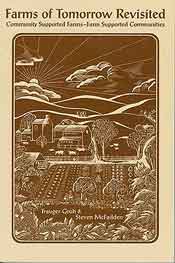 Farms of Tomorrow was published by the Biodynamic Farming and Gardening Association in English since 1990; the 2nd edition of the book, Farms of Tomorrow Revisited was published in 1998, with many new chapters including one by Marcie Ostrom on CSA coalitions. The book has also been published in Japanese, and Russian translations. Now, nearly a quarter century after the CSA farm book first came out, it’s available in a handsome new German translation, Hofe der Zukunft.
German farmer and scholar Wolfgang Stranz worked for over a year to translate Farms of Tomorrow, and to write a special new chapter for readers in Germany and Austria.
As Resurgence Magazine noted in a review, “it is rare to come across any practical farming guide that sets out, from its inception, a set of principles that embrace social, spiritual, and economic concerns on completely equal terms. The wisdom and clarity of philosophy are striking throughout.” CSA is a dynamic movement at the heart of agricultural renewal.
The German-language edition of the book, Hofe der Zukunft, is available here.
The English-language edition of Farms of Tomorrow Revisited, published by the Biodynamic Association, is available in print and for the Kindle ebook readers at Amazon.com, in print through Steiner Books, and for all Apple devices in the iBook and iTunes stores.

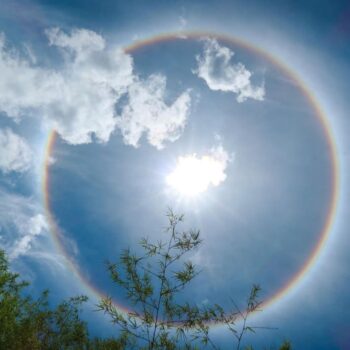
On Sunday, January 19, Valera Yangurazov, a passenger on a Moscow train, videotaped a dramatically vivid Whirling Rainbow (Sundog, or Sunbow) illuminating the sky in Russia. You can watch the short video on this page.
Beholding the natural beauty of the Sunbow as I watched the video, I immediately recalled how that vivid sky sign played a key role in the Odyssey of the 8th Fire,
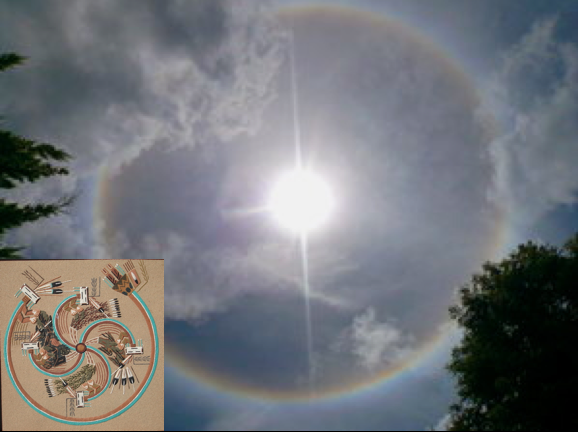
The Sundog is the rainbow gone Full Circle around the Sun. This natural phenomenon — said to be especially relevant to our era — is also known as the Sunbow or Whirling Rainbow.
Odyssey of the 8th Fire tells the true story of how the Sunbow served as a central motivating image for a band of pilgrims who walked across America. I had the honor of being with them and of keeping an online, nonfiction journal about that epic walk and the teachings that became available through the many steps we took.
Day 7 of the 230-day online journal reports on some of the relevant science and lore associated with the SunDog, or Sunbow, or Whirling Rainbow, and it explores the natural phenomenon’s relevance to our era. If you follow this link, and scroll about halfway down the page below the picture of the Sunbow, you will find the teachings.
“Festivals are not merely the commemoration of historical events or personalities. They are in and of themselves, each year, spiritual events carrying a significance that grows and deepens with the developing phases of human evolution.”
— Rudolf Steiner
 For most of us, for much of the world, the heart of Winter Festival lies obscured behind the veil of outer celebration. Yet the veil is translucent. Through it, with a willful gaze, we may behold the mystery of the low-hanging Sun as it seems to stop, heralding the onset of the north wind and the clear, hard bite of winter. Through the veil we also may sense something else just beyond our grasp – something vast, poignant, resonant.
Annually at this festival point in December the celestial rhythm of Earth and Sun come momentarily to pause – an anomaly that moves us inescapably into the deep, the dark, the other. At this Winter point, consciously or unconsciously, we set an inner pattern to guide what we will weave in the outer world through another solar cycle. We dream the dreams that will flower in another season. How much more powerful if we know we are dreaming? How much more beguiling if we know nature is inviting us to peer through the veils?
– If we do not wakefully intend,
we are subconsciously compelled –
N.B. The rest of this Winter Festival essay, which I wrote in 2002, can be found at this link.
 I was there in New Hampshire a year ago in September 2012, just a few miles away when dairyman Lincoln Geiger was badly hurt by a trampling bull.
That Sunday they airlifted him to a hospital in Boston to reckon with life-threatening injuries. But Lincoln’s spirit was strong and he moved through the wounds and the shock, and the many phases of recovery to come back to the land.
“I was given a new outlook on the world, Lincoln later explained, “by what I now call a form of initiation. My whole sense of reality shifted from an objective view of nature and the environmental movement, to a deeply caring heart-centered understanding.
“I now feel that the way to engage people to improve our world is with an intelligence that emanates through the heart. We need to ensoul nature and all its creatures and feel like guests, friends, or part of the familywhen in the presence of the forest or the garden or the herd. That is the attitude that comes from the warmth of the soul through the wisdom of the heart.”
From the very beginning Lincoln has been one of the core farmers at the remarkable Temple-Wilton Community Farm. One of the first two Community Supported Agriculture farms (CSAs) in America, it is still growing strong nearing thirty growing seasons.
In a blog post recounting his recent visit to the farm, Robert Karp of the Biodynamic Association noted that the Temple-Wilton Community Farm, “keeps showing the way” for thousands of other CSA farms across the nation and around the world.

A day-and-a-half before his fateful encounter with the bull, Lincoln came and sat beside me in the barn loft at Stonewall Farm Center, just west of Keene. He shared a grace with our conference of people talking about implementing greater food security for the Monadnock Region of New Hampshire.
Lincoln sat as part of a circle of 40 of us or so — all Twentyfirst Century agrarians alive with a sense of doing something foundationally important in the world. After dinner, to offer a blessing, he talked with us for about ten minutes.
He began by telling the story of how on a spring day he had climbed aboard the farm’s tractor and set about mowing the high fields. He never noticed the place in the deep grasses where a fawn lay hidden, and so to his dismay and anguish he found that the blades of his mower had badly injured the fawn.
Within two weeks he had hit four fawns and felt the deer were trying to teach him something monumental. “The day I hit the last fawn I was super alert to make sure there would be no accident. I stood on the tractor platform the whole time I was mowing. About a third into the 10-acre field I saw a deer standing about 200 feet from me. I stopped the tractor, got off and noticed that the deer was looking at me and then looked down and then back at me.
“I felt right away that she was standing by her fawn. I turned off the tractor and headed straight towards the deer. She ran away, I kept walking and soon there in front of me lay a beautiful fawn. I just stood with it for a while, then I called my dairy partner Andrew and our apprentice Sara to come to the field with a cage or something to hold the fawn while I finished mowing.
“I picked up the fawn, it was totally calm and carried it to the bottom of the field. Andrew and Sara came but had no cage, they brought it into the Forrest and let it go. I kept on mowing and just as I was finishing the last couple of swaths, as I look back, there it is with its hoof cut off an inch up. I cried out loud, turned off the tractor and picked it up in my arms again. My heart was broken so bad I can’t tell you. I brought my little friend into the forest, I knew it would never make it. I laid it on a large stone and crushed its beautiful head with a rock.
“Then I cracked open inside and screamed loudly for the world to hear our pain and our love,” Lincoln told me. Time went by. To bring some light and healing to all that arose with the death of the fawns, to respond give some beauty back to the world Lincoln wrote graces.
At Stonewall Farm a year ago, Lincoln spoke one of those graces aloud for the circle:
Thank you Earth so soft and strong
Thank you meadow filled with song
Thank you mountain, forest and stream
By you we rest and find our dream
Thank you creatures wild and tame
Your trust we love and hope to gain
Thank you for your milk and fleece
And for your meat that we may eat
Thank you root and leaf and seed
We’ll not forget your wondrous deed
You hold the earth
You catch the rain
You fill the world with air again
Thank you wind for bringing rain
Please help our friends who are in pain
For us who thirst and cry from hunger
Please bring hope, life and wonder
Thank you moon for guidance and grace
For heart bent flowers
With dew drop lace
Thank you sun as day begins
For golden light
By angel wings
With thankful hearts
and open hands
We ask to share your loving lands.
– Lincoln Geiger, Temple-Wilton Farm
As of Thanksgiving 2013, Lincoln writes: “I am well and full of living.” The Temple-Wilton Community Farm is also well and full of living, as attested to by yet another article about the farm’s place in the history and the destiny of the CSA movement, complete with some wonderful photos. The story – The First CSAs – is published on page 10 of the John Deere company magazine, The Furrow.
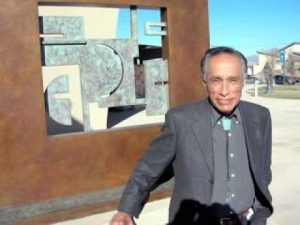
Grandfather Leon Secatero
The late Navajo elder Leon Secatero once told me that he saw the Wind Walkers take corn pollen in their mouths to bless their words before they spoke to him.
“The elders talked about positive things, focusing on the positive to make things happen, to bring in good energy so that life will continue. They said to use song, prayer, dance to focus on positive thought, and to help us go forward on the path to the future in a good way, in a sacred way.”
“What I was shown,” Grandfather Leon told me, “was the way we should be, how we must be to influence the future, and also to influence all the plants, the animals, the waters, the air and the fire.
“It’s important. I came to a knowing that the only way you can have the power, is through the color and the light of positive thought and energy. Put all your concentration on this, not other things.
“Put your concentration on the positive. That’s how it’s done.”
– Excerpt from a forthcoming Soul*Sparks book
by author Steven McFadden
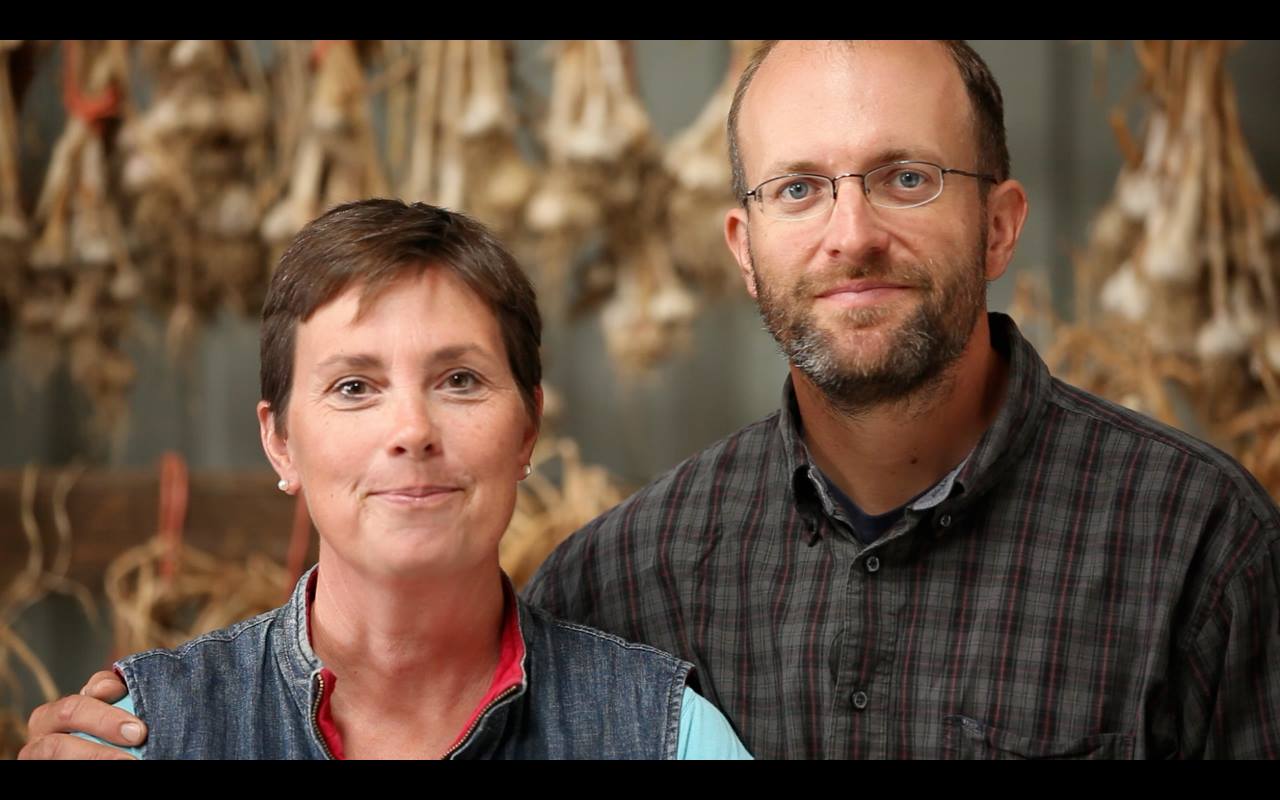
Evrett Lunquist and wife Ruth Chantry, parents of five children, own and operate Common Good Farm in Nebraska. They produce for a CSA and the market: herbs, vegetables, free-range eggs, grass-fed beef, and pork. Photo courtesy of Open Harvest Coop Grocery.
On December 7, 2011 the USDA’s National Organic Program (NOP) inadvertently violated its own policies and released the name of a Nebraska man who had accurately reported a farmer who was flouting the legally binding organic rules.
In so doing, the NOP unleashed upon Evrett Lunquist a multi-year plague of legal pleadings, and a barnload of legal expenses to defend himself.
After his name was released in response to a request under the Freedom of Information Act, the man who correctly reported the violations, Biodynamic farmer and part time inspector Evrett Lunquist, was sued for $7.6 million in a Nebraska Court by Paul A. Rosberg, the vengeful farmer who had violated organic rules. Later in the proceedings, International Certification Services was added as a defendant.
After more than 18 months of tedious hearings and a numbing cascade of motions filed by the plaintiff, Lancaster County Judge Paul D. Merritt finally in August 2013 issued a summary judgment dismissing the case.
 After the expensive ordeal of defending himself against the allegations unleashed by the NOP’s procedural error, Lunquist, who followed the letter of the law acting as a private citizen when he initially reported the violations, had racked up more than $43,000 in legal expenses. While he received no support or acknowledgement of responsibility from the NOP, he and his family did find generous support from their church and their community. I have previously reported on this case both here and here.
 This convoluted case calls into question the ability of the USDA and its National Organic Program (NOP) to stand behind citizens and inspectors who report violations of organic standards. Consequently, the case has sent a palpable chill through America’s network of organic inspectors, and may thereby compromise consumer confidence in the integrity of the USDA’s “Certified Organic” label. Meanwhile, another kind of food certification — Certified Naturally Grown — is emerging….
The rest of this story is on my blog for The Call of the Land. – Steven M.
 Your actual, real-time Odyssey parallels this Summer’s ‘blockbuster’ film
 New and improved: Classical Considerations
 Behold the Light: Farms, Photons, Futures
 Our Collective Odyssey: Song and Story for the Generations Arising