Gallery I. Gallery II. Gallery III. Gallery IV. Gallery V. Gallery VI. Gallery VII. Gallery VIII. Gallery IX. Gallery X.
May you scroll in beauty.


“Here is a concept from Iroquois cosmology which might explain many physical phenomena: Light has awareness, light has consciousness. Light has its own life.” — Doug George-Kanentiio, Akwesasne Mohawk

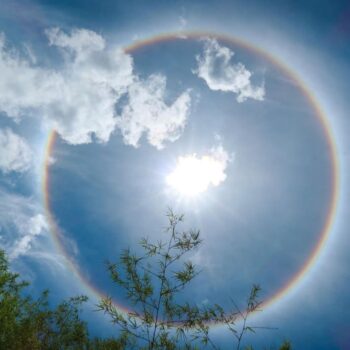
As we may clearly behold, in all ways light is both extrinsic and intrinsic to our lives.

BEHOLD THE LIGHT. Researchers have now created an image of a single photon.
Especially consequential in one key circle of considerations, light is a prime factor for land, farms, farmers, and food. We human beings need and eat a lot of light.
Back in 1905, the same year that Albert Einstein proposed the Theory of Special Relativity (E=MC2), he also identified what he called a “light quantum,” a single unit of light.
Today we call these basic, natural units of light, photons. As has recently come into focus, researchers have developed a theory that, astonishingly, made it possible to create an image of a single photon.
The theory that made this image possible, reported in the journal Physical Review Letters, enables scientists to calculate and understand more about photonic properties — opening a range of possibilities across fields such as quantum computing, and photovoltaic devices.
As the atom is a fundamental unit of matter, so the photon is a fundamental unit of light. Yet photons display properties of both waves and particles. This quantum behavior of light is well established, with over 100 years of experiments showing that light can and does express in both particle and wave form.

Our understanding of this quantum nature has much further to go — the great contemporary adventure of exploring subtle realms previously regarded as purely mystical.
How do light and matter interact at the quantum level? That’s a question not just for theoreticians and technologists, but also for our ambassadors to the earth: the women and men who touch the earth on our behalf and grow the food we eat. Those who prepare the food with hands and tools also engage with light forces, consciously or unconsciously.
As has long been readily seen, various qualities of light are integral in nature as well as in technology. This is where the ideas explored in my book Deep Agroecology: Farms, Food, and Our Future come into focus. Through disciplines such as biodynamics, quantum agriculture, and real organics, pioneering farmers are gaining in their understanding and engagement with light forces. In this manner these pioneers enhance and enrich the land, our food, and our lives.
Some of these evolving approaches to working intelligently and skillfully with photon streams of light are considered in Chapter 4 of Deep Agroecology.
Biophotons—The sparks of light and life generated from within biological systems are called biophotons. They are used by and stored in all organisms, including the food we eat, the water we drink, the air we breathe, and our bodies—the physical temples in which our spirits dwell.
You can imagine the ongoing, invisible biophotonic dance between us and the rest of the world. Take a relaxed breath and there it is.
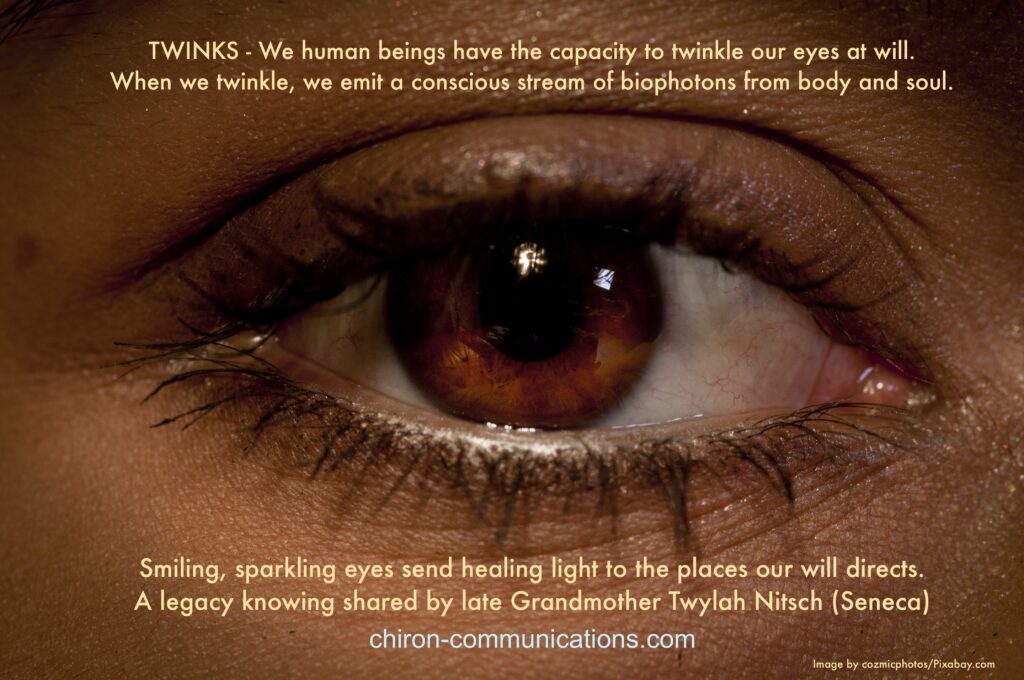
When our food is vibrant with high-quality life energy (biophotons), that energy is absorbed and becomes part of us, in addition to the material substances of vitamins and minerals. Recognition and engagement with this reality for farmers and diners makes a subtle but important difference.
In matters biophotonic, of course, quality as much as quantity is consequential.
The importance of biophotonic life force, usually spoken of as basic life force, has been known for centuries around the world. In China it is referenced as chi, in Japan as ki. The Sanskrit term is prana. The Huichol people of the Sierra Madre mountains in the western states of Mexico speak of it as kupuri. Other native peoples of the Americas as well as around the world know it by other names. In recent decades, especially since the wide acceptance of acupuncture and Reiki with their understandings of human energy systems, Western science has increasingly recognized the reality of the animating life force.
Light and Life—Fritz Albert Popp was among the first Western investigators to theorize that this light must come, at least in part, from the foods we eat. The more light a food is able to store and to convey, the more nutritious it is. Naturally grown fresh fruits and vegetables, for example, are rich in biophotons.
Biophotons elevate an organism—such as your physical body—to a higher oscillation (vibe). If you eat fresh, clean food grown on healthy, natural, biophoton-rich land, you are supporting your body at a higher, healthier vibe.
That’s how I see the light. 
THANKS – and a bouquet of floral biophotons to M. Kelley Hunter of Helia Star for flipping the photon ON switch in her recent newsletter.


Academia.com recently reviewed my book, Deep Agroecology: Farms, Food and Our Future. They rendered their review in a five-minute podcast. You can listen to it by clicking below on the start arrow for the MP3 recording.
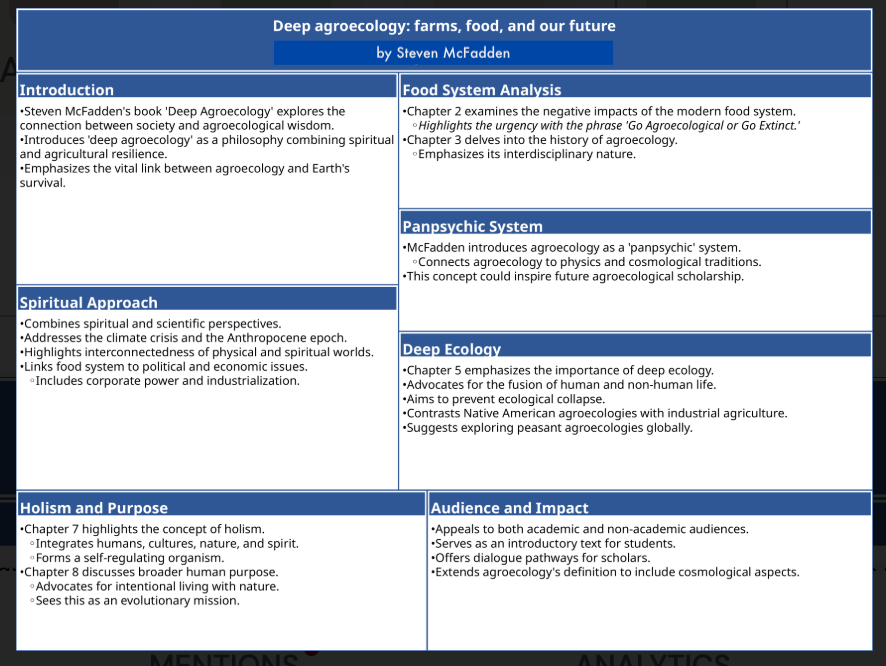
Their AI-generated Abstract
Steven McFadden’s book Deep Agroecology: Farms, Food, and Our Future presents a blend of spiritual and scientific perspectives on agroecology.
The book argues for the inseparable connection between agroecology and the survival of the Earth, emphasizing a holistic approach that integrates the physical and spiritual realms within food systems.
Through a critical analysis of modern agricultural practices and historical contexts, McFadden advocates for a shift towards sustainable agroecological methods, which he posits as essential for addressing ecological crises and fostering an intentional relationship with nature.
The book suggests that by seeking deeper knowledge and connection with our food and farm sources, we don’t just eat better, we participate in much bigger, far more consequential healing deed as our life-sustaining Planet Earth passes through an era of tremendous challenge.
Click on the start arrow to listen to the brief podcast review:
This is a rendering of an AI poster for the book, also from Acdemia.com. In my view it is just kind of ok, but one statement is way off the mark. AI claims the book “advocates for the fusion of human and non-human life.” What? I never wrote that, never even thought it. Dangerously wrong “wishful thinking” on the part of AI.

As of 2025 one of the classic books about the CSA movement—Farms of Tomorrow Revisited—has been translated and published in the Spanish language as Las Granjas del Mañana Revisitadas: Comunidad apoyada por Granjas, Granja apoyada por Comunidades.
Nearly 40 years ago I was the Organic Outlook columnist for a rural newspaper when I met a farmer setting down roots the next town over, Trauger Groh (1932-2016). Trauger and his colleagues Lincoln Geiger and Anthony Graham were founding one of the first CSAs in the nation: the Temple-Wilton Community Farm in New Hampshire.
Recognizing the importance of the seeds the first CSAs were planting, Trauger and teamed up to write Farms of Tomorrow in 1990, published by the Biodynamic Association.
Eight years later we returned to the subject and wrote Farms of Tomorrow Revisited (1998) to consider what farmers and communities were actually experiencing and learning. That’s the version of the book now translated as Las Granjas del Mañana Revisitadas by Martin Alonso of StayTrue Organics in Argentina.
Along with other CSA books, educational materials, and organizations, our books have helped to spark and to support well over 8,000 CSAs (est.) in the USA, and many thousands more worldwide.

Journalist Steven McFadden stands before a poster for Farms of Tomorrow, and also one for Farms of Tomorrow Revisited.
Whether in English or Spanish, the subtitles for our books express a main point of focus: “Community Supported Farms, and Farm Supported Communities.” The phrase reversal in the subtitle highlights an key point. In recent years CSA has often been promoted as a “marketing model,” whereas Trauger and I—along with many others—envisioned CSA as a “community model.” Consequently, in our writing we actively explored social, environmental, and spiritual dimensions of this emerging form.
Our explorations remain healthfully provocative now in 2025, and beyond, especially the explorations of “associative economy,” “parallel polis,” and the preservation of farmland via innovative trusts, that young farmers might be enabled to fulfill their vocations.
Note: In early February 2025 I participated in an online zoom conversation about CSA with the publisher of Las Granjas del Manana. The English-language recording of that zoom call is at this link; the Spanish-language recording is at this link.
In a review of the English-language version of our book, Resurgence Magazine commented “It is rare to come across any practical farming guide that sets out, from its inception, a set of principles that embrace social, spiritual and economic concerns on completely equal terms…The wisdom and clarity of philosophy are striking throughout.”
As Bill T. put it in an Amazon review: “The concepts of community supported agriculture (CSA) grab at the imagination: reconnect with the land and farmer, know exactly where your food is coming from…”
In yet another review published in the Journal of Applied Communications, Mickie Swisher wrote “For those who have little or no previous experience with community-based agriculture, this book brings together information and resources in one place. Even for those who think that community-based agriculture is either unimportant or unrealistic, Groh and McFadden’s book is worth reading. It will, at the least, stimulate thought. With luck, it will produce action.”
The actions now needed – actions that Las Granjas del Mañana Revisitadas can help stimulate – are the further development and networking of clean, healthy, just CSA farms in thousands more communities, both Spanish and English speaking, along with the many other languages of the world.


Ga
After 16 years wearing the same internet face, my website for Deep Agroecology needed an update. My steady-state blog about food, farms, and our future has been online since 2008. For several years its messages made their way through the digisphere as The Call of the Land. But the blog now bears the name Deep Agroecology. That may sound abstract or academic, but the words actually represent what I regard as one of our main chances for navigating safely and wisely through the cascade of earth changes now unfolding,
My thanks to Tim Hill of Draft Horse Studio for expert web support, making the transition smooth and straightforward for Deep Agroecology.
Chiron Communications–upon whose pages you now gaze, dear readers–is my main, umbrella website, hosting a range of subjects that have drawn my interest over the years.
But to give emphasis to particular subjects, I long ago created and two satellite web sites. They remain alive and active.
The first website is my blog for Deep Agroecology, which has now undergone a facelift. The focus on that blog is the intelligent, and proactive response of farms and communities around the world to establish clean, just, sustainable food systems in the face of ongoing climate change.
My second satellite web site is Odyssey of the 8th Fire. That site tells at epic length the true saga of a great, long pilgrimage on foot from the Eastern Door at the Atlantic Ocean, toward the Western Gate at the Pacific Ocean. The 8th Fire relates a nonfiction tale about a quest arising from the deepest roots of our land, but taking place in the present and the future. In it, circles upon circles, elders make a great and generous giveaway of the teachings they carry.
My 8th Fire website could use a facelift as well, no doubt. But that will have to wait for the right moment. For now, I’m pleased to be able to shine a light upon the new look of Deep Agroecology — a main chance for us all.
As cloaks of summer heat settled upon most of North America, and storms raged severe in sky, land, and sea, I happened upon a 2020 academic review of Deep Agroecology.
I’d missed the review at the time, as I was reckoning that year with the passing of generational elders, and also a household move from Nebraska back to the mountains of the Southwest. But I’m happy to have come upon the review now, some four years later. I needed to hear a familiar chord sounded again.
Reading the analysis reminded me of the perilous realities that had driven the writing of the book, realities that had gone into soft focus for me since publication five years ago. That came about as, after the year of transition, I became intent on completing another writing project, the biography of Iina’bi’ho spiritual elder Leon Secatero (1943-2008). That book is moving toward completion.
The 2020 review of Deep Agroecology was written by Hannah Kass, Ph.D and published in the journal Food, Culture & Society. What sparked me in reading the review was her proficient description of my book’s goal: to state plainly the crucial knowledge that agroecology has to offer to the general public, and to sound a call for wide, strategic implementation in our era of mounting perils.
Professor Charles A. Francis (U. Nebraska) suggested the deep agroecology theme to me around 2012. After seven years of study and contemplation what emerged was not so much the expression of a personal vision, but rather the synthesis of a chorus of learned voices. Together they express an evolving vision—a strategic vision—shared by millions of people around the world. Deep Agroecology is my effort to articulate that compelling vision, along with a host of healthy pathways that can lead toward a just, sustainable, and spiritually elevated future.
Despite appearing as an academic concept, agroecology is altogether of the people and the earth: of the way we live on the land, and the way we give and receive sustenance with the earth. As we are at a point of peril, and our farm and food foundations are in critical transition, I wrote Deep Agroecology for the people—for all the people.
In her book review, Kass noted: “Using the framework of extinction and evolution to explain deep agroecology’s spiritual purpose, McFadden aptly demonstrates the inextricability of physical and spiritual worlds in the food system…He connects these worlds to the political economy of food, pointing out the climate’s ties to the intersecting problems of corporate power, industrialization and rural dispossession.”
Agroecology offers a wide array of sensible, sustainable, just, and strategically intelligent pathways to sustain our civilizations, and help them to progress in ever-wiser way.
Terra Madre – We Are Nature
One place where the theme of agroecology will resonate with power and beauty is at this years 20th anniversary Tierra Madre global food community gathering in Turin, Italy (Sept. 26-0).
The 2024 theme is “We Are Nature.” As a key part of the proceedings, the conference is establishing a spectacular space dedicated to agroecology: “an alternative food system paradigm that counters industrial agriculture…It is rooted in the reconstruction of relationships between people, agriculture and environment, food systems and society.”
![]()
We’re in transition, that’s for sure. By that I mean the rate of change around the globe–climate, business, education, technology, etc.–is cracking along at a wildfire pace: in our faces. We’re moving decidedly toward some new state of life.

To add to the wealth of speculation about what some qualities of that new state may be, I offer yet another descriptor–one with mythic unifying attributes: the Age of Flowers. The concept qualifies as an aspect of deep agroecology.
But rather than lay the whole tale out a second time on this blog, I created a permanent page on this same website. Here’s the link. Give it a click and it will whisk you along to the page with the floral essay.
Note: I wrote this material in the mid-1990s as a facet of Legend of the Rainbow Warriors, an exploration in nonfiction mythology. Now in the summer of 2024, it feels relevant and worthwhile to publish it online and to thereby make it more widely accessible. – S.M.
As the pace of world transition intensifies, I’m moved to once again articulate in direct language my understanding of the vision held by millions of people around the world: the vision of agroecology.
Thus, I offer below a two-minute slide show with words and images characterizing some basic elements of the agroecological vision, and also offering a glimpse at how deep agroecology embraces the vision, then endeavors to explore further into positive possibilities.
Note: The slides are set at 7-second intervals. You can start and stop the presentation by using the slide at the bottom.
Your actual, real-time Odyssey parallels this Summer’s ‘blockbuster’ film
New and improved: Classical Considerations
Behold the Light: Farms, Photons, Futures
Our Collective Odyssey: Song and Story for the Generations Arising