Post Views: 2,760
 Note Well: A news story from The New York Times (2.18.2014) reports: “A gas cloud named G2 is about to collide with Sagittarius A*, the supermassive black hole at the center of our galaxy…”
Our galaxy, which we know as the Milky Way, is known as Hunab Ku in Mayan Cosmology.
The noteworthy galactic event that the Times reported on is on track to play out in March or April of this year, at Sagittarius A, which astrologers reckon as located at about 27 degrees of Mutable sign Sagittarius. This degree of the sign of the Archer is at the very center of our Milky Way Galaxy – Hunab Ku), and it will unfold this Spring just as the much-heralded Grand Cross of 2014 is manifest in the Cardinal signs of the Zodiac.
Metaphysicians regard these planetary and stellar events as noteworthy and significant in accord with the ancient astrological dictum of correspondence: As above, so below.

Hunab Ku – image by Jose Arguelles, is a Mayan-inspired symbol for our galaxy.
To quote again from the Times article: “…(this) black hole lies just 26,000 light-years from Earth. (The actual event, of course, took place 26,000 years ago.)” This means that the gas cloud G2 was drawn into the center of our galaxy (Hunab Ku), some 26,000 years ago, but it has taken the light from that event that long to reach earth.
This 26,000-year span matches the cyclic period of time defined in the Mesoamerican (Mayan) Long Count Calendar.
The Long Count calendar was famously forecast to complete, and then to roll over into the start of a new cycle (5th World) at or near the date of December 21, 2012, just a year and three months ago.
Click here to read the rest of the Times article about the impending Black Hole event of 2014. Click here to watch a Youtube video clip simulation of the Gas Cloud being drawn into Hunab Ku – the center of our galaxy.

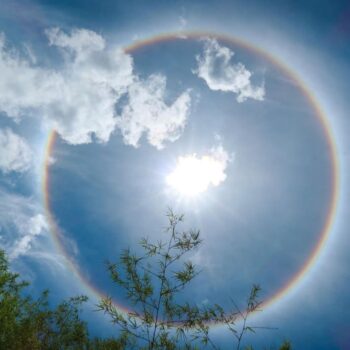
On Sunday, January 19, Valera Yangurazov, a passenger on a Moscow train, videotaped a dramatically vivid Whirling Rainbow (Sundog, or Sunbow) illuminating the sky in Russia. You can watch the short video on this page.
Beholding the natural beauty of the Sunbow as I watched the video, I immediately recalled how that vivid sky sign played a key role in the Odyssey of the 8th Fire,
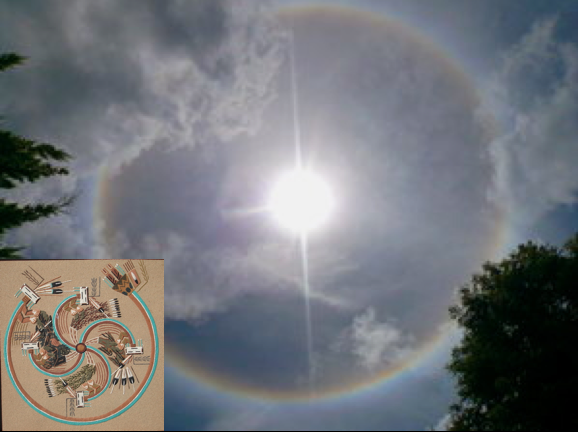
The Sundog is the rainbow gone Full Circle around the Sun. This natural phenomenon — said to be especially relevant to our era — is also known as the Sunbow or Whirling Rainbow.
Odyssey of the 8th Fire tells the true story of how the Sunbow served as a central motivating image for a band of pilgrims who walked across America. I had the honor of being with them and of keeping an online, nonfiction journal about that epic walk and the teachings that became available through the many steps we took.
Day 7 of the 230-day online journal reports on some of the relevant science and lore associated with the SunDog, or Sunbow, or Whirling Rainbow, and it explores the natural phenomenon’s relevance to our era. If you follow this link, and scroll about halfway down the page below the picture of the Sunbow, you will find the teachings.
“Festivals are not merely the commemoration of historical events or personalities. They are in and of themselves, each year, spiritual events carrying a significance that grows and deepens with the developing phases of human evolution.”
— Rudolf Steiner
 For most of us, for much of the world, the heart of Winter Festival lies obscured behind the veil of outer celebration. Yet the veil is translucent. Through it, with a willful gaze, we may behold the mystery of the low-hanging Sun as it seems to stop, heralding the onset of the north wind and the clear, hard bite of winter. Through the veil we also may sense something else just beyond our grasp – something vast, poignant, resonant.
Annually at this festival point in December the celestial rhythm of Earth and Sun come momentarily to pause – an anomaly that moves us inescapably into the deep, the dark, the other. At this Winter point, consciously or unconsciously, we set an inner pattern to guide what we will weave in the outer world through another solar cycle. We dream the dreams that will flower in another season. How much more powerful if we know we are dreaming? How much more beguiling if we know nature is inviting us to peer through the veils?
– If we do not wakefully intend,
we are subconsciously compelled –
N.B. The rest of this Winter Festival essay, which I wrote in 2002, can be found at this link.
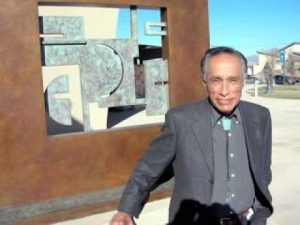
Grandfather Leon Secatero
The late Navajo elder Leon Secatero once told me that he saw the Wind Walkers take corn pollen in their mouths to bless their words before they spoke to him.
“The elders talked about positive things, focusing on the positive to make things happen, to bring in good energy so that life will continue. They said to use song, prayer, dance to focus on positive thought, and to help us go forward on the path to the future in a good way, in a sacred way.”
“What I was shown,” Grandfather Leon told me, “was the way we should be, how we must be to influence the future, and also to influence all the plants, the animals, the waters, the air and the fire.
“It’s important. I came to a knowing that the only way you can have the power, is through the color and the light of positive thought and energy. Put all your concentration on this, not other things.
“Put your concentration on the positive. That’s how it’s done.”
– Excerpt from a forthcoming Soul*Sparks book
by author Steven McFadden

For most Americans the Four Corners is just a curiosity on the map where the survey lines that define four states come together and form a classic cross: Arizona, New Mexico, Utah and Colorado. But for many native peoples, Four Corners is a broad and austerely beautiful region bounded by four sacred mountains.*  Four Corners is appreciated as an exquisitely sensitive and foundationally important feminine holy place on the land, a place that serves as an earthly anchoring point for the spiritual heart of North America (Turtle Island).
Today, as has been true for over 50 years, Four Corners is under assault. Today also, as has been true for millennia, Four Corners is under the watch of human beings who have accepted their role as protectors of the land and the life that depends upon the land.
Within the Mountain boundaries of the Four Corners lies the sweeping, majestic prominence of Black Mesa in northeast Arizona. Upon the mesa, in simplicity and humility, stands Big Mountain, a geomantic ground zero. As held in traditional knowings, Four Corners in general and Black Mesa and Big Mountain in particular are understood to represent what we might conceive of as a microcosmic holograph of our entire planet — a subtle, supersensible phenomenon of the region possibly grasped only through legend, direct perception, or quantum mechanics.
What happens in the Four Corners does not stay in the Four Corners, but through the web of life and relationship resonates consequences across and within all of Mother Earth.
 Over the last decades of our era, traditional native peoples at Black Mesa have lived in resistance. Strip-mines have ripped apart the sacred lands, coal-burning power plants have befouled the desert air to send electricity to the Las Vegas Strip, and elsewhere, and mining corporations have dug up the toxic ‘cledge’ (uranium). According to various Creation stories, native peoples were explicitly warned to leave the cledge unmolested; digging yellowcake up, the traditions related, would cause it to arise in the world as nayee, a monster.
In resistance of this ongoing exploitation, there will be a gathering on Black Mesa the week of June 3-9, 2013. The gathering will include workshops and conversations among the Big Mountain/Black Mesa community and other frontline resistance communities from around North America. They will participate in a native youth caucus, cultural sharing, work parties, an elders’ circle, community meals, and concerts with hip hop artists.
This June gathering is being organized by Black Mesa Indigenous Support (BMIS), an all-volunteer, non-native collective committed to long-term, relationship-based, request-based solidarity with the native communities of Black Mesa.
This is not the first such gathering in support of Black Mesa/Big Mountain and surely will not be the last. Thousands of people have learned of Big Mountain over the last 40 years, and hundreds of gatherings have been held in support. This particular gathering is a “big doing” not so much in the sense of size, but rather in the overall context of extreme planetary imbalance or earth changes, and overall patterns of spiritual awakening.
Sovereignty Summer
The Black Mesa gathering in early June happens toward the beginnings of Sovereignty Summer, and thus can be appreciated as a node in a network of awakenings now underway onward through 2013. What is “big” in the ultimate realm of possibilities, is the potential for good that may come from Big Mountain, from Ottawa, and from hundreds of other gatherings and non-violent actions across Turtle Island (North America).
 What unfolds on Black Mesa is part of a social movement, a people-powered uprising for a healthy planet liberated from fossil fuel extraction, exploitative economies, racism, and oppression.
The BMIS collective sets out their ideal by echoing a statement from Honor the Earth: “We believe a sustainable world is predicated on transforming economic, social, and political relationships that have been based on systems of conquest toward systems based on just relationships with each other and with the natural world. We are committed to restoring a paradigm that recognizes our collective humanity and our joint dependence on the Earth.”
General Geomantics
Occupying a spiritual axis for North America, Black Mesa is home to one of the world’s largest and richest coal mines. A site long considered sacred by traditional Hopi and Dine’ (Navajo), the mesa is also home to profitable deposits of gas, petroleum, and uranium.
As understood for millennia, Black Mesa and Big Mountain are inherently, energetically feminine. Yang, masculine digging and drilling for monetary profit and environmental ruin constitute a direct assault on this yin feminine holy center of the land we live on, North America.
In that sense Black Mesa/Big Mountain represent a microcosmic mirror of the deranged yang-masculine dominance, and the ongoing determined debasement of feminine, life-sustaining peoples, persons, substances and ways — as is evidenced all over the planet.
The native elders and the traditional families of Black Mesa appreciate coal as a substance that serves as the liver of the Sacred Female Mountain. When coal is taken from the ground, it no longer can absorb and neutralize impurities in the air and water, the arising thoughts and feelings that circulate in the atmosphere of our planet home.
Even in the face of genocide and ongoing persecution, native peoples have faithfully perpetuated ceremonies intended to give back appreciation and the primal energies of thought, song and dance to help maintain the balance of natural forces of sunlight, rain and winds, and further to reaffirm respect for all life and trust in the Great Spirit. This is how they express it. This is what they do. This is the nature of the call they are sounding, the support they seek.
Igniting a Spiritual Fire
Sovereignty Summer is a term that originated in Canada, arising through the indigenous movement Idle No More. The movement demands sustainable development as well restoration of integrity to sworn treaties. “We believe in healthy, just, equitable and sustainable communities,” the movement reasons, “and (we) have a vision and plan of how to build them. Please join us in creating this vision.”
 Idle No More has ignited a spiritual fire in the hearts of thousands of human beings to address a range of core matters, including the fundamental issue of protecting the earth that sustains us so life may endure and we may all go forward. They intend to keep striking sparks.
The human beings who sparked Idle No More have networked with Defenders of the Land to make a declaration: “We are in a critical time,” they write, “where lives, lands, waters and Creation are at-risk and they must be protected.” They call the attention of people to the potential of Sovereignty Summer. Meanwhile, in Alberta earlier this month, many native peoples gathered to create and then to sign a historic document, the Turtle Lodge Treaty. Of this treaty we are likely to hear more in the years to come.
Big Medicine is afoot. There is a spiritual energy stirring and a larger awakening is on the horizon as we transition to Sovereignty Summer. The gathering at Big Mountain is one facet or node of this ongoing awakening.
The gathering space at Black Mesa is already full this year. Organizers cannot accommodate anyone else coming. But there are other ways to support the effort to maintain Big Mountain, Black Mesa and the Four Corners, and to support the whole of the earth in a sacred manner. That is the idea animating Sovereignty Summer: to come together not in one particular place, but to establish a spiritually respectful stance where you are called upon the land.
* The four sacred mountains: Mount Blanca in Colorado, Mount Taylor in New Mexico, San Francisco Peaks in Arizona, and Mount Hesperus in Utah.

This month a small band of women from the Ojibwe native nation is walking the land in prayer from the source of the Mississippi River at Lake Itasca in the north, more than 1,200 miles in a south direction along the shore to the point where the great river spills into the sea at the Gulf of Mexico.

Pilgrim paths form a cross.
The Mississippi River Water Walkers sang the Water Song when they began their walk on March 1, 2013. By now they are many hundreds of miles further south, still in ceremony, still walking on to fulfill their vision.
When the Mississippi Water Walkers reach Memphis, Tennessee in a week or so, their north-to-south trail will intersect with the east-to-west trail of the Sunbow Prayer Walk, which was guided 2,500 miles across the land 20 years ago by Grandfather William Commanda, now in spirit.
The trails of these two pilgrim bands will intersect in space and across time, forming a Four Directions wheel anchored in prayer and ceremony on the land at the Memphis shore of the Mississippi.
The eight-month long, male-driven Sunbow Walk from the Atlantic to the Pacific crossed the Mississippi River from Tennessee to Arkansas on the ninety-eighth day of the journey (Sept. 28, 1995). They traveled then under the teachings of the Seventh Fire and the skysign of the Whirling Rainbow
The women who are the Mississippi River Walkers, now on foot in real time 2013, are approaching intersection with the Sunbow trail in Memphis.
You can friend the River Walkers and support them on their Facebook page, a page which is growing as the walkers make their way to the south, stopping at key points along the way to offer ceremonial blessings.
“We want the walk to be a prayer,” says Sharon Day, walk organizer, on their Facebook page. “Every step we take we will be praying for and thinking of the water. The water has given us life and now, we will support the water.”
©- Copyright 2002 by Steven McFadden
In early Autumn 2002, Carlos Barrios journeyed North from his home in Guatemala to the Eastern edge of the Four Corners. In Santa Fe, New Mexico, at the tail of the Rocky Mountain spine of North America, Mr. Barrios spoke in a knowledgeable manner about the Mayan tradition and the fabled Mayan calendars.
The Mayan calendars are an object of intense interest for many thousands of people right now, because they focus upon the watershed date of Dec. 21, 2012. Everything changes by then, it is said.
With a cultural heritage including thousands of pyramids and temples, and a calendar that has proven itself to be astronomically accurate over millions of years, the Maya tradition is widely considered to be a mystic key to the soul of Turtle Island (North America).

Carlos Barrios
In public talks and in private interviews, Mr. Barrios laid out his account of the history and future of the Americas, and the larger world, based on his understanding of the Mayan tradition as both an anthropologist and an initiate. He spoke also about the path he sees ahead from now until the Winter Solstice of 2012.
The range of teachings and insights offered by Mr. Barrios must be considered in the context of the realpolitik in his American homeland. The Maya of Guatemala, their pyramids, and their calendar have endured not in a new-age Shambhala of love and light, but in a milieu of treachery, beatings, torture, rape, and mass murder. Mr. Barrios himself is viewed critically by some knowledgeable about the calendars and teachings, including some traditional elders who feel he has betrayed them.
Decades of Darkness
For 30 long years right-wing Guatemalan governments — supported both overtly and covertly by the US government — waged a terrorist war against the people of the land, murdering over 200,000 citizens, many of them indigenous Mayan people.
 When the war finally wound down in the 1990s, the United Nations Truth Commission conducted an 18-month investigation.* The UN found massive violations of human rights by the government of Guatemala with the complicity of the US government. The UN report stated that acts of “aggressive, racist and extremely cruel” violence descended to the level of genocide directed against the country’s indigenous Mayan population.
When Amnesty International studied the Guatemalan situation in recent years, they came to an arresting conclusion. They wrote that real peace could come only through confronting Guatemala’s “Corporate Mafia State.”*
They described this corporate Mafia state as an “unholy alliance” of certain national and international economic actors, who work alongside sectors of the police and military and common criminals to control ‘black’ industries such as drugs, arms trafficking, money laundering, car theft rings, illegal adoptions, and kidnapping for ransom.”
About the great dark shadow that has hung over the south-most part of Turtle Island, Mr. Barrios observes: “These injustices began five hundred years ago and continue to this very day in all the Americas. The Indian Wars have never ended…I think the power holders in the developed world see it as necessary to destroy the indigenous peoples, or at least to destroy their culture, because they are not ‘consumers.’ The American Dream is built on the back of the Third World…But that is a false distinction for there is no Third World. There is only one world. We are all part of that one world, and we are all due respect.”
While Guatemala has ostensibly been at peace for the last eight years, it is a disturbed peace. The war continues to have a residual impact on the people. Human rights violations still occur regularly, and even international human-rights monitors have been under threat.
Still, in the view of Mr. Barrios who came of age during the war, there have been improvements. “There are no armed guerillas, and the police and army are more decent, more respectful,” he observed. “Because there is more human respect now, we can try to find a new life.”
One eventual consequence of Guatemala’s long-enduring climate of terrorism, has been mistrust and criticism. From this few are immune. Accusations are often aimed at people who purport to speak of the Mayan traditions. Mr. Barrios is enmeshed in this matrix of uncertainty. He criticizes others, and he is criticized himself. He has become a figure of controversy for some traditional Mayan elders.
The World will Not End
 Carlos Barrios says he was born into a Spanish family on El Altiplano, the highlands of Guatemala. His home was in Huehuetenango, also the dwelling place of the Maya Mam tribe. With other Maya and other indigenous tradition keepers, the Mam carry part of the old ways on Turtle Island (North America). They are keepers of time, authorities on remarkable calendars that are ancient, elegant and relevant.
According to Mr. Barrios, he is a historian, an anthropologist and investigator. After studying with traditional elders for 25 years since the age of 19, Barrios says he has also become a Mayan Ajq’ij, a ceremonial priest and spiritual guide, Eagle Clan.
Years ago, along with his brother, Gerardo, Carlos initiated an investigation into the different Mayan calendars. He studied with many teachers. He says his brother Gerardo interviewed nearly 600 traditional Mayan elders to widen their scope of knowledge.
“Anthropologists visit the temple sites,” Mr. Barrios says, “and read the stelas and inscriptions and make up stories about the Maya, but they do not read the signs correctly. It’s just their imagination. Other people write about prophecy in the name of the Maya. They say that the world will end in December 2012. The Mayan elders are angry with this. The world will not end. It will be transformed. The indigenous have the calendars, and know how to accurately interpret it, not others.”
The Calendars
Mayan comprehension of time, seasons, and cycles has proven itself to be vast and sophisticated. The Maya understand 17 different calendars, some of them charting time accurately over a span of more than ten million years.
The calendar that has steadily drawn global attention since 1987 is called the Tzolk’in or Cholq’ij. Devised ages ago and based on the cycle of the Pleiades, it is still held as sacred.
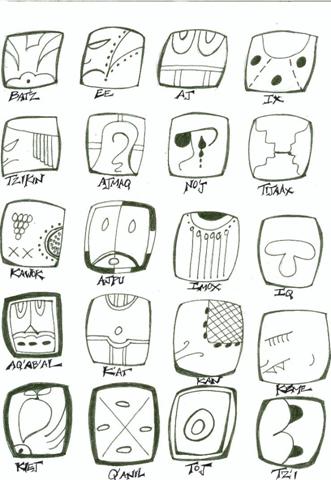
Mayan Cholq’ij – an image of the Mayan Tzolkin calendar used on the Altiplano
With the indigenous calendars, native people have kept track of important turning points in history. For example, the daykeepers who study the calendars identified an important day in the year One Reed, Ce Acatal as it was called by the Mexica. That was the day when an important ancestor was prophesied to return, “coming like a butterfly.”
The One Reed date correlates to the day that Hernando Cortez and his fleet of 11 Spanish galleons arrived from the East at what is today called Vera Cruz, Mexico. When the Spanish ships came toward shore, native people wereS waiting and watching to see how it would go. The billowing sails of the ships did indeed remind the scouts of butterflies skimming the ocean surface.
In this manner was a new era initiated, an era they had anticipated through their calendars. The Maya termed the new era the Nine Bolomtikus, or Nine Hells of 52 years each. As the nine cycles unfolded, land and freedom were taken from the native people. Disease and disrespect dominated.
What began with the arrival of Cortez, lasted until August 16, 1987 – a date many people recall as Harmonic Convergence. Millions of people took advantage of that date to make ceremony in sacred sites, praying for a smooth transition to a new era: the World of the Fifth Sun.
From that 1987 date until now, Mr. Barrios says, we have been in a time when the right arm of the materialistic world is disappearing, slowly but inexorably. We are at the cusp of the era when peace begins, and people live in harmony with Mother Earth. We are no longer in the World of the Fourth Sun, but we are not yet in the World of the Fifth Sun. This is the time in-between, the time of transition.
As we pass through transition there is a colossal, global convergence of environmental destruction, social chaos, war, and ongoing Earth changes. All this, Mr. Barrios says, was foreseen via the simple, spiral mathematics of the Mayan calendars.
“It will change,” Mr. Barrios observes. “Everything will change.” He said Mayan Daykeepers view the Dec. 21, 2012 date as a rebirth, the start of the World of the Fifth Sun. It will be the start of a new era resulting from — and signified by — the solar meridian crossing the galactic equator, and the earth aligning itself with the center of the galaxy.
As John Major Jenkins has written in Maya Cosmogenesis 2012, at sunrise on December 21, 2012 — for the first time in 26,000 years — the Sun rises to conjunct the intersection of the Milky Way and the plane of the ecliptic, describing in the sky a great cross of stars and planets. This cosmic cross is considered to be an embodiment of the Sacred Tree, The Tree of Life — a tree remembered in all the world’s spiritual traditions.
Some observers say this alignment with the heart of the galaxy in 2012 will open a channel for cosmic energy to flow through the earth, cleansing it and all that dwells upon it, raising all to a higher level of vibration. This process has already begun, Mr. Barrios suggested. “Change is accelerating now, and it will continue to accelerate.”
If the people of the earth can get to this 2012 date in good shape, without having destroyed too much of the Earth, Mr. Barrios said, we will rise to a new, higher level. But to get there we must transform enormously powerful forces that seek to block the way.
A Picture of the Road Ahead
 From his understanding of the Mayan tradition and the calendars, Mr. Barrios offered a picture of where we are at and what may lie on the road ahead:
The date specified in the calendar — Winter Solstice in the year 2012 — does not mark the end of the world. Many outside people writing about the Mayan calendar sensationalize this date, but they do not know. The ones who know are the indigenous elders who are entrusted with keeping the tradition.
“Humanity will continue,” he contends, “but in a different way. Material structures will change. From this we will have the opportunity to be more human.”
“We are living in the most important era of the Mayan calendars and prophecies. All the prophecies of the world, all the traditions, are converging now. There is no time for games. The spiritual ideal of this era is action.
Many powerful souls have reincarnated in this era, with a lot of power. This is true on both sides, the light and the dark. High magic is at work on both sides.
Things will change, but it is up to the people how difficult or easy it is for the changes to come about.
The economy now is a fiction. The first five-year stretch of transition — from August 1987 to August 1992 — was the beginning of the destruction of the material world. We have progressed ten years deeper into the transition phase by now, and many of the so-called sources of financial stability are in fact hollow.
The banks are weak. This is a delicate moment for them. They could crash globally if we don’t pay attention. One critical period is October and November 2002. If the banks crash in these months then we will be forced to rely on the land and our skills. The monetary systems will be in chaos, and we must then rely on our direct relationship with the Earth for our food and shelter.
The North and South Poles are both breaking up. The level of the water in the oceans is going to rise. But at the same time, land in the ocean, especially near Cuba, is also going to rise.
A Call for Fusion
 As he met with audiences in Santa Fe, Mr. Barrios told a story about the most recent Mayan New Year ceremonies in Guatemala. He said that one respected Mam elder, who lives all year in a solitary mountain cave, journeyed to Chichicastenango to speak with the people at the ceremony.
The elder delivered a simple, direct message. He called for human beings to come together in support of life and light. Right now each person and group is going his or her own way. The elder of the mountains said there is hope if the people of the light can come together and unite in some way.
Reflecting on this, Mr. Barrios explained: “We live in a world of polarity: day and night, man and woman, positive and negative. Light and darkness need each other. They are a balance. Just now the dark side is very strong, and very clear about what they want. They have their vision and their priorities clearly held, and also their hierarchy. They are working in many ways so that we will be unable to connect with the spiral Fifth World in 2012.”
“On the light side everyone thinks they are the most important, that their own understandings, or their group’s understandings, are the key. There’s a diversity of cultures and opinions, so there is competition, diffusion, and no single focus.”
As Mr. Barrios sees it, the dark side works to block fusion through denial and materialism. It also works to destroy those who are working with the light to get the Earth to a higher level. They like the energy of the old, declining Fourth World, the materialism. They do not want it to change. They do not want fusion. They want to stay at this level, and are afraid of the next level.
The dark power of the declining Fourth World cannot be destroyed or overpowered. It’s too strong and clear for that, and that is the wrong strategy. The dark can only be transformed when confronted with simplicity and open-heartedness. This is what leads to fusion, a key concept for the World of the Fifth Sun.
Mr. Barrios said the emerging era of the Fifth Sun will call attention to a much-overlooked element. Whereas the four traditional elements of earth, air, fire and water have dominated various epochs in the past, there will be a fifth element to reckon with in the time of the Fifth Sun: ether.
The dictionary defines ether as the rarefied element thought to fill the upper regions of space, the Heavens. Ether is a medium that permeates all space and transmits waves of energy in a wide range of frequencies, from cell phones to human auras. What is “ethereal” is related to the regions beyond earth: the heavens.
Ether — the element of the Fifth Sun — is celestial, and lacking in material substance, but is no less real than wood, wind, flame, stone or flesh.
“Within the context of ether there can be a fusion of the polarities,” Mr. Barrios said. “No more darkness or light in the people, but an uplifted fusion. But right now the realm of darkness is not interested in this. They are organized to block it. They seek to unbalance the Earth and its environment so we will be unready for the alignment in 2012. We need to work together for peace, and balance with the other side. We need to take care of the Earth that feeds and shelters us. We need to put our entire mind and heart into pursuing unity and fusion now, to confront the other side and preserve life.”
To Be Ready for this Moment in History
Mr. Barrios told his audiences in Santa Fe that we are at a critical moment of world history. “We are disturbed,” he said. “We can’t play anymore. Our planet can be renewed or ravaged. Now is the time to awaken and take action.”
“Everyone is needed. You are not here for no reason. Everyone who is here now has an important purpose. This is a hard, but a special time. We have the opportunity for growth, but we must be ready for this moment in history.”
Mr. Barrios offered a number of suggestions to help people walk in balance through the years ahead. “The prophesized changes are going to happen,” he said, “but our attitude and actions determine how harsh or mild they are.”
Many Mayan elders and knowledge keepers may be eliminated in the next few years, Barrios said. For the first half of the current Katun (20-year period) the dark side has a lot of power. But that will pass 3 to 4 years from now. The tide can turn. Amazing things are going to happen.
One simple but effective prayer technique is to light a white or baby-blue colored candle. Think a moment in peace. Speak your intention to the flame and send the light of it on to the leaders who have the power to make war or peace.
We Have Work to Do
According to Mr. Barrios this is a crucially important moment for humanity, and for earth. Each person is important. If you have incarnated into this era, you have spiritual work to do balancing the planet.
He said the elders have opened the doors so that other races can come to the Mayan world to receive the tradition. The Maya have long appreciated and respected that there are other colors, other races, and other spiritual systems. “They know,” he said, “that the destiny of the Mayan world is related to the destiny of the whole world.”
“The greatest wisdom is in simplicity,” Mr. Barrios advised before leaving Santa Fe. “Love, respect, tolerance, sharing, gratitude, forgiveness. It’s not complex or elaborate. The real knowledge is free. It’s encoded in your DNA. All you need is within you. Great teachers have said that from the beginning. Find your heart, and you will find your way.”
– END –
Carlos Barrios is the author of Kam Wuj: El Libro del Destino, a book published in Spanish that explores Mayan teachings.
For background see these reports:
UN Truth Commission Report on Guatemala
Guatemala: Twenty Years Crying for Justice
Guatemala’s Lethal Legacy:
Past Impunity and Renewed Human Rights Violations
General information on 2012
http://www.diagnosis2012.co.uk

Turquoise Mountain (Mount Taylor) — the South Mountain on the Medicine Wheel — has already committed to ceremony under the guidance of Grandfather Martin Martinez and Grandmother Janíce, and many other elders and Medicine People from nearby Pueblos. With Grandfather Leon Secatero, the elders established a Protocol for the Turquoise Mountain Ceremony and made the Protocol available for others to consider.

Leon Secatero
The Indigenous Elders are asking us to stop and think with them, wherever you are, whatever you are doing, to reconnect with our Mother Earth as her children. These unified ceremonies are to awaken everyone, to be done by everyone at the beginning of every season in their own traditional protocol.This is only the beginning of the reorientation and reconnection for Mother Earth and her children.
What follows is the traditional protocol for the ceremony on Turquoise Mountain (Mt. Taylor) on May 8th, 2004 as set by Grandfather and Grandmother Martinez, and Leon Secatero, Spiritual Messenger.
Grandfather Martin Martinez’s vision came to him in the spring of 2002 when he and other medicine people visited the sacred spring on Turquoise Mountain to offer gifts to the mountain and its holy ones as they have always done.
The warriors on horses of long ago appeared. They were carrying a staff with eagle feathers from many nations. The Thunder called to them, “Why aren’t you doing the ceremony?” Next, they saw rainbow houses and many people camping in the clearing with their drums in a circle to reset the sky roads of the holy ones. The time had come.
When Grandfather came down from the mountain he called all his children (The Five Finger Ones) to tell them that a spiritual gathering is to happen at the sacred site on Turquoise Mountain. In the vision, the ancestors came to tell him that it is time to journey to this mountain for the sacred purpose of reconnecting Mother Earth with her children. Since then, many traditional planning meetings have taken place.
However, there was a question in regards to the participation of many nations and how they are to connect. This connection came together when an Eastern Shoshone Spiritual leader came with a message: Mother Earth is calling all cultures to come together in Sacred Ceremonies now to restore balance and harmony. To help alleviate worldwide concerns about past, present, and future earthquakes and volcanic activities within Yellowstone and Grand Teton National Parks, the elders have envisioned a unified ceremony to include the western territory of North America.
All people from all nations are welcome to participate.
TRADITIONAL PROTOCOL
 When our Star appears in the East (about 4:00 AM), the mounds for 12 staffs will be marked and put in a circle with an opening to the East. All nations represented with a staff will circle around the center fire for the entrance of the sacred pipes, to be placed in the Four Directions with prayer and song.
After the sacred pipes are in place, cleansing with sage and prayer will begin for the staffs. Once the staffs are placed in the mounds, the cleansing for the people and their medicine bundles will begin.
Morning Songs will be sung until dawn. Everyone will come together with their prayer offerings as traditional flute music is played to welcome the Sun as it appears through the aspen forest.
Breakfast will be on your own. A prayer offering of food will be given to Turquoise Mountain.
Midmorning (10:00 AM) the participating groups will bring their prayer sticks, with their own designs and colors, to the center west of the central fire. The prayer sticks will be placed in a line representing the participating groups. When the time comes, the south prayer stick will begin their song. When they complete their song, the next prayer stick will start and so forth, until the last one in the north is completed.
With with the singing and prayer, two bows -– one a 740-year-old bow representing the ancestors, and a new one representing the Five Finger Ones –- will be used to connect the vibration south to north, and east to west.
Placing of Crystals (11:30 AM) with the prayer sticks will be done before noon. Everyone is invited to place their crystal around the mound of the prayer sticks as the Honoring Song is sung. When the time is right, the Connecting Song will be sung, starting very softly and increasing as more lift the song. All drums, flutes, eagle-bone whistles, and voices will begin with the rhythm of the Medicine Rattle to open up the vibration.
The Sky Path of the Holy Ones is connected at Noon, when the energy is most direct and powerful. The group with the South prayer stick will lead off with their song. They may ask others to join them.
After the last prayer stick at the north has sung their song, the singing is open and all the people will join in the healing dance. This is for Mother Earth to acknowledge you, and for you to acknowledge Mother Earth in renewing your sacred relationship with her. The dance will end in the afternoon to prepare for the next ceremony.
Honoring Mother Earth (2:00 PM), after the sacred water is brought in, a tobacco/pipe ceremony will begin. Mother Earth Song will be sung and offerings will be prepared for the water to be placed near the sacred spring, so her seeds will carry the sacred message to the universe when the plants arrive.
 Honoring the Sacred Path for the Five Finger Ones will be done with a Mountain Song, ending with the Blessing Way. The prayer sticks will be taken to the mountain spirits for their guidance and wisdom, as our journey begins here.
Our first responsibility is to clean up the area before leaving for home to share our experiences with our loved ones. Grandfather and Grandmother Martinez have given their permission for a certain portion of this event to be videotaped, recorded and distributed for the Martinez family and the building of the Red Mountain Healing Center.
– Leon Secatero, Spiritual Messenger, 3/27/2004
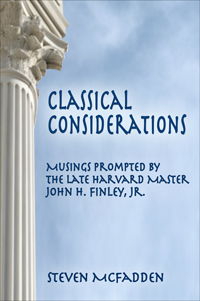 What does it mean to be a human being? What is the purpose of scientific knowledge, or any rational knowledge?
Understanding of what it means to be a Human Being – in any era of time and any place in the world – is a fundamental wisdom question contemplated in Classical Greece and Classical Native America, as well as hundreds of other traditions around the world.
Becoming a Human Being means rising above base instincts and emotions to reach a place of equanimity and integrity, to rise to an expanded level of consciousness and generativity.
For 51 years Professor John H. Finley, Jr. made the archetypal dilemmas of life compellingly relevant in the lecture halls of Harvard. In the pages of Classical Considerations, his story and his thinking unfolds.
Like shards of pottery, the fragments of Finley’s life and his beloved classics gathered in this digital volume allow readers to put some pieces together, and thereby to experience some of the insight and inspiration that he nurtured at Harvard.
Classical Considerations is available in 10 different eBook, Smartphone and computer formats at Smashwords.com, for Kindle through Amazon.com, and on all Apple devices through the iTunes and iBook stores.


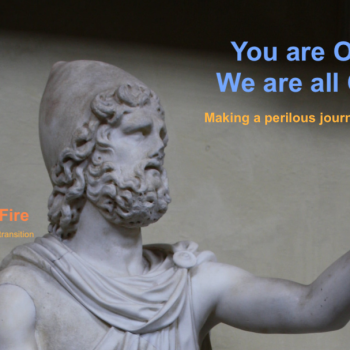 Your actual, real-time Odyssey parallels this Summer’s ‘blockbuster’ film
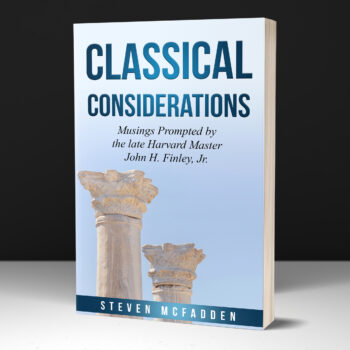 New and improved: Classical Considerations
 Behold the Light: Farms, Photons, Futures
 Our Collective Odyssey: Song and Story for the Generations Arising