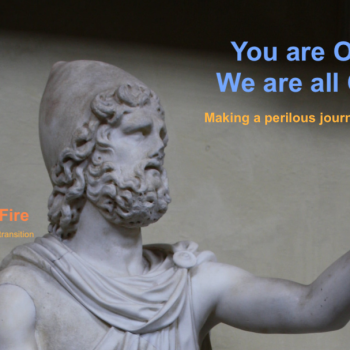
“Here is a concept from Iroquois cosmology which might explain many physical phenomena: Light has awareness, light has consciousness. Light has its own life.” — Doug George-Kanentiio, Akwesasne Mohawk

As we may clearly behold, in all ways light is both extrinsic and intrinsic to our lives.

BEHOLD THE LIGHT. Researchers have now created an image of a single photon.
Especially consequential in one key circle of considerations, light is a prime factor for land, farms, farmers, and food. We human beings need and eat a lot of light.
Back in 1905, the same year that Albert Einstein proposed the Theory of Special Relativity (E=MC2), he also identified what he called a “light quantum,” a single unit of light.
Today we call these basic, natural units of light, photons. As has recently come into focus, researchers have developed a theory that, astonishingly, made it possible to create an image of a single photon.
The theory that made this image possible, reported in the journal Physical Review Letters, enables scientists to calculate and understand more about photonic properties — opening a range of possibilities across fields such as quantum computing, and photovoltaic devices.
 As the atom is a fundamental unit of matter, so the photon is a fundamental unit of light. Yet photons display properties of both waves and particles. This quantum behavior of light is well established, with over 100 years of experiments showing that light can and does express in both particle and wave form.
Our understanding of this quantum nature has much further to go — the great contemporary adventure of exploring subtle realms previously regarded as purely mystical.
How do light and matter interact at the quantum level? That’s a question not just for theoreticians and technologists, but also for our ambassadors to the earth: the women and men who touch the earth on our behalf and grow the food we eat. Those who prepare the food with hands and tools also engage with light forces, consciously or unconsciously.
Thank you light workers
As has long been readily seen, various qualities of light are integral in nature as well as in technology. This is where the ideas explored in my book Deep Agroecology: Farms, Food, and Our Future come into focus. Through disciplines such as biodynamics, quantum agriculture, and real organics, pioneering farmers are gaining in their understanding and engagement with light forces. In this manner these pioneers enhance and enrich the land, our food, and our lives.
Some of these evolving approaches to working intelligently and skillfully with photon streams of light are considered in Chapter 4 of Deep Agroecology.
Biophotons—The sparks of light and life generated from within biological systems are called biophotons. They are used by and stored in all organisms, including the food we eat, the water we drink, the air we breathe, and our bodies—the physical temples in which our spirits dwell.
 You can imagine the ongoing, invisible biophotonic dance between us and the rest of the world. Take a relaxed breath and there it is.
When our food is vibrant with high-quality life energy (biophotons), that energy is absorbed and becomes part of us, in addition to the material substances of vitamins and minerals. Recognition and engagement with this reality for farmers and diners makes a subtle but important difference.
In matters biophotonic, of course, quality as much as quantity is consequential.
The importance of biophotonic life force, usually spoken of as basic life force, has been known for centuries around the world. In China it is referenced as chi, in Japan as ki. The Sanskrit term is prana. The Huichol people of the Sierra Madre mountains in the western states of Mexico speak of it as kupuri. Other native peoples of the Americas as well as around the world know it by other names. In recent decades, especially since the wide acceptance of acupuncture and Reiki with their understandings of human energy systems, Western science has increasingly recognized the reality of the animating life force.
Light and Life—Fritz Albert Popp was among the first Western investigators to theorize that this light must come, at least in part, from the foods we eat. The more light a food is able to store and to convey, the more nutritious it is. Naturally grown fresh fruits and vegetables, for example, are rich in biophotons.
Biophotons elevate an organism—such as your physical body—to a higher oscillation (vibe). If you eat fresh, clean food grown on healthy, natural, biophoton-rich land, you are supporting your body at a higher, healthier vibe.
That’s how I see the light. 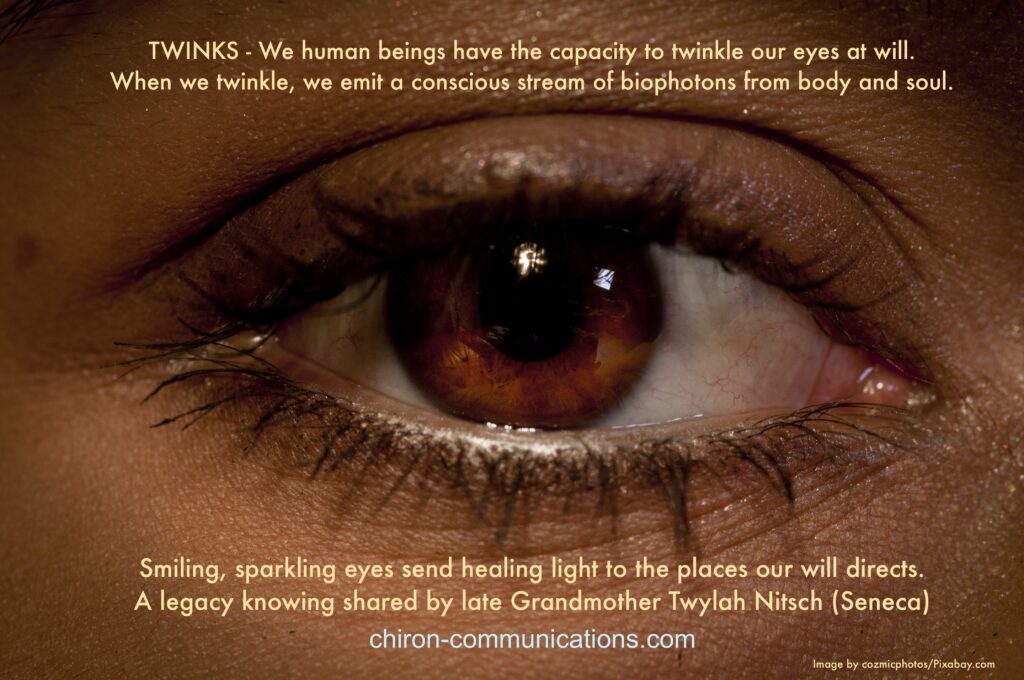
THANKS – and a bouquet of floral biophotons to M. Kelley Hunter of Helia Star for flipping the photon ON switch in her recent newsletter.


 Our community circle existed in time for just 91 minutes during Tierra Viva (Farming the Living Earth), the hemisphere-wide conference that was summoned into being by the
  practical and spiritual benefits arise for participants in CSA farming. CSA puts shareholders in greater tune with nature. This instinctual impulse to connect with the earth that sustains us is inherent in healthy people; consequently farming and gardening are healing and stabilizing for human beings, and of critical importance as we continue to face extreme and intensifying conditions in our digital era. Biodynamic principles and practices support and enhance all of this.
 “core groups” to create a strong and reliable network of farm support, similar to the way volunteer Boards of Directors serve food coops. While the CSA core group concept hasn’t been popular in CSAs in recent years, it does “take a village” to make a CSA work at the highest possible level. Considering the radically changing circumstances in climate, politics and economics, the core group model – drawing on collective intelligence and resources – is well worth re-considering.
 community awareness of environmental issues. CSAs connect people to the earth viscerally. Through that connection people become more firmly rooted in the places where they live and in the natural world, which supports life. Food is a binding impulse that can transcend political orientation. Food is an effective way to invite people into a real community conversation, and to combine their skills and resources to become more effectively and skillfully resilient in the face of the great challenges.
 mmunities often awaken late because of direct crisis, but they can also awaken from intelligent pursuit of models and opportunities. Dialogue can be a big factor in this; thus, it’s important to continue to articulate not just the economic and health dimensions of CSA farms, but also the social and ecological benefits.


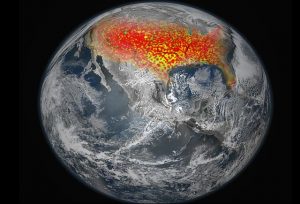 Our era is sharply marked by the mounting, menacing clouds of climate chaos, paralleled by dramatic and urgent shifts in global politics, economics, and social relations. Much more than a market strategy is required. I remain steadfast in my conviction that CSA can play a key role in addressing these issues. It’s time to expand exponentially the CSA vision and reality to hundreds of thousands of community farms around the world, and time also to evolve consciously the community and the associative economic dimensions of CSA.
 A rootstock is part of a plant, often an underground part, from which new above-ground growth can be produced. Grafting refers to the process by which a plant, sometimes just a stump with an established root system, serves as the base onto which cuttings (scions) from another plant are joined.
 Is there, or could there be, a biodynamic preparation that aids, nurtures and supports the grafting of the world’s wide array of cultural and agricultural traditions to the native rootstock and wisdom ways so inseparably a part of North America?