Renowned orator Oren Lyons looked all of his venerable 96 years as he sat with a panel of esteemed native elders for a lecture yesterday. Having traveled the world for decades sharing traditional wisdom ways, he mentioned that he felt very natural and at home in Santa Fe, New Mexico. The afternoon program proved he was still in possession of his compelling rhetorical medicine.
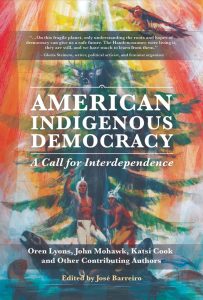 “I’m not done yet,” Lyons remarked, signaling that even after nine-and-a-half decades of life, he knows he has more work to do. Then the panel discussion got underway at the New Mexico History Museum. The elders began to share, engaging their good minds, and the good minds of the audience, in an exploration of American Indigenous Democracy — the title of an important new book.
“There was no democracy on the Niña, the Pinta, and the Santa Maria*,” Lyons observed about the explorations of Christopher Columbus. “Democracy didn’t arrive here on a boat. It was already here.”
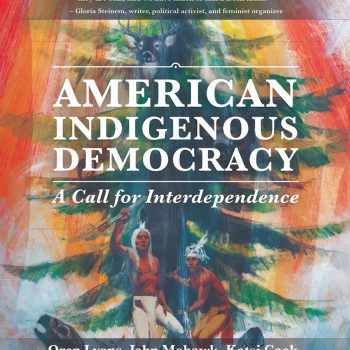
The new book, edited by Jose Barreiro, offers an array of insights on democracy with chapters from elders, wisdom keepers, scholars, and advocates. It explores the enduring political philosophy of the Haudenosaunee Confederacy (Iroquois), and its relevance to the defining challenges of our moment in history.
The elders’ messages about democracy come during the 250th anniversary of Declaration of Independence by the United States, a time when the basic tenets of American democracy are under direct threat from rapacious fascist forces — a threat widely regarded as an emergency for the health of democratic forms of government.
American Indigenous Democracy argues that in many cases indigenous democratic principles fit our times and offer a more holistic, spiritually grounded, and equitable model for modern democracy. The principles, they argue, can help re-humanize government and public life in America.
The book these elders are offering to the public explores checks and balances, consensus decision-making, women’s leadership and matrilineal structures, and interdependence (a shift from individualism to a communal, interconnected model of society and governance, with respectful recognition of the natural world).
Stepping forward at a time of democratic crisis, these indigenous elders of the Americas call for active, healthy reconsideration of democracy. They offer insight and understanding into the actual roots of democracy in the Americas; and they propose that those roots, if grasped anew, have potential to help rescue and to enrich the national soul with servings of philosophical, political, and cultural nourishment.
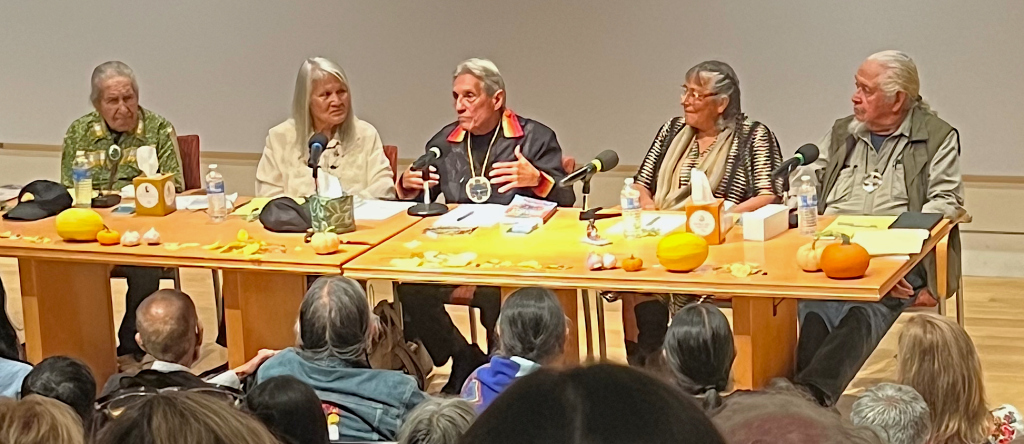
ELDERS DISCUSS DEMOCRACY – (L to R) Oren Lyons, Katsi Cook, Jose Barreiro, Roxanne Swentzell, Bob Haozous (photo by S. McFadden)
- The actual, original names of the three ships in the Columbus expedition were: la Santa Clara, la Pinta, and la Santa Gallega. According to the Christian Science Monitor, the crews gave each ship nicknames. “La Santa Clara became la Niña (“the girl”); la Pinta became la Pintada (“the painted one,” in other words, “the prostitute”); and la Santa Gallega became Maria Galante (the name of another prostitute). The church censored these nicknames, but the way we remember them today borrows heavily from the crews’ vernacular.”