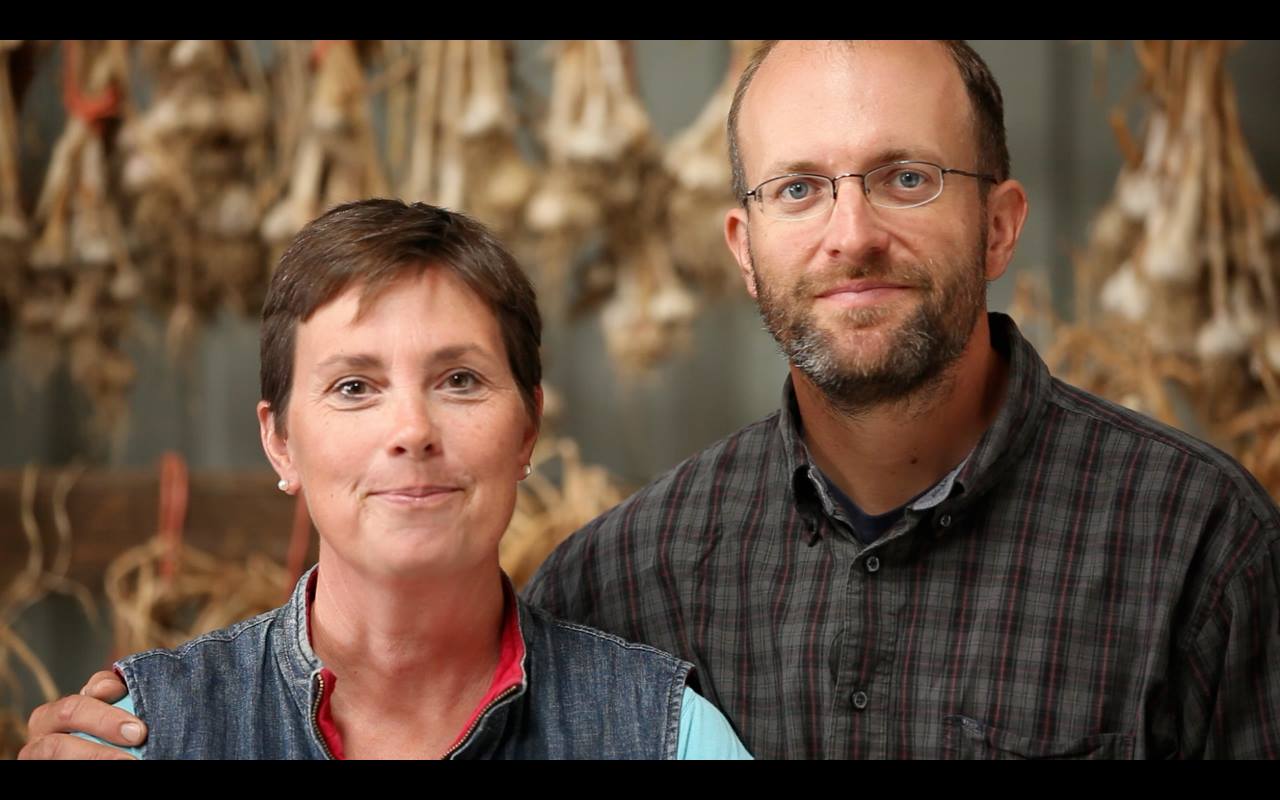
Evrett Lunquist and wife Ruth Chantry, parents of five children, own and operate Common Good Farm in Nebraska. They produce for a CSA and the market: herbs, vegetables, free-range eggs, grass-fed beef, and pork. Photo courtesy of Open Harvest Coop Grocery.
On December 7, 2011 the USDA’s National Organic Program (NOP) inadvertently violated its own policies and released the name of a Nebraska man who had accurately reported a farmer who was flouting the legally binding organic rules.
In so doing, the NOP unleashed upon Evrett Lunquist a multi-year plague of legal pleadings, and a barnload of legal expenses to defend himself.
After his name was released in response to a request under the Freedom of Information Act, the man who correctly reported the violations, Biodynamic farmer and part time inspector Evrett Lunquist, was sued for $7.6 million in a Nebraska Court by Paul A. Rosberg, the vengeful farmer who had violated organic rules. Later in the proceedings, International Certification Services was added as a defendant.
After more than 18 months of tedious hearings and a numbing cascade of motions filed by the plaintiff, Lancaster County Judge Paul D. Merritt finally in August 2013 issued a summary judgment dismissing the case.
 After the expensive ordeal of defending himself against the allegations unleashed by the NOP’s procedural error, Lunquist, who followed the letter of the law acting as a private citizen when he initially reported the violations, had racked up more than $43,000 in legal expenses. While he received no support or acknowledgement of responsibility from the NOP, he and his family did find generous support from their church and their community. I have previously reported on this case both here and here.
 This convoluted case calls into question the ability of the USDA and its National Organic Program (NOP) to stand behind citizens and inspectors who report violations of organic standards. Consequently, the case has sent a palpable chill through America’s network of organic inspectors, and may thereby compromise consumer confidence in the integrity of the USDA’s “Certified Organic” label. Meanwhile, another kind of food certification — Certified Naturally Grown — is emerging….
The rest of this story is on my blog for The Call of the Land. – Steven M.







 As we move on into the new century and a new millennium, CSA is still generally regarded as outside the box of conventional agriculture. Yet from the vantage that is indigenous to our land, CSA is respectfully within the Sacred Hoop, a traditional philosophical concept of Turtle Island (North America) for 12,000 years or more.
 In many respects CSA embodies and expresses the original Native American social and environmental ethos, the Sacred Hoop. The Sacred Hoop is a metaphor for a core concept, or worldview, encompassing a host of subtleties and paradoxes.
 The indigenous concept of the Sacred Hoop closely corresponds with what modern scientists are glimpsing about the nature of reality through the theories of Relativity, Quantum Mechanics, Uncertainty, and Superstrings.
 The Algonquin words Manitou and Gitchee Manitou describe a similar, if not the same, understanding. They refer not a Supreme Being, as in Western spiritual conceptions, but rather to a cosmic, mysterious power existing everywhere in nature, and connecting all things.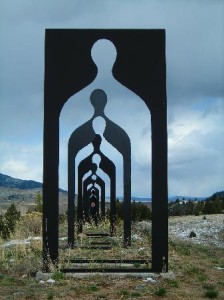
 Our first book contained basic essays on new structures for community supported farms which acknowledged that farming is not just a business like any other profit-making business, but a precondition of all human life on earth, and a precondition of all economic activity. As such, farming is everyone’s responsibility, and has likewise to be accessible for everyone. Emerging awareness of this reality was, we felt, steadily inspiring the creation of CSAs: new farms for a new time. The millennium, after all, lay just 10 years ahead.
 As a journalist, I’m the author of a range of
  A
A 



 The book describes a wide range of models – creative 21st Century agrarian responses – to the urgent call of our land. The full title of the book tells the story –