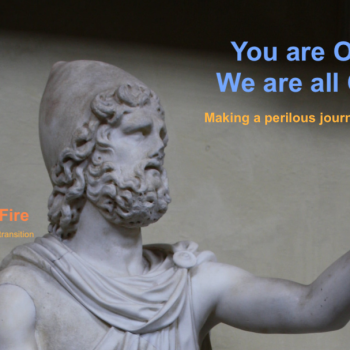
“What they greatly thought, they nobly dared.” – Homer, the Odyssey
 Right now a small band of women from the Ojibwe native nation is walking in prayer from the source of the Mississippi river at Lake Itasca in the North, to the point where the great river spills into the sea at the Gulf of Mexico.
They sang the Water Song as they began on March 1, and they are by now well into Iowa and walking on.
If you would like to follow the Mississippi River Walkers, you can friend them on their Facebook page, a page which is growing as the walkers make their way to the south, stopping at key points along the way to offer ceremonial blessings.
As I read about the powerful spiritual deed of these sisters, I was reminded of the 8-month long epic walk from sea to sea in 1996-96 guided by the late Algonquin teacher, Grandfather William Commanda – the Sunbow Walk many know as the Odyssey of the 8th Fire.
 The wind spiked out over Cape Cod Bay, frothing the blackened waters into angry, spitting caps. A great, bitter wind was upon the land and the sea. Still, the people came. In the face of icy needles cast by the unrelenting gale, 40 people broke from their cars into a wild, scattered search for a place with a scrap of windbreak. They needed protection, for they had arrived to light a sacred fire at First Encounter Beach, just five years before the Millennium.

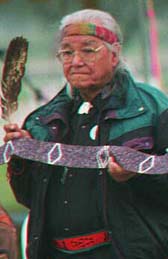
 A belt of beads is the traditional Algonquin device employed to record the solemn and binding agreement they entered into in 1793 with the US and Great Britain. This was a time when the newly formed government of the United States was defining its corporate existence upon Turtle Island and the Canadian nation did not yet exist. Native nations were full and equal partners to the treaty, with the same standing as the United States and Great Britain. But the Algonquins did not use black marks upon paper to keep important records; they used beads woven into beautiful, long-lasting belts.
 Snyder revealed himself as one the many elders we had set out to find on
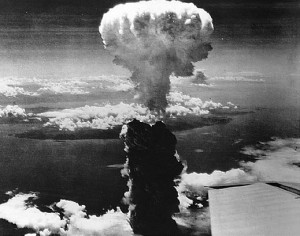 The fire that was ignited 57 years ago on August 6, 1945 when the Enola Gay dropped the first atomic bomb on Hiroshima, Japan, was ceremonially extinguished by a band of pilgrims May 27, 2002 at Big Mountain on Black Mesa in Arizona, in a high desert range sweet with the smell of sagebrush.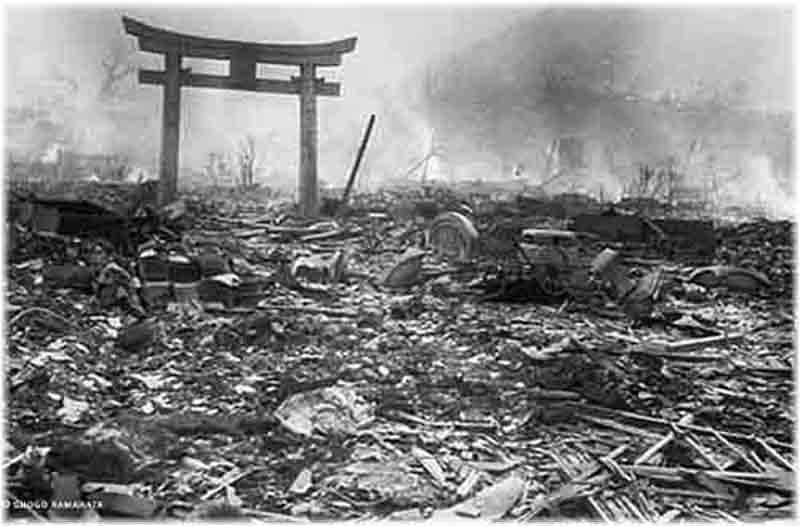


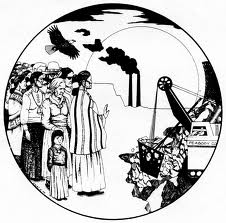 The assault on the material resources of Black Mesa continues. Peabody Coal Co. is planning on expanding operations by opening a new mine, which will ultimately infringe upon Big Mountain itself.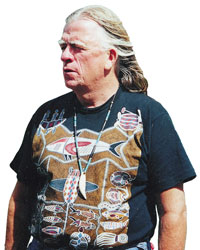
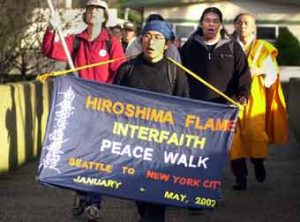 The Hiroshima Flame Interfaith Pilgrimage had its origins in the year 2000 under the inspiration of Tom Dostou while he was in Japan. At that time he was entrusted with a spark of the Hiroshima Flame (the source flame remains burning in Japan). Tom conceived the vision of returning the flame to where it had come from — not as a protest, but as a necessary deed of spiritual redemption, because not only the people of Hiroshima had died, but also many native peoples were poisoned by the uranium dug up, without spiritual permission, on their lands.

 The flame, flickering in a lantern borne by pilgrims on foot, was largely unrecognized and unacknowledged in Los Alamos. Still, the pilgrims completed the work of spiritual redemption they had come to accomplish, and then they walked on toward the East, planning to arrive in New York City on May 12, 2002. Their visit to this place of fire is of marked spiritual significance.
 In the beginning, it is said, the four nations lived together as one and shared their gifts. Then came a time when it was necessary for spiritual growth that the Four Nations disperse to the Four Directions and live apart. Over time they could develop as human beings and master the mysteries of their element for good or ill, according to their free will. Earth, air, fire and water — the peoples went apart.
 The flame the pilgrims carry was ignited 57 years ago and has been tended with prayer ever since. In1945, after the atomic bomb was dropped on Hiroshima, Japan, a man named Tatsuo Yamamoto walked into the ruins of the city to look for friends and family. In shock and anger, he collected some of the embers still smoldering from the bomb and carried them home.
 The nuclear bomb is an ultimate expression of materialism. When the atomic scientists of Los Alamos took the secret of the atom — the fundamental particle of matter — and developed it into a weapon of mass destruction, they unleashed a scathing, wrathful demon of fire rather than a higher angel of warmth and illumination.
 The glyph was carved into the rock face of the outcropping thousands of years ago by the indigenous Pueblo peoples, whose descendents still live nearby. There are such petroglyphs all over North America, serving as signs and signals of importance to native peoples.
 From the place of Avanyu, the walkers proceeded — drumming and chanting each step — about seven miles to Tsankawi, a prehistoric site that is now part of Bandelier National Monument. Tsankawi is a spectacular place high on a mesa overlooking the Jemez Mountains to the West and the Sangre de Christo Mountains to the East.
 The wind people, the messengers, brought the flame home to its point of origin, having purified it with their chants, prayers and incense. They offered it to the people of the city without rancor, recrimination, or challenge. They offered the flame with understanding and hope. And then they walked on.
 Also on that day, to sound an alarm about the rapidly growing danger of a nuclear conflagration, the Bulletin of Atomic Scientists moved their famous Doomsday Clock forward two minutes closer to midnight. The scientists wanted to highlight the dramatically mounting dangers of political instability, the wide availability of nuclear materials, terrorism, and the aggressive unilateral stance of the US government.
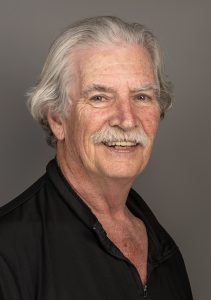 Welcome to Chiron Communications, a conceptual umbrella to unify my diverse work as writer, storyteller, and healer. My name is Steven McFadden, and my passion is casting light upon keys that may serve the health of human beings and the earth we share.