 Academia.com recently reviewed my book, Deep Agroecology: Farms, Food and Our Future. They rendered their review in a five-minute podcast. You can listen to it by clicking below on the start arrow for the MP3 recording.
Their AI-generated Abstract
Steven McFadden’s book Deep Agroecology: Farms, Food, and Our Future presents a blend of spiritual and scientific perspectives on agroecology.
The book argues for the inseparable connection between agroecology and the survival of the Earth, emphasizing a holistic approach that integrates the physical and spiritual realms within food systems.
Through a critical analysis of modern agricultural practices and historical contexts, McFadden advocates for a shift towards sustainable agroecological methods, which he posits as essential for addressing ecological crises and fostering an intentional relationship with nature.
The book suggests that by seeking deeper knowledge and connection with our food and farm sources, we don’t just eat better, we participate in much bigger, far more consequential healing deed as our life-sustaining Planet Earth passes through an era of tremendous challenge.
Click on the start arrow to listen to the brief podcast review:
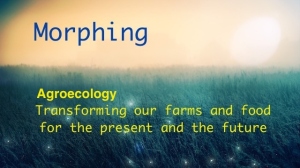
This is a rendering of an AI poster for the book, also from Acdemia.com. In my view it is just kind of ok, but one statement is way off the mark. AI claims the book “advocates for the fusion of human and non-human life.” What? I never wrote that, never even thought it. Dangerously wrong “wishful thinking” on the part of AI.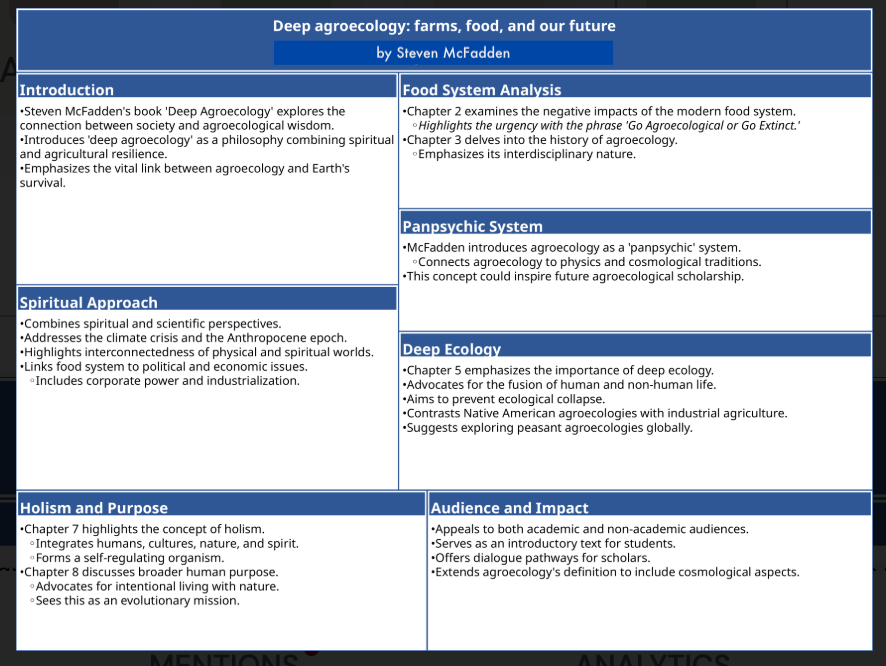


 As it happens there’s a great debate underway about that system—about the people, values, politics, and profits that influence our farms, our people in the fields and packing houses, our farm animals, and ultimately our food and our health. That debate will reach a crescendo this coming October at the UN’s global



 “Deep agroecology” is “our next natural, intelligent, and necessary evolutionary step” for a better, cleaner, healthier, more just world through the transformation of agriculture from an industrialized and chemicalized agribusiness model to a holistic approach which supports a culture of respect for the earth and all life on it; a culture in which farmers are our heroes. An extensive list of resources is included and a subject index is provided.


 We will define our destiny by the ways we farm, and the ways we eat.
 The United Nations has declared the years 2019-2028 to be the “Decade of Family Farming.” With this declaration the UN intends to create opportunities for people to transform existing food systems around the world so they are clean, sustainable, and just both economically and socially.
 LINCOLN, NEBRASKA—Inspired by a casual conversation with a UNL professor of agronomy and agroecology in 2012, independent journalist Steven McFadden penned the new title