Gallery I. Gallery II. Gallery III. Gallery IV. Gallery V. Gallery VI. Gallery VII. Gallery VIII. Gallery IX. Gallery X.
May you scroll in beauty.


“Here is a concept from Iroquois cosmology which might explain many physical phenomena: Light has awareness, light has consciousness. Light has its own life.” — Doug George-Kanentiio, Akwesasne Mohawk

As we may clearly behold, in all ways light is both extrinsic and intrinsic to our lives.

BEHOLD THE LIGHT. Researchers have now created an image of a single photon.
Especially consequential in one key circle of considerations, light is a prime factor for land, farms, farmers, and food. We human beings need and eat a lot of light.
Back in 1905, the same year that Albert Einstein proposed the Theory of Special Relativity (E=MC2), he also identified what he called a “light quantum,” a single unit of light.
Today we call these basic, natural units of light, photons. As has recently come into focus, researchers have developed a theory that, astonishingly, made it possible to create an image of a single photon.
The theory that made this image possible, reported in the journal Physical Review Letters, enables scientists to calculate and understand more about photonic properties — opening a range of possibilities across fields such as quantum computing, and photovoltaic devices.
As the atom is a fundamental unit of matter, so the photon is a fundamental unit of light. Yet photons display properties of both waves and particles. This quantum behavior of light is well established, with over 100 years of experiments showing that light can and does express in both particle and wave form.

Our understanding of this quantum nature has much further to go — the great contemporary adventure of exploring subtle realms previously regarded as purely mystical.
How do light and matter interact at the quantum level? That’s a question not just for theoreticians and technologists, but also for our ambassadors to the earth: the women and men who touch the earth on our behalf and grow the food we eat. Those who prepare the food with hands and tools also engage with light forces, consciously or unconsciously.
As has long been readily seen, various qualities of light are integral in nature as well as in technology. This is where the ideas explored in my book Deep Agroecology: Farms, Food, and Our Future come into focus. Through disciplines such as biodynamics, quantum agriculture, and real organics, pioneering farmers are gaining in their understanding and engagement with light forces. In this manner these pioneers enhance and enrich the land, our food, and our lives.
Some of these evolving approaches to working intelligently and skillfully with photon streams of light are considered in Chapter 4 of Deep Agroecology.
Biophotons—The sparks of light and life generated from within biological systems are called biophotons. They are used by and stored in all organisms, including the food we eat, the water we drink, the air we breathe, and our bodies—the physical temples in which our spirits dwell.
You can imagine the ongoing, invisible biophotonic dance between us and the rest of the world. Take a relaxed breath and there it is.
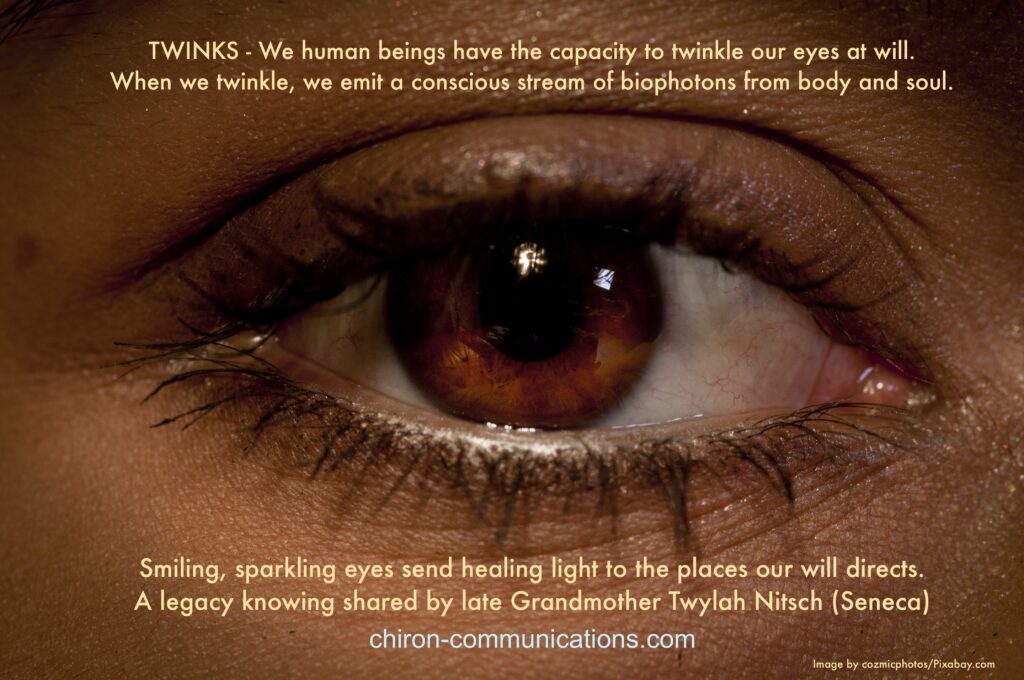
When our food is vibrant with high-quality life energy (biophotons), that energy is absorbed and becomes part of us, in addition to the material substances of vitamins and minerals. Recognition and engagement with this reality for farmers and diners makes a subtle but important difference.
In matters biophotonic, of course, quality as much as quantity is consequential.
The importance of biophotonic life force, usually spoken of as basic life force, has been known for centuries around the world. In China it is referenced as chi, in Japan as ki. The Sanskrit term is prana. The Huichol people of the Sierra Madre mountains in the western states of Mexico speak of it as kupuri. Other native peoples of the Americas as well as around the world know it by other names. In recent decades, especially since the wide acceptance of acupuncture and Reiki with their understandings of human energy systems, Western science has increasingly recognized the reality of the animating life force.
Light and Life—Fritz Albert Popp was among the first Western investigators to theorize that this light must come, at least in part, from the foods we eat. The more light a food is able to store and to convey, the more nutritious it is. Naturally grown fresh fruits and vegetables, for example, are rich in biophotons.
Biophotons elevate an organism—such as your physical body—to a higher oscillation (vibe). If you eat fresh, clean food grown on healthy, natural, biophoton-rich land, you are supporting your body at a higher, healthier vibe.
That’s how I see the light. 
THANKS – and a bouquet of floral biophotons to M. Kelley Hunter of Helia Star for flipping the photon ON switch in her recent newsletter.
This blog post marks the 30th anniversary of the suspended steps of the Sunbow 5 Walk for the Earth (aka Odyssey of the 8th Fire). Those historic steps were pressed into shifting beach sands on February 2, 1996, several miles downcoast of North America’s anciently honored Western Gate on the shore of the Pacific Ocean.
For reasons related to our current moments in time, that long-ago multicultural, multifaith sunbow odyssey remains relevant, resonant, and incomplete.

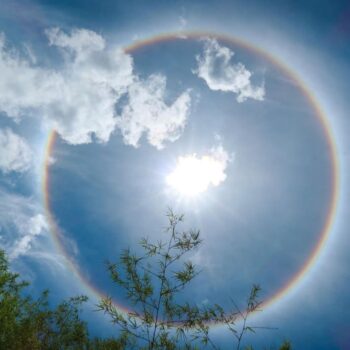
Whirling Rainbow (sunbow)
The sunbow pilgrimage followed the path of the Sun from east to west—in ways similar to the celebrated Walk for Peace now underway from west to east. It serves as metaphor and example for all of us right now as we swiftly progress through turbulence into a new time. Choose it or not, we’re all on personal and collective pathways of change. We’ve been cast onto an uncertain cultural, economic, governmental, environmental, and spiritual journey – an odyssey of our individual and collective souls.
Where are we going? Visions will lead the way, as ever. With cold, dry, controlling visions authored by billionaire techno-bullies now predominating—and hope declining grievously among younger people—we need healthy visions. The true North American story of the 8th Fire represents one such vision: a vision arising from the deepest roots of our land, a vision that embraces and honors all the healthy possibilities inherent in the different colors and faiths of people who have come to inhabit Turtle Island (North America). There are miles to go for all, and many more sparks to be struck.
To mark this 30th anniversary of our long walk, I’ve added singing and orchestration to the Invocation for Odyssey of the 8th Fire. With respect, I invite you to check out my venerable (2007) story-telling web site, and to listen. Epilogue coming later this year. < 8thFire.net >
Nota Bene: The heroic journey-odyssey theme is very much front and center culturally. Check out the trailer for Christopher Nolan’s new film, The Odyssey, set for release as a summer blockbuster, July, 2026.

![]()
Academia.com recently reviewed my book, Deep Agroecology: Farms, Food and Our Future. They rendered their review in a five-minute podcast. You can listen to it by clicking below on the start arrow for the MP3 recording.
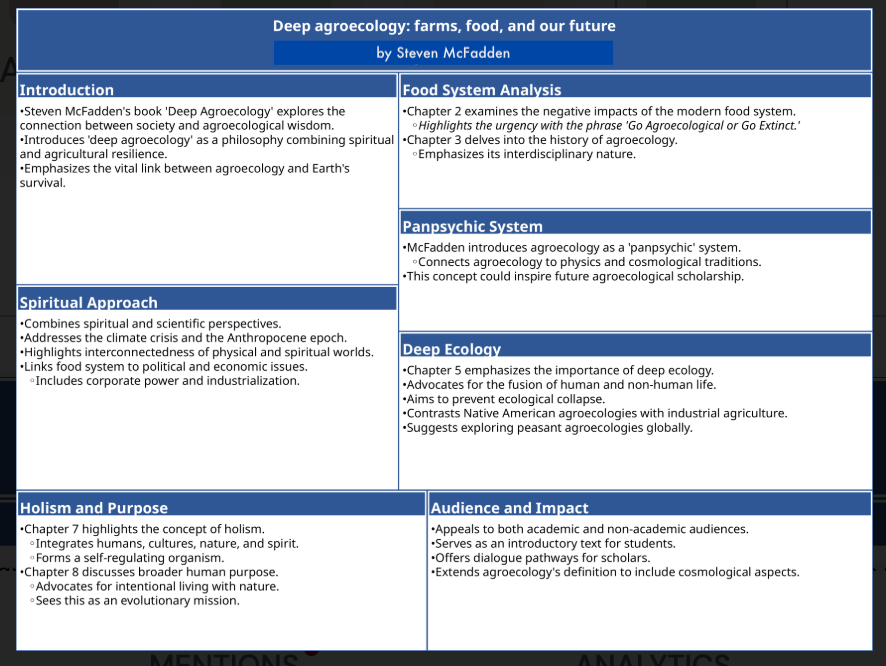
Their AI-generated Abstract
Steven McFadden’s book Deep Agroecology: Farms, Food, and Our Future presents a blend of spiritual and scientific perspectives on agroecology.
The book argues for the inseparable connection between agroecology and the survival of the Earth, emphasizing a holistic approach that integrates the physical and spiritual realms within food systems.
Through a critical analysis of modern agricultural practices and historical contexts, McFadden advocates for a shift towards sustainable agroecological methods, which he posits as essential for addressing ecological crises and fostering an intentional relationship with nature.
The book suggests that by seeking deeper knowledge and connection with our food and farm sources, we don’t just eat better, we participate in much bigger, far more consequential healing deed as our life-sustaining Planet Earth passes through an era of tremendous challenge.
Click on the start arrow to listen to the brief podcast review:
This is a rendering of an AI poster for the book, also from Acdemia.com. In my view it is just kind of ok, but one statement is way off the mark. AI claims the book “advocates for the fusion of human and non-human life.” What? I never wrote that, never even thought it. Dangerously wrong “wishful thinking” on the part of AI.


Ga
As cloaks of summer heat settled upon most of North America, and storms raged severe in sky, land, and sea, I happened upon a 2020 academic review of Deep Agroecology.
I’d missed the review at the time, as I was reckoning that year with the passing of generational elders, and also a household move from Nebraska back to the mountains of the Southwest. But I’m happy to have come upon the review now, some four years later. I needed to hear a familiar chord sounded again.
Reading the analysis reminded me of the perilous realities that had driven the writing of the book, realities that had gone into soft focus for me since publication five years ago. That came about as, after the year of transition, I became intent on completing another writing project, the biography of Iina’bi’ho spiritual elder Leon Secatero (1943-2008). That book is moving toward completion.
The 2020 review of Deep Agroecology was written by Hannah Kass, Ph.D and published in the journal Food, Culture & Society. What sparked me in reading the review was her proficient description of my book’s goal: to state plainly the crucial knowledge that agroecology has to offer to the general public, and to sound a call for wide, strategic implementation in our era of mounting perils.
Professor Charles A. Francis (U. Nebraska) suggested the deep agroecology theme to me around 2012. After seven years of study and contemplation what emerged was not so much the expression of a personal vision, but rather the synthesis of a chorus of learned voices. Together they express an evolving vision—a strategic vision—shared by millions of people around the world. Deep Agroecology is my effort to articulate that compelling vision, along with a host of healthy pathways that can lead toward a just, sustainable, and spiritually elevated future.
Despite appearing as an academic concept, agroecology is altogether of the people and the earth: of the way we live on the land, and the way we give and receive sustenance with the earth. As we are at a point of peril, and our farm and food foundations are in critical transition, I wrote Deep Agroecology for the people—for all the people.
In her book review, Kass noted: “Using the framework of extinction and evolution to explain deep agroecology’s spiritual purpose, McFadden aptly demonstrates the inextricability of physical and spiritual worlds in the food system…He connects these worlds to the political economy of food, pointing out the climate’s ties to the intersecting problems of corporate power, industrialization and rural dispossession.”
Agroecology offers a wide array of sensible, sustainable, just, and strategically intelligent pathways to sustain our civilizations, and help them to progress in ever-wiser way.
Terra Madre – We Are Nature
One place where the theme of agroecology will resonate with power and beauty is at this years 20th anniversary Tierra Madre global food community gathering in Turin, Italy (Sept. 26-0).
The 2024 theme is “We Are Nature.” As a key part of the proceedings, the conference is establishing a spectacular space dedicated to agroecology: “an alternative food system paradigm that counters industrial agriculture…It is rooted in the reconstruction of relationships between people, agriculture and environment, food systems and society.”
![]()
In a thought-provoking essay published in 1990, Wendell Berry asked, “What are people for?” Now more than three decades later, with the aggressive incursion of artificial intelligence (AI) into our lives, Berry’s rhetorical question takes on added magnitude.
What does it mean to be human in the Age of AI? Especially if the craft, trade, or profession you mastered is rendered irrelevant by “intelligent machines.”
Meanwhile…In our moment of history, with the aid of AI, enormous industrial, chemical, GMO infused agri-corporations are continuing to subsume and to overshadow food systems, while colossal billion-buck investment firms continue to hoard farmland. This commercial juggernaut of consolidation and concentration for greater profit brings a second question into focus: What are farms for?…
Note: the rest of my essay is located on my dedicated blog for DEEP AGROECOLOGY. Click here to read the rest.
As the pace of world transition intensifies, I’m moved to once again articulate in direct language my understanding of the vision held by millions of people around the world: the vision of agroecology.
Thus, I offer below a two-minute slide show with words and images characterizing some basic elements of the agroecological vision, and also offering a glimpse at how deep agroecology embraces the vision, then endeavors to explore further into positive possibilities.
Note: The slides are set at 7-second intervals. You can start and stop the presentation by using the slide at the bottom.


In 1993 I had the honor of serving as National Coordinator for the annual Earth Day USA observation. When appointed to the position, I reached out to the Seventh Generation Fund. We formed a project partnership, and together we developed a plan and a protocol for community council circles.
People came together with their neighbors in a respectful matter to talk about something they (and their children) all have a stake in: the health of the earth, their responsibilities, and their opportunities.
That year Earth Day was marked with formal Council Circles in over 500 US and Canadian communities, a host of other activities from the Boston Esplanade to the Winnebago Reservation in Nebraska, and circles along the Pacific shore.
Now, 29 years later, the materials are still relevant for all kinds of communities. They describe a way to bring people together in a respectful and positive manner.
To access the guidelines and protocol for hosting a community Council Circle (on Earth Day or any day), follow this link then scroll down to where you see the scanned copies of the original typewritten documents.
Council Circles remains a powerful tool for any group of people needing to address serious issues. The circles function as a perennial way of democratically developing and engaging community wisdom and strength.
![]()
Your actual, real-time Odyssey parallels this Summer’s ‘blockbuster’ film
New and improved: Classical Considerations
Behold the Light: Farms, Photons, Futures
Our Collective Odyssey: Song and Story for the Generations Arising