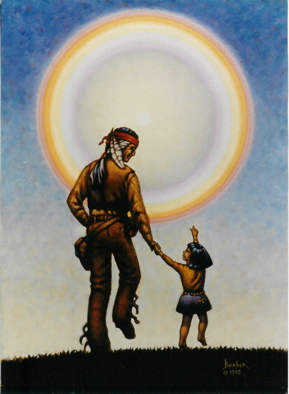
Walking under the sign of the Whirling Rainbow
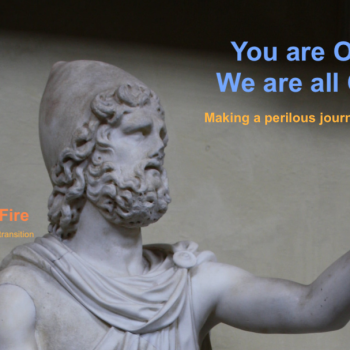
Nineteen years ago today – June 23, 1995 – a small band of pilgrims set out walking from the Atlantic to the Pacific on an epic journey that I have come to regard, and to write about, as the Odyssey of the 8th Fire.
The saga of their journey is well worth knowing, for it remains critically relevant to the journey all of us are making now through an era of profound change upon our Earth.
As well as the tale of the pilgrims’ travels on foot across Turtle Island (North America), Odyssey of the 8th Fire is the essential story of their meetings with dozens of traditional, learned elders of North America. They gifted the pilgrims with messages to deliver to all the people.
Reading Odyssey of the 8th Fire online is a demanding quest. The story is exceedingly long. Because of this, and because many of the elders who are part of the story noted that their teachings take both time and attention to understand, I recommend this literary pilgrimage be undertaken step by step, over a span of eight months or so.
Odyssey consists of a lengthy Prologue, and then 225 accounts, one for each day of travel. Those journal entries are ordered chronologically.
By engaging this online account of the epic walk one day at a time, a reader can make a steady eight-month literary and spiritual pilgrimage from East to West across Turtle Island (North America). The journey proceeds place to place, elder to elder, teaching to teaching.

“I ask you to listen not just with your minds. I ask you to listen with your hearts, because that is the only way you can receive what it is — what we are giving. These are the teachings of our hearts.
“This walk is going to take eight or nine months. There are lots of elders out there across Turtle Island, and they have many beautiful teachings, many teachings that all the people need now. It is our hope, it is our prayer that they will come forward now that the Eastern Door is open
“It is our prayer that they will meet us as we walk; that they will teach and share what they understand from their hearts. Be patient. Listen to the elders. You need patience to receive these teachings. It doesn’t all come at once. You need patience.”
– Frank Decontie, Algonquin – June 23, 1995 – First Encounter Beach, Massachusetts







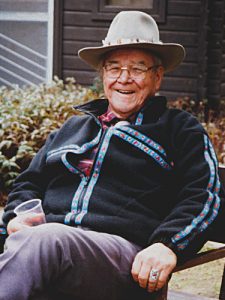
 The wind spiked out over Cape Cod Bay, frothing the blackened waters into angry, spitting caps. A great, bitter wind was upon the land and the sea. Still, the people came. In the face of icy needles cast by the unrelenting gale, 40 people broke from their cars into a wild, scattered search for a place with a scrap of windbreak. They needed protection, for they had arrived to light a sacred fire at First Encounter Beach, just five years before the Millennium.

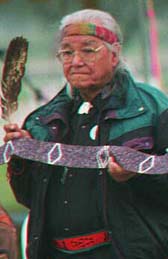
 A belt of beads is the traditional Algonquin device employed to record the solemn and binding agreement they entered into in 1793 with the US and Great Britain. This was a time when the newly formed government of the United States was defining its corporate existence upon Turtle Island and the Canadian nation did not yet exist. Native nations were full and equal partners to the treaty, with the same standing as the United States and Great Britain. But the Algonquins did not use black marks upon paper to keep important records; they used beads woven into beautiful, long-lasting belts.

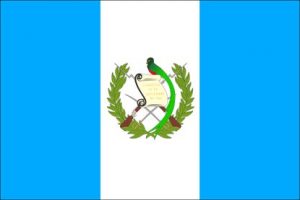 When the war finally wound down in the 1990s, the United Nations Truth Commission conducted an 18-month investigation.* The UN found massive violations of human rights by the government of Guatemala with the complicity of the US government. The UN report stated that acts of “aggressive, racist and extremely cruel” violence descended to the level of genocide directed against the country’s indigenous Mayan population.
 Carlos Barrios says he was born into a Spanish family on El Altiplano, the highlands of Guatemala. His home was in Huehuetenango, also the dwelling place of the Maya Mam tribe. With other Maya and other indigenous tradition keepers, the Mam carry part of the old ways on Turtle Island (North America). They are keepers of time, authorities on remarkable calendars that are ancient, elegant and relevant.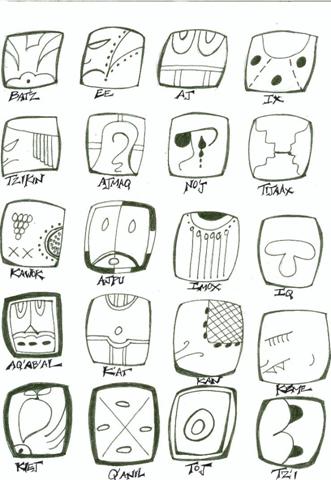
 From his understanding of the Mayan tradition and the calendars, Mr. Barrios offered a picture of where we are at and what may lie on the road ahead:
 As he met with audiences in Santa Fe, Mr. Barrios told a story about the most recent Mayan New Year ceremonies in Guatemala. He said that one respected Mam elder, who lives all year in a solitary mountain cave, journeyed to Chichicastenango to speak with the people at the ceremony.

 When our Star appears in the East (about 4:00 AM), the mounds for 12 staffs will be marked and put in a circle with an opening to the East. All nations represented with a staff will circle around the center fire for the entrance of the sacred pipes, to be placed in the Four Directions with prayer and song.
 Honoring the Sacred Path for the Five Finger Ones will be done with a Mountain Song, ending with the Blessing Way. The prayer sticks will be taken to the mountain spirits for their guidance and wisdom, as our journey begins here.