Reviewed by Steve Leshin for Readers’ Favorite
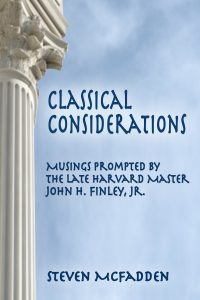
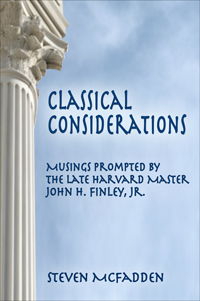
Classical Considerations by Steven McFadden brings focus to the ancient Greek philosophers and culture that have influenced our modern society in the arts, mathematics, politics, and philosophy. This is accomplished by introducing the reader to the lectures of Harvard professor John H. Finley, Jr., a popular classicist who taught a generation of men at Harvard how to live through his courses, none more popular than Humanities 103 – the Great Age of Athens.
 McFadden picks a good sample of Finley’s lectures beginning with a short discourse on Diogenes, the ancient Greek who wandered the streets of Athens carrying a lighted lamp in daylight. When asked why, most people assumed it was to look for an “honest man”. It was really to look for a “human being.” What this means is explained by the late professor in clear and engaging language.
Classical Considerations gives a good sampling of Professor Finley’s lectures and the reader will learn as well as appreciate his knowledge and how the study of ancient Greece is very relevant in our world of the present day. Steven McFadden gives his personal insight and how he formed a friendship with John H. Finley, Jr. after he retired in the 1970s.
I, for one, hope to look at Finley’s study of the Odyssey by Homer. I recommend this book to anyone with an appreciation of Professor Finley and to those who seek knowledge of how to be a human being through the Greek classics.

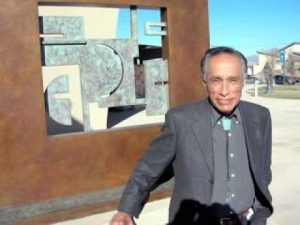
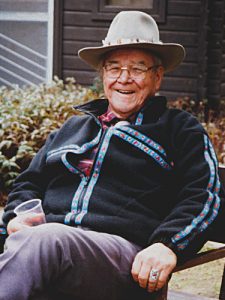
 The wind spiked out over Cape Cod Bay, frothing the blackened waters into angry, spitting caps. A great, bitter wind was upon the land and the sea. Still, the people came. In the face of icy needles cast by the unrelenting gale, 40 people broke from their cars into a wild, scattered search for a place with a scrap of windbreak. They needed protection, for they had arrived to light a sacred fire at First Encounter Beach, just five years before the Millennium.
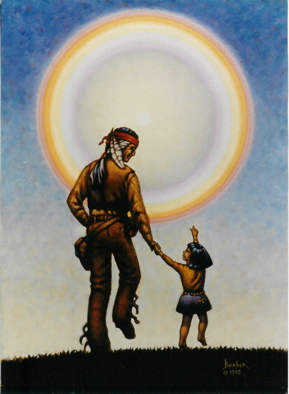

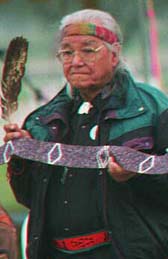
 A belt of beads is the traditional Algonquin device employed to record the solemn and binding agreement they entered into in 1793 with the US and Great Britain. This was a time when the newly formed government of the United States was defining its corporate existence upon Turtle Island and the Canadian nation did not yet exist. Native nations were full and equal partners to the treaty, with the same standing as the United States and Great Britain. But the Algonquins did not use black marks upon paper to keep important records; they used beads woven into beautiful, long-lasting belts.


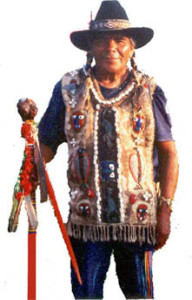 An elder of the Yaqui Indian Nation, and a Nahual (man of power), Cachora has remained a mystery figure for decades. But now he is coming forward from his homeland in the Sonoran Desert of Mexico into the public realm. It is time for this, he says. Chachora says says he is the real man who is portrayed as the enigmatic shaman don Juan in the series of books by Carlos Castaneda: Journey to Ixtlan; The Teachings of Don Juan; and so forth.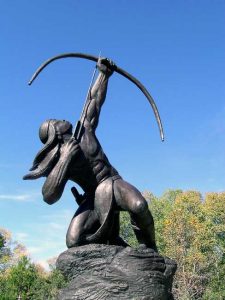



 “A lot of the spiritual work people do is just putting whipped cream on top of a bowl of garbage. You’ve got to clean up the garbage first before you add the whipped cream.
 “What happens when you grow old and no longer wish to compete with younger people? Who do you look toward for models? Someone who is old, or someone who is an elder? And what is the difference? How do you become a sage? It’s not necessarily the result of book learning.
 So the story is: a person comes to the wise man and says, ‘how do you get wisdom.’ He says, ‘wisdom comes from good judgment.’ And how do you have good judgment? So the wise one says, ‘from experience.’ And where do you get experience? ‘From bad judgment.’
 “Rabitizikel is a teenager, and the father is the venerable head of a Hassidic group. Suddenly there appears before them a person who says, ‘Rabbi, I need some help, I’m about to get married and I need some money badly.’ The Rabbi looks at him and says, ‘don’t you know you’re dead, you’ve died already.’ The man says, ‘what are you talking about? They are waiting for me. I need the money, please help me.’ The Rabbi lifts up the man’s coat and shows him that underneath his coat he has shrouds, the shrouds with which he was buried. Suddenly, it dawns on the man what has really happened and he disappears.
 “There was a pearl beyond any price and he had to go find that pearl. The pearl was in Egypt. It was guarded by a dragon, a very fierce dragon. The king called his son and told him that he must do this, and don’t you want to some day assume the role of being a person of majesty? The son said ‘yes, I want to do it.’ The whole dream, the whole notion excited him a great deal — yes, he wants to do the heroic thing.
 “I start looking ahead,” Zaida Zalman says, “and suddenly I find I am looking through the rearview mirror. When you ask, ‘what would the future look like,’ I then go into a nostalgic past, a romanticized past, and then go into a tribal thing, and think for a moment, it would look like that. But it’s not going to look like that.
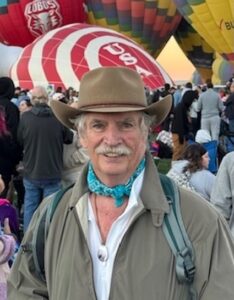
 As a journalist, I’m the author of a range of
  A
A