Return to Meme Museum Entry: Gallery I.


 Academia.com recently reviewed my book, Deep Agroecology: Farms, Food and Our Future. They rendered their review in a five-minute podcast. You can listen to it by clicking below on the start arrow for the MP3 recording.
Their AI-generated Abstract
Steven McFadden’s book Deep Agroecology: Farms, Food, and Our Future presents a blend of spiritual and scientific perspectives on agroecology.
The book argues for the inseparable connection between agroecology and the survival of the Earth, emphasizing a holistic approach that integrates the physical and spiritual realms within food systems.
Through a critical analysis of modern agricultural practices and historical contexts, McFadden advocates for a shift towards sustainable agroecological methods, which he posits as essential for addressing ecological crises and fostering an intentional relationship with nature.
The book suggests that by seeking deeper knowledge and connection with our food and farm sources, we don’t just eat better, we participate in much bigger, far more consequential healing deed as our life-sustaining Planet Earth passes through an era of tremendous challenge.
Click on the start arrow to listen to the brief podcast review:
This is a rendering of an AI poster for the book, also from Acdemia.com. In my view it is just kind of ok, but one statement is way off the mark. AI claims the book “advocates for the fusion of human and non-human life.” What? I never wrote that, never even thought it. Dangerously wrong “wishful thinking” on the part of AI.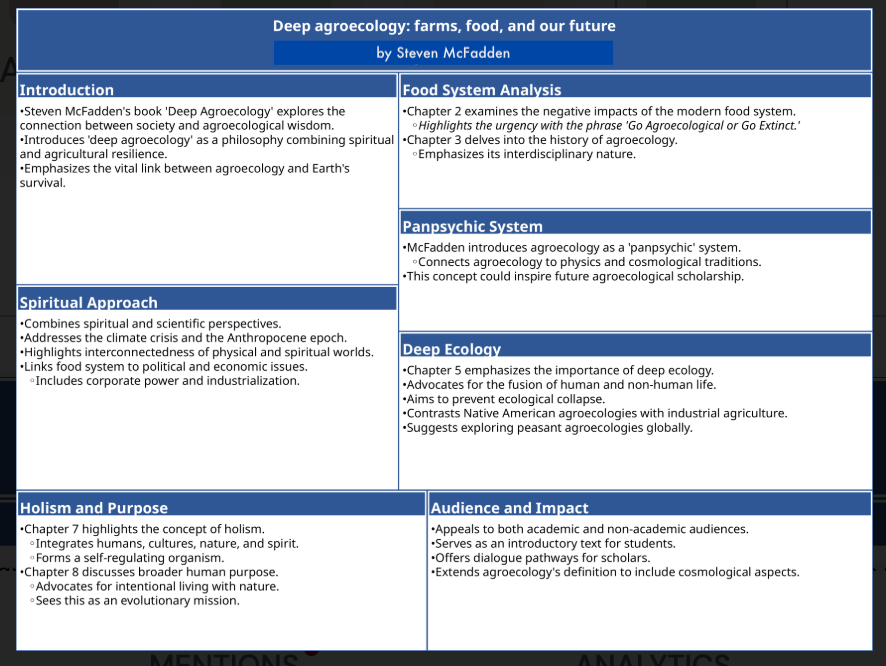

As of 2025 one of the classic books about the CSA movement—Farms of Tomorrow Revisited—has been translated and published in the Spanish language as Las Granjas del Mañana Revisitadas: Comunidad apoyada por Granjas, Granja apoyada por Comunidades.
 Nearly 40 years ago I was the Organic Outlook columnist for a rural newspaper when I met a farmer setting down roots the next town over, Trauger Groh (1932-2016). Trauger and his colleagues Lincoln Geiger and Anthony Graham were founding one of the first CSAs in the nation: the Temple-Wilton Community Farm in New Hampshire.
Recognizing the importance of the seeds the first CSAs were planting, Trauger and teamed up to write Farms of Tomorrow in 1990, published by the Biodynamic Association.
Eight years later we returned to the subject and wrote Farms of Tomorrow Revisited (1998) to consider what farmers and communities were actually experiencing and learning. That’s the version of the book now translated as Las Granjas del Mañana Revisitadas by Martin Alonso of StayTrue Organics in Argentina.
Along with other CSA books, educational materials, and organizations, our books have helped to spark and to support well over 8,000 CSAs (est.) in the USA, and many thousands more worldwide.

Journalist Steven McFadden stands before a poster for Farms of Tomorrow, and also one for Farms of Tomorrow Revisited.
Whether in English or Spanish, the subtitles for our books express a main point of focus: “Community Supported Farms, and Farm Supported Communities.” The phrase reversal in the subtitle highlights an key point. In recent years CSA has often been promoted as a “marketing model,” whereas Trauger and I—along with many others—envisioned CSA as a “community model.” Consequently, in our writing we actively explored social, environmental, and spiritual dimensions of this emerging form.
Our explorations remain healthfully provocative now in 2025, and beyond, especially the explorations of “associative economy,” “parallel polis,” and the preservation of farmland via innovative trusts, that young farmers might be enabled to fulfill their vocations.
Note: In early February 2025 I participated in an online zoom conversation about CSA with the publisher of Las Granjas del Manana. The English-language recording of that zoom call is at this link; the Spanish-language recording is at this link.
In a review of the English-language version of our book, Resurgence Magazine commented “It is rare to come across any practical farming guide that sets out, from its inception, a set of principles that embrace social, spiritual and economic concerns on completely equal terms…The wisdom and clarity of philosophy are striking throughout.”
As Bill T. put it in an Amazon review: “The concepts of community supported agriculture (CSA) grab at the imagination: reconnect with the land and farmer, know exactly where your food is coming from…”
In yet another review published in the Journal of Applied Communications, Mickie Swisher wrote “For those who have little or no previous experience with community-based agriculture, this book brings together information and resources in one place. Even for those who think that community-based agriculture is either unimportant or unrealistic, Groh and McFadden’s book is worth reading. It will, at the least, stimulate thought. With luck, it will produce action.”
The actions now needed – actions that Las Granjas del Mañana Revisitadas can help stimulate – are the further development and networking of clean, healthy, just CSA farms in thousands more communities, both Spanish and English speaking, along with the many other languages of the world.


Screenshot of updated Deep Agroecology blog.
After 16 years wearing the same internet face, my website for Deep Agroecology needed an update. My steady-state blog about food, farms, and our future has been online since 2008. For several years its messages made their way through the digisphere as The Call of the Land. But the blog now bears the name Deep Agroecology. That may sound abstract or academic, but the words actually represent what I regard as one of our main chances for navigating safely and wisely through the cascade of earth changes now unfolding,
My thanks to Tim Hill of Draft Horse Studio for expert web support, making the transition smooth and straightforward for Deep Agroecology.
Chiron Communications–upon whose pages you now gaze, dear readers–is my main, umbrella website, hosting a range of subjects that have drawn my interest over the years.
But to give emphasis to particular subjects, I long ago created and two satellite web sites. They remain alive and active.
The first website is my blog for Deep Agroecology, which has now undergone a facelift. The focus on that blog is the intelligent, and proactive response of farms and communities around the world to establish clean, just, sustainable food systems in the face of ongoing climate change.
My second satellite web site is Odyssey of the 8th Fire. That site tells at epic length the true saga of a great, long pilgrimage on foot from the Eastern Door at the Atlantic Ocean, toward the Western Gate at the Pacific Ocean. The 8th Fire relates a nonfiction tale about a quest arising from the deepest roots of our land, but taking place in the present and the future. In it, circles upon circles, elders make a great and generous giveaway of the teachings they carry.
My 8th Fire website could use a facelift as well, no doubt. But that will have to wait for the right moment. For now, I’m pleased to be able to shine a light upon the new look of Deep Agroecology — a main chance for us all.

Steven McFadden is an independent journalist based in the Southwest of the USA. In the early 1980s he initiated Chiron Communications as an umbrella concept for his varied interests and pursuits. Chiron is a bridging figure, and bridging is what he has mainly been interested in over the years. What follows is the transcript of his 2023 interview with Heena at The Reading Bud.
In the early 1960s, upon my older brother Mark’s urging, I took typing class. I was in the 9th grade, and my brother said it was a foolproof way to meet girls. Ha. I did make a few friends, but no teen romances. Just as well for that moment in time, I suppose.
We learned on clanky old manual machines, and back then I felt it was a complete waste of time, although my hands and fingers did become knowing of the keys. By the end of the year I could type perhaps 25-30 WPM. Not impressive, but enough to get by. As school ended and summer began, I thought it likely that I’d never see a keyboard again.
Wrong.
Here it is now, some 60+ years later and I’m still typing on a keyboard, albeit on a far superior machine, the digital age having dawned for me in 1990 with my first computer. Through the decades typing has been my core skill, a reliable tool for the fulfillment of my dharma – the soul impulses that have guided me along the path of my destiny.
What more to say beyond my bio? I’m happily married to Elizabeth Wolf. We’ve been together 16-plus years, and our relationship deepens. Our dog is Amigo, and our cat Lily. We are grateful to be together, to have shelter and food, and to be purposefully engaged in life.
Beyond the blurb, the main thing that occurs to me is to let readers know the profound depth of feeling I experienced in Spring 2023. That’s when I was moved to update this little book, Native Knowings, and make it available to readers in a print version as well as an ebook.
I’m glad I followed through. As the environmental, social, and political climates intensified, I understood with calm certainty that the voices of learned elders and tradition keepers could be steadying for many people. So those were my main motivations for compiling this version of Native Knowings: steadying the people, and giving readers an opportunity to engage some of the deeper roots of Turtle Island (North America) as we pass through a turbulent era of transition.
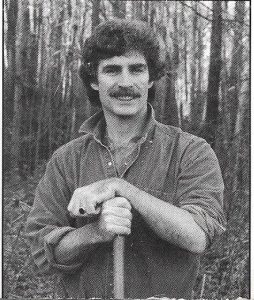
Author Steven McFadden – circa 1985
Since graduating from Boston University in 1975 with a degree in journalism, my personal and professional interest has been to explore intelligent and spirited ways of living on the earth, and then to explain in writing what I’ve been able to understand.
The contemporary tradition keepers of the North American continent are part of an unbroken chain of practical and contemplative understandings (knowings) that go back many thousands of years, long before immigrants came to the land and began calling it America. It is altogether worthwhile to listen to what the learned elders have to say.
From my point of view, considering the condition of our world, listening is critical, deepening, and enriching. The elders offer keys to survival and well-being for all who now call America home, and in many respects for people all around the world.
My response to question 3 also addresses this question in general. But to add context: I first became interested in learning about our indigenous relatives and neighbors in the late 1970s. I was awakened by a bumper sticker on the back of a beat-up VW in a parking lot of my small village. It said something like “Broken Treaty Score: Red Man 0, White Man 370.”
When I looked into what that might possibly mean I learned that in fact the USA had broken or violated virtually every single one of the solemnly sworn treaties it made with various Native nations. Recognizing that track record of faithlessness by my own government raised an persistent series of questions for me. What? How? Why? And so forth. As a citizen, I felt a share of responsibility for the agreements my government had made and broken. As a journalist, I felt compelled to pursue answers to the questions. What’s going on here? What’s the story. Where does honor lie, and how can honor be advanced? That’s been my career, and Native Knowings is but one concise expression of what I’ve experienced and heard along the trail.
As the years of my life unfurled I began to write about clean, sustainable farms and food (so important), and also to engage the native knowings that were at the heart my personal mission as a messenger: take care of the earth and each other.
In terms of compiling the words and photographs, then dealing with layout, cover and other technicalities, it took me just over a month. But to get to the point in life where I had the experience, the tools, the material, and the artistic discernment to express them, about 75 years.
Good question. I’ll be 80 in five years, and of course one never knows…At this mature stage one has seen so many souls come and go, and thereby inevitably one has passed through many enriching stages of emotion and understanding about life and death. I’m at peace with whatever comes, although I’m staying fit and actively writing, aiming to live into my 90s. We shall see.
Of note, I had a clear perception at age 40 that I had fulfilled my dharma and could sail off into spirit if I so desired. It was a profoundly peaceful and satisfying sensation. A knowing. For me that knowing was pronounced and enduring. But at the same time I recognized that I could contribute more to the world, that it had potential to be benevolent, and that I was not ready to release. All these years later, I still feel that way.
Yes. I’m nearly finished writing a full-length biography. The title is “Wind Walker: The Sacred Journey of Naa t’áanii Leon Secatero in concert with Ni?ch?i Diyin (Holy Wind).” Leon (1943-2008) was a talented and dedicated leader, a servant to his own Navajo community in the Southwest of the United States, as well as for the world at large. His story presents a great and uplifting vision for the world, and also offers a model of exalted courage and leadership. The book should be in print some time in 2024.
No.
My mother’s brother–good old Uncle Paul–was a writer. He once wrote an article for True Magazine. It came out when I was about 11 or 12. The title was “Why I poach deer” and the byline was not my uncle’s name. He instead used my father’s name (Edward Leo M.) as a pseudonym, so no game wardens could read the article and then come hunting for him.
The article made a notable impression in our household. Among other things, it started me thinking that writing could be a job; it could be what a person did in life, among all the possibilities – engineer, builder, doctor, teacher, etc. So many possibilities. And now, for me least, writer was also among that range of possibilities.
While it has not been financially easy to be an independent journalist, and it has required many sacrifices, it’s been worthwhile. I’ve been able to write not what others assigned to me, but rather what called me from both within and without.
At this stage I’m not sure I’d call anything I do a ritual. Beyond my first cup of coffee, I’m very much in the moment. If I feel it’s time to write, I write. Time to research, I research. Time to hike along the river or climb a mountain, then I’m off to do that.
Always in the back of my mind I’m aware of deadlines, and I am faithful to them, but I’ve no set times or procedures. When the juice is flowing, I write. Otherwise I am called along the trails of One and also Ten Thousand Things.
Writing is my profession, yet it has not provided sufficient income over the decades of work and marriage. I’ve been able to create hundreds of newspaper and magazine stories, and 15 or more nonfiction books, but I’ve also scrambled for income, working intermittently in a number of occupations: tree surgeon, groundskeeper, cook, yoga teacher, home care for elders, laborer, babysitter, pipe fitter, and more.
I recommend Basic Call to Consciousness, published by Akwesasne Press.
Having started my career writing for newspapers for several years, I never experienced the luxury of being able to surrender to a writers block. There were always deadlines to meet, and the job was on the line. Meet the deadlines, or find a new career. That early conditioning has, thankfully, remained more or less consistent for me.
The mantra in my mind: my job is to tell verifiably true stories that offer a compelling and practical vision of the future. “Where there is no vision, the people perish.” – Proverbs 29:18 “ If you don’t have a dream, how can your dream come true?” – South Pacific
Pay attention to your breath. Master your breath, and you will more readily remain centered and capable through all you meet in life and in your profession.
With mastery of the breath you will be inspired: both literally and figuratively. Your personal inspiration will add light to your soul, to your words, and to the truths you strive to reveal through writing.

This original compilation–a small treasure of 72 pages–offers a concise and contemporary compendium of some key North American (Turtle Island) wisdom teachings to help support people through this era of transition.
– Frank Decontie, Kitigan Zibi Anishinabeg
What do some of the venerable, deeply rooted wisdom teachings of the Americas offer in our era of transition?
This Soul*Sparks small treasure offers an array of thoughtful messages, a compilation of keys that everyone has opportunities to turn. We’d be wise to understand and then to weave their enduring insights into the fabric of what we are creating for ourselves, our children, and our children’s children
The words of contemporary elders, in particular, sound notes of urgency.

As the pace of world transition intensifies, I’m moved to once again articulate in direct language my understanding of the vision held by millions of people around the world: the vision of agroecology.
Thus, I offer below a two-minute slide show with words and images characterizing some basic elements of the agroecological vision, and also offering a glimpse at how deep agroecology embraces the vision, then endeavors to explore further into positive possibilities.
Note: The slides are set at 7-second intervals. You can start and stop the presentation by using the slide at the bottom.
 Thanks to the enterprise and good graces of the New Mexico Book Association (NMBA), I’ve been invited to a reception Celebrating New Mexico Writers at the convention center in our stucco-studded capital city.
The New Mexico Writers’ Reception is an opening event for the Santa Fe International Literary Festival.
 My book Deep Agroecology: Farms, Food, and Our Future is what secured the invitation—an invitation I was honored to receive, and pleased to accept. The reception will perhaps afford opportunities for wider understanding of agroecology and what I regard as its essential role in our raucous era of transition.
Over the last several years my attention has been focused on completing the biography of the late Navajo leader, Leon Secatero (1943-2008). I’ve not given a lot of thought or energy to agroecology or deep agroecology. Yet I still regard them as the Main Chances for positive action in our unavoidable reckoning with climate crisis, food security, earth care, and worker justice.
For the sake of digital experimentation I asked an online Artificial Intelligence (AI) program to declare what it might about “deep agroecology.” Here’s a calculated response from ChatGPT:
“Deep agroecology is a term used to describe an ecological approach to agriculture that encompasses the social, cultural, and spiritual aspects of farming as well as the economic and environmental dimensions. It recognizes the interdependence of all living things and emphasizes the importance of maintaining healthy ecosystems, biodiversity, and cultural diversity.
“It is a holistic approach to agriculture that recognizes the interconnectedness of social, cultural, ecological, and economic systems and strives to create a more just and equitable food system for all.”
There you have it, the computer brain at work. Fair enough for a start, I suppose. But it’s not enough to cause me to abandon my vocation and stop doing my own writing on this or any other subject.
 One fundamental understanding of agroecology in general and deep agroecology in particular is that being directly in touch with the earth promotes good physical, mental, and spiritual health for people, animals, plants, and the whole. There’s nothing artificial about that earth-based quality of intelligence, qualities naturally intrinsic to full health.
Traditional peoples long ago recognized that in times of great personal, family, or community trauma, human beings could find emotional and psychic stability by going to the land, by deliberately touching or lying upon it, relaxing, breathing, and releasing the trauma to the embrace of Mother Earth. That creates a simple, cost-free opportunity to be filled with grounded peace, even if just for a moment. This is one of the many gifts of our home planet. In reciprocity we have the opportunity to complete a circle by offering our gratitude.
As earth changes intensify, we will always have opportunity to anchor ourselves in strength and wisdom, and then to take positive steps forward. That’s true, now even in the context of the authoritative final warning so recently delivered to the world. Positive action is still possible, still the key.


 The phrase main chance generally refers to the most advantageous prospect available, the opportunity for the greatest progress or gain in any given set of circumstances. I use the phrase now in regard to our tempestuous environmental, climatological, social, and spiritual circumstances.
In a historical context, playwright William Shakespeare employed the phrase main chance memorably in a speech by the Earl of Warwick in Henry VI, Part 2:
“There is a history in all men’s lives,
figuring the nature of the times deceased,
the which observed,
a man may prophesy, with a near aim,
of the main chance
of things as yet not come to life…”
With my nearest aim, I now prophesy for the future that our main chance would be wisely grasped in reference to collective ambitions that we must of necessity awaken in ourselves: ambitions for survival and well-being through climate chaos and more, for a clean Earth, for health, for respect, for purpose, for the next seven generations, for beauty, for spiritual maturity.
All of this is what farms are for, what they can be for if we set our minds and hearts to make it so. Farms and food are the key to our physical, moral, community, and spiritual survival and evolution. Our main chance to realize all of this lies in the realms of agroecology and deep agroecology.
For your consideration, here’s a sample of five memes I was inspired to create by the main chance theme:


by Steven McFadden
My primary work throughout the rest of 2021 is dedicated to researching and writing the biography of a man who was a kind, knowledgeable, and skillful leader for the Navajo people, as well as for people around the world. Having died in 2008, he left a legacy of insight into the well being of our earth, and indications for time-tested ways of supporting hózhó – life in balance and beauty.
While at first a biography might appear to be a divergence from the topics of agroecology and deep agroecology, it’s actually related. Part of the biography, through the subject’s eyes, is an exploration of how we might reckon wisely with the catastrophes described in Code Red for Humanity, the alarming new UN report. In my view it’s the most critical report in history. The dire realities it spells out demand our global attention.
While I’m at work on the biography, I’ll continue to let people know about my book, Deep Agroecology, and to create occasional memes to call attention to the critical issues in the book, and the high, necessary vision it sets out.
Here’s a sample of the kinds of memes that I create from time to time, as the spirit moves me.


My video conversation with Brooke Medicine Eagle about The Call of the Land and the accompanying slide show, is freely available now on Youtube. To learn more about deep agroecology and the possibilities for our food and farms, follow this link.

 Our Collective Odyssey: Song and Story for the Generations Arising
 Musical Invocation: Odyssey of the 8th Fire
 Marvelous Meme Museum Makes Memories
 Podcast book review of Deep Agroecology (5 minutes)