Community Supported Agriculture (CSA) is an agrarian movement that arose in America starting in the 1980s. In an era of general farm consolidation and industrialization, CSA has continued to develop. By now there are many thousands of farms and many hundreds of thousands of households networked directly with local farms.
The initial vision of CSA arose in the context of wide recognition of the necessity for renewal of agriculture through its healthy linkage with the human community that depends on farming for survival. The vision united farmers and consumers in an agrarian relationship for the health of people and planet, and explicitly recognized the necessary stewardship of soil, plants, and animals: the essential capital of human cultures. CSA emerged as a web of relationships.
Recently I had an opportunity to engage in conversation about the movement and its future with two renowned CSA farmers: Jean-Paul Courtens of Roxbury Farm in New York, and Allan Balliett of Fresh and Local CSA in Shepherdstown, West Virginia.
My thanks to Allan for creating and hosting BDnow Podcast 017 (The Future of CSA), and to Jean Paul for sharing his experience and insight.
As it happens, I must demur on the matter of “foremost…philosopher,” which is a descriptor applied to me in the podcast. CSA farms arose as a community supported concept. “The idea of CSA was in the air in the late 1980s.” Many different people were contributing to the thoughts and practices, including Jan Vander Tuin, John Root, Jr., Andrew Lorand, Robyn Van En, Elizabeth Henderson, Anthony Graham, Lincoln Geiger, and Alice Groh. Trauger Groh – my coauthor on Farms of Tomorrow and Farms of Tomorrow Revisited – had a profound and eloquent grasp of farming and of the budding CSA vision. My role with CSA in those days, and ongoingly, has been not to philosophize, but rather to listen closely and then to write about what I learn.

#csa #organicfarmers #organic #agrarian
 A pioneering book that helped spark the CSA farm movement in the United States has now been published in a German-language edition.
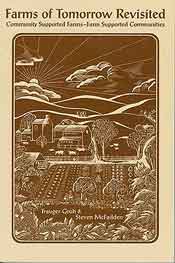 Farms of Tomorrow was published by the










 As we move on into the new century and a new millennium, CSA is still generally regarded as outside the box of conventional agriculture. Yet from the vantage that is indigenous to our land, CSA is respectfully within the Sacred Hoop, a traditional philosophical concept of Turtle Island (North America) for 12,000 years or more.
 In many respects CSA embodies and expresses the original Native American social and environmental ethos, the Sacred Hoop. The Sacred Hoop is a metaphor for a core concept, or worldview, encompassing a host of subtleties and paradoxes.
 The indigenous concept of the Sacred Hoop closely corresponds with what modern scientists are glimpsing about the nature of reality through the theories of Relativity, Quantum Mechanics, Uncertainty, and Superstrings.
 The Algonquin words Manitou and Gitchee Manitou describe a similar, if not the same, understanding. They refer not a Supreme Being, as in Western spiritual conceptions, but rather to a cosmic, mysterious power existing everywhere in nature, and connecting all things.
 Our first book contained basic essays on new structures for community supported farms which acknowledged that farming is not just a business like any other profit-making business, but a precondition of all human life on earth, and a precondition of all economic activity. As such, farming is everyone’s responsibility, and has likewise to be accessible for everyone. Emerging awareness of this reality was, we felt, steadily inspiring the creation of CSAs: new farms for a new time. The millennium, after all, lay just 10 years ahead.