Welcome to Gallery VIII
Links to the other pages:
Gallery I Gallery II. Gallery III. Gallery IV. Gallery V. Gallery VI. Gallery VII.




Welcome to Gallery VIII
Links to the other pages:
Gallery I Gallery II. Gallery III. Gallery IV. Gallery V. Gallery VI. Gallery VII.
 Academia.com recently reviewed my book, Deep Agroecology: Farms, Food and Our Future. They rendered their review in a five-minute podcast. You can listen to it by clicking below on the start arrow for the MP3 recording.
Their AI-generated Abstract
Steven McFadden’s book Deep Agroecology: Farms, Food, and Our Future presents a blend of spiritual and scientific perspectives on agroecology.
The book argues for the inseparable connection between agroecology and the survival of the Earth, emphasizing a holistic approach that integrates the physical and spiritual realms within food systems.
Through a critical analysis of modern agricultural practices and historical contexts, McFadden advocates for a shift towards sustainable agroecological methods, which he posits as essential for addressing ecological crises and fostering an intentional relationship with nature.
The book suggests that by seeking deeper knowledge and connection with our food and farm sources, we don’t just eat better, we participate in much bigger, far more consequential healing deed as our life-sustaining Planet Earth passes through an era of tremendous challenge.
Click on the start arrow to listen to the brief podcast review:
This is a rendering of an AI poster for the book, also from Acdemia.com. In my view it is just kind of ok, but one statement is way off the mark. AI claims the book “advocates for the fusion of human and non-human life.” What? I never wrote that, never even thought it. Dangerously wrong “wishful thinking” on the part of AI.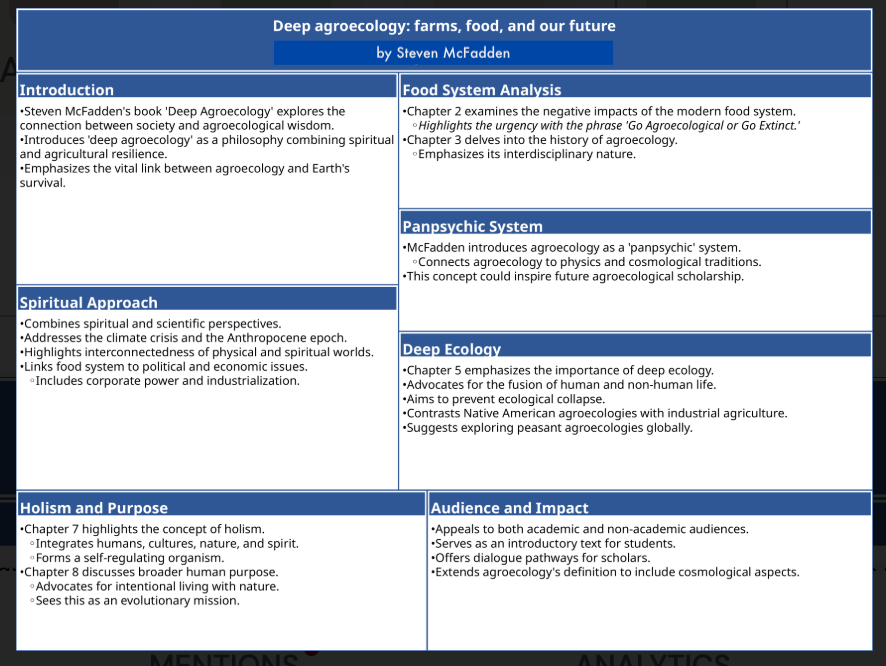

As of 2025 one of the classic books about the CSA movement—Farms of Tomorrow Revisited—has been translated and published in the Spanish language as Las Granjas del Mañana Revisitadas: Comunidad apoyada por Granjas, Granja apoyada por Comunidades.
 Nearly 40 years ago I was the Organic Outlook columnist for a rural newspaper when I met a farmer setting down roots the next town over, Trauger Groh (1932-2016). Trauger and his colleagues Lincoln Geiger and Anthony Graham were founding one of the first CSAs in the nation: the Temple-Wilton Community Farm in New Hampshire.
Recognizing the importance of the seeds the first CSAs were planting, Trauger and teamed up to write Farms of Tomorrow in 1990, published by the Biodynamic Association.
Eight years later we returned to the subject and wrote Farms of Tomorrow Revisited (1998) to consider what farmers and communities were actually experiencing and learning. That’s the version of the book now translated as Las Granjas del Mañana Revisitadas by Martin Alonso of StayTrue Organics in Argentina.
Along with other CSA books, educational materials, and organizations, our books have helped to spark and to support well over 8,000 CSAs (est.) in the USA, and many thousands more worldwide.

Journalist Steven McFadden stands before a poster for Farms of Tomorrow, and also one for Farms of Tomorrow Revisited.
Whether in English or Spanish, the subtitles for our books express a main point of focus: “Community Supported Farms, and Farm Supported Communities.” The phrase reversal in the subtitle highlights an key point. In recent years CSA has often been promoted as a “marketing model,” whereas Trauger and I—along with many others—envisioned CSA as a “community model.” Consequently, in our writing we actively explored social, environmental, and spiritual dimensions of this emerging form.
Our explorations remain healthfully provocative now in 2025, and beyond, especially the explorations of “associative economy,” “parallel polis,” and the preservation of farmland via innovative trusts, that young farmers might be enabled to fulfill their vocations.
Note: In early February 2025 I participated in an online zoom conversation about CSA with the publisher of Las Granjas del Manana. The English-language recording of that zoom call is at this link; the Spanish-language recording is at this link.
In a review of the English-language version of our book, Resurgence Magazine commented “It is rare to come across any practical farming guide that sets out, from its inception, a set of principles that embrace social, spiritual and economic concerns on completely equal terms…The wisdom and clarity of philosophy are striking throughout.”
As Bill T. put it in an Amazon review: “The concepts of community supported agriculture (CSA) grab at the imagination: reconnect with the land and farmer, know exactly where your food is coming from…”
In yet another review published in the Journal of Applied Communications, Mickie Swisher wrote “For those who have little or no previous experience with community-based agriculture, this book brings together information and resources in one place. Even for those who think that community-based agriculture is either unimportant or unrealistic, Groh and McFadden’s book is worth reading. It will, at the least, stimulate thought. With luck, it will produce action.”
The actions now needed – actions that Las Granjas del Mañana Revisitadas can help stimulate – are the further development and networking of clean, healthy, just CSA farms in thousands more communities, both Spanish and English speaking, along with the many other languages of the world.


As cloaks of summer heat settled upon most of North America, and storms raged severe in sky, land, and sea, I happened upon a 2020 academic review of Deep Agroecology.
I’d missed the review at the time, as I was reckoning that year with the passing of generational elders, and also a household move from Nebraska back to the mountains of the Southwest. But I’m happy to have come upon the review now, some four years later. I needed to hear a familiar chord sounded again.
 Reading the analysis reminded me of the perilous realities that had driven the writing of the book, realities that had gone into soft focus for me since publication five years ago. That came about as, after the year of transition, I became intent on completing another writing project, the biography of Iina’bi’ho spiritual elder Leon Secatero (1943-2008). That book is moving toward completion.
The 2020 review of Deep Agroecology was written by Hannah Kass, Ph.D and published in the journal Food, Culture & Society. What sparked me in reading the review was her proficient description of my book’s goal: to state plainly the crucial knowledge that agroecology has to offer to the general public, and to sound a call for wide, strategic implementation in our era of mounting perils.
Professor Charles A. Francis (U. Nebraska) suggested the deep agroecology theme to me around 2012. After seven years of study and contemplation what emerged was not so much the expression of a personal vision, but rather the synthesis of a chorus of learned voices. Together they express an evolving vision—a strategic vision—shared by millions of people around the world. Deep Agroecology is my effort to articulate that compelling vision, along with a host of healthy pathways that can lead toward a just, sustainable, and spiritually elevated future.
Despite appearing as an academic concept, agroecology is altogether of the people and the earth: of the way we live on the land, and the way we give and receive sustenance with the earth. As we are at a point of peril, and our farm and food foundations are in critical transition, I wrote Deep Agroecology for the people—for all the people.
 In her book review, Kass noted: “Using the framework of extinction and evolution to explain deep agroecology’s spiritual purpose, McFadden aptly demonstrates the inextricability of physical and spiritual worlds in the food system…He connects these worlds to the political economy of food, pointing out the climate’s ties to the intersecting problems of corporate power, industrialization and rural dispossession.”
Agroecology offers a wide array of sensible, sustainable, just, and strategically intelligent pathways to sustain our civilizations, and help them to progress in ever-wiser way.
Terra Madre – We Are Nature
 One place where the theme of agroecology will resonate with power and beauty is at this years 20th anniversary Tierra Madre global food community gathering in Turin, Italy (Sept. 26-0).
The 2024 theme is “We Are Nature.” As a key part of the proceedings, the conference is establishing a spectacular space dedicated to agroecology: “an alternative food system paradigm that counters industrial agriculture…It is rooted in the reconstruction of relationships between people, agriculture and environment, food systems and society.”
Excerpted from Chapter 11 – Legend of the Rainbow Warriors – by Steven McFadden
We’re in transition, that’s for sure. By that I mean the rate of change around the globe–climate, business, education, technology, etc–is cracking along at a wildfire pace: in our faces. We’re moving decidedly toward some new state of life. To add to the wealth of speculation about what some qualities of that new state may be, I offer yet another descriptor–one with mythic unifying attributes: the Age of Flowers. I wrote this chapter in the mid-1990s as a facet of Legend of the Rainbow Warriors, an exploration in nonfiction mythology. Now in the summer of 2024, it feels worthwhile to publish it online and to make it more widely accessible.
 Moving Around the Spiral
Ven. Dhyani Ywahoo has spent much time contemplating the traditional calendars of the Americas and the Orient, and the concept of a new cycle emerging.
A teacher in the Etowah Cherokee tradition and also a recognized teacher of Tibetan Buddhism, in the Nyingma and Drikung Kagyu lineages. Ven. Ywahoo teaches from the Sunray Peace Village in the heart of Vermont’s Green Mountains, toward the crown end of the Appalachian mountain spine, along the Eastern flank of Turtle Island (North America).
Dhyani says that many Indigenous people have paid attention to the transition described in Native calendars. “The age ending has been a time when people have gathered information about building and about inventions to make life better,” she explained. “Now it’s time for people to recognize that the inventions are a creation of mind, to put aside such inventions as cause harm, and to bring forth and further develop those activities that benefit all beings and benefit the future generations.”
“We are moving around the spiral, coming again to a place of whole civilization, of true planetary consciousness. What we see now are the fever throes, the end of the fever’s nightmares as the sickness and poisons leave the system. Just how well the culture, the people, go through this time is really dependent upon the calling of the light, because in a time of purification the light makes clear the places of darkness.
“How much the planet will suffer, how much the people will suffer, is really determined by the consciousness of groups. It is no longer a matter of just individuals finding the light within themselves; it’s really necessary to establish a network, to rebuild those areas of the Earth’s web that have been harmed by unclear thinking.
 “According to the way we are taught, and the seeds that are being planted, the new calendar that has begun is to manifest peace–an age of peace. The elders have asked–this is a large council of elders, so they speak to Central and North American people–that the morning after every full moon at about 10 a.m., that we gather flowers and go outside and look to the Sun, to the flowers, and to the heart of the Earth. In so doing, we bring more solar energy and flower wisdom to the Earth, because the new age is an Age of Flowers.
“Flowers give light and joy. They also have a very subtle consciousness. They have a unity of mind. Flower energy is peaceful, and flowers are great medicine. By meditation on flowers, we can reduce the inflammation caused by aggressive habits of mind. Flowers are our medicine for the next age. In this new time, flowers will become very significant as teachers and healers of humanity.
“Flowers move with the Sun; thus they have a certain committed solar consciousness. They know the proper relationship between Spirit and Earth. The flowers remind us to look up to heaven and to actualize the solar energy in our own lives–to speak more clearly and to act more clearly.
“Flowers are the medicine we need for balance and tone,” she said. “The old people say that when properly prepared–and some of the preparations can take as long as twelve years–flower essences can widen the frequency response of the human mind. They increase our sensitivity. But they need to be prepared with prayer, right offering, and dedication. Flowers can remove the poisons of incorrect thought and stir the body to its fullest health.”
According to Ven. Ywahoo, one way the flowers are teaching humanity is through their pollen. In recent years…doctors have reported an increase in the number of cases of hay fever, other allergies, and asthma. As Dhyani explains, “Through the movement of flower pollen in the air, we are all being quickened. That quickening for some is frightening, and it also brings a reaction–just like when someone takes a homeopathic remedy. First, they may become a little bit sicker, but it’s really the sickness being exaggerated so that the organism can be awakened to heal itself.”
 “The whole issue of allergy,” she says, “is really an issue of the planetary system and not the human system. In some instances the Earth and the people are so out of alignment with one another that anything natural is disturbing to the human body. For years we’ve been taking artificial vitamins, and for years our food has been grown with artificial fertilizers. So the natural kingdom has been made an enemy, and the body and the immune system respond as if nature were an enemy. This is a result of years and years of improper drugging of the crops.
“By releasing their pollen, flowers are trying to attract the attention of human beings. The plants do that specifically. Plants do have minds and they have alertness and consciousness, and they can change,” Dhyani explained. “Notice also that the atmosphere’s quality is changing. Certainly there’s less oxygen. There are more heavy metals and acid in the air. So the plants are working even harder to transmute these things, and in their efforts for transformation the plants that survive become more potent.”
In the late 1980s, best-selling author Tom Robbins published a novel entitled Jitterbug Perfume. The book contains a chapter with a peculiar title: Dannyboy’s Theory (Where We Are Going and Why It Smells the Way It Does). In that chapter the fictional characters contend that humankind is about to enter the floral stage of evolutionary development.
 Although the book is a novel, within this chapter Robbins offers some illuminating facts about human brains and the quality of their consciousness.
Specifically, through his characters, he notes that reptile consciousness is cold, aggressive, self-preserving, angry, greedy, and paranoid. Of note, neurophysicist Paul McLean has pointed out that within our skulls we modern-day human beings still harbor a fully intact and functional reptilian brain: the limbic lobe, the hypothalamus, and perhaps other organs of the diencephalon. When we are in a cold sweat or a blind rage, he says, our reptile brain is in control of our consciousness.
Robbins explains that human beings also have a mammal brain, called the midbrain or mesencephalon, and that characteristics of mammal consciousness are warmth, generosity, loyalty, love, joy, grief, humor, pride, and appreciation of art and music. In late mammalian times–the last several thousand years–human beings have developed a third brain, the telencephalon, consisting principally of the neocortex, a dense rind of nerve fibers about an eighth of an inch thick. This part of the brain is molded over the top of the existing mammal brain.
Brain researchers were initially puzzled by the neocortex. What is its function? And why has it developed? In his book, Robbins concludes that this third brain is a floral brain, corresponding to the evolving stage of human development.
Flowers extract energy from light. Likewise, neuromelanin–one of the principal chemicals in this part of the brain–absorbs light and also has the capacity to convert light into other forms of energy. Consequently, Robbins notes, the neocortex is light sensitive and can itself be lit up by higher forms of mental activity, such as meditation or chanting.
Thus, Robbins writes, “the ancients were not being metaphoric when they referred to ‘illumination.”‘ They were being literal.
Jitterbug Perfume brings forward the encouraging idea that we are moving gradually toward a dominant floral consciousness: “We require a less physically aggressive, less rugged human being now. We need a more relaxed, contemplative, gentle, flexible kind of person, for only he or she can survive (and expedite) this very new system that is upon us. Only he or she can participate in the next evolutionary phase. It has definite spiritual overtones, this floral phase of consciousness…”
“As our neocortex comes into full use, we, too, will practice a kind of photosynthesis,” Robbins writes. “As a matter of fact, we already do, but compared to the flowers, our kind is primitive and limited. For one thing, information gathered from daily newspapers, soap operas, sales conferences, and coffee klatches is inferior to information gathered from sunlight. (Since all matter is condensed light, light is the source, the cause of life. Therefore, light is divine. The flowers have a direct line to God that an evangelist would kill for.)”
“With reptile consciousness,” Robbins concludes, “we had hostile confrontation. With mammal consciousness, we had civilized debate. With floral consciousness, we’ll have empathetic telepathy.”
Since the early part of the twentieth century, flowers have emerged as an effective modality of healing. Specifically, in the late 1920s a British doctor began experimenting with flowers as remedies for human disease. The results of his experiments opened a whole new field of health care that began to blossom throuh the 1980s and onward.
 Edward Bach, M.D. (1886-1936) practiced traditional medicine from 1914 until 1918, when he became interested in homeopathy, the healing modality founded on the principle that like cures like: in other words, that small doses of whatever is causing a problem, intelligently applied, can bring about a positive healing reaction within the body.
Bach was an outstanding doctor, held in high regard by both orthodox and homeopathic physicians. In 1928, he became interested in flowers and began to prepare homeopathic remedies from various blossoms. As time went on, he observed excellent results from these medicines. Working steadily until the time of his death, he developed 38 individual flower essences as well as the popular Rescue Remedy, a combination of several flowers used to alleviate trauma.
Bach believed that bodily ills were only symptoms. He wrote that the ills of the heart and the spirit should instead be the focus of a healer’s attention: “It is our fears, our cares, our anxieties, and such like that open the path to the invasion of illness.” Dr. Bach also believed that the overweening materialism of our times has caused us to focus almost exclusively on the physical aspects of disease and to pay scant attention to the underlying or spiritual causes.
In response to this perception, Bach developed a new branch of herbal and homeopathic medicine that employed flowers to relieve mental distress. With this system, problems could be dealt with on an inner level. Specifically, he created his flower remedies to heal attitudes such as anger, resentment, remorse, lack of confidence, greed, and anxiety. Bach believed that by correcting harmful mental attitudes, one could prevent a disease from becoming established in the body. If one treated a disease at the energy level, he posited, one could avoid having to deal with it later as a gross physical malady.
Flower essences are part of an evolving branch of the healing arts known as vibrational medicine. With vibrational medicine the subtle energies of the human body are influenced gently and non-obtrusively, through means such as color, light, sound, fragrance, and the essences of flowers. The theory underlying these modalities is that all living things, including human beings, have energy that flows in and around the body in particular patterns. Those energy patterns are directly related to–and in fact may even be the mold for–the physical form of the body. Therefore, if one can bring a person’s energy patterns (or energy bodies) into vitality and balance, then theoretically there will be a corresponding shift in the person’s physical health.
 As viewed from the perspective of the classical four elements (earth, fire, water and air), floral healing approaches can be said to fall within the realm of air, specifically within the realm of Aquarius, which is the third and highest of the Zodiac’s air signs. The classical figure of Aquarius is not pouring out water, but rather waves of energy. Aquarius has long been said to rule electricity, high technology, flying, forward progress. In human beings the Aquarian impulse can be expressed as a cool detached intellectualism, the scientific mind. Aquarius is yang, and can be exceedingly dry.
In the context of our times, one might well ask, where does the yin or feminine energy come from to balance the yang-masculine energy of Aquarius. A likely response is from the flowers–which are a yin expression of the Aquarian air impulse.
One leading organization in the development of flowers as a healing modality has been the Alaskan Flower Essence Project. The project describes this aspect vividly: “Flowers,” the project’s brochures say, “are light patterns of truth, beautifully expressed in physical form.”
Flowers are the highest, most beautiful, most refined part of plants. They are said to correspond to the human soul. Flower essences may influence the subtle electrical energy field of the human body in much the same way acupuncture does, albeit more gently, and less obtrusively.
Flowers become an evolutionary force in the consciousness of the person who uses them. They are not the cause of the healing or the health that results from their use; rather, they are agents that support the free will and clear intention of the person who seeks to heal him or herself.
Richard Katz and Patricia Kaminski are the founders of the Flower Essence Society (FES). Through this organizational vehicle, they support research and educational programs that deepen public understanding of flowers as a medium for healing.
FES teaches that flower essences address health in a broad sense by strengthening the link between body and soul. The organization professes that flowers can be used to treat a wide variety of disorders such as stress, addictions, depression, fear, emotional repression, and jealousy. They can also be used to enhance creativity and spiritual awareness.
 “With flower essences,” Richard Katz commented, “we are seeking to bring spiritual light into our lives. Forty years ago, with the nuclear explosion, we split apart matter to create light. Now the generation that was born in that time has matured and is deciding whether to continue to split apart matter to create light or to radiate it from within. Never has the choice been clearer.”
If this is an Age of Flowers, and if flowers are to become our healers and teachers, then what have we got to learn? As Richard Katz sees it, “Flowers are the soul of nature, and they give it expression through color, form, and fragrance. Flower essences are the art and science of bringing the balance of nature to the human soul.
“Most remedies are intended to make us feel better, but flower essences can help us heal our souls and find our life direction. Perhaps the most healing experience you can have is to be aware of your life purpose.”
To help a person develop awareness of and to take steps toward fulfilling his or her life purpose, Katz recommends one of three specific flower essences, or a combination of all three: Mullein, Walnut, and Wild Oat. He suggests that the person place a few drops of the flower essences under the tongue and then relax, repeating this process rhythmically, several times a day for several weeks, to internalize the subtle qualities of the flowers. To strengthen the process, the person might also use affirmations, either of their own design or as suggested by a supplier of flower essences.
The Flower Essence Society has published a pioneering booklet on this theme, entitled Affirmations: The Messages of the Flowers in Transformative Words for the Soul. As the booklet explains, “Affirmations are a specialized activity within the larger field of meditation, contemplation and prayer. They are simple, directly evocative words which enable the soul to work toward positive, specific goals of inner development. It is a tenet of all spiritual teachings, as well as business and professional training programs, that the ordering of thought and the harmonizing of feeling has a powerful impact on our ability to manifest change, both within ourselves and within the world.”
Affirmations are not magical words that immediately bring fortune or fame; rather, they are verbal tools that can help the personality to develop virtue and moral strength in accord with the real needs and capacities of the soul. Here, for example, are the original FES affirmations for two flower essences relating to life purpose:
Mullein
I hear the spiritual call that guides me.
I stand true to my inner guidance.
I bear aloft the torch of my Spirit Light.
Wild Oat
I am clear in my life direction.
I express my soul’s purpose in my life activities.
I create and attract the opportunities I need
 At this juncture of world history many people sense the compelling forces of change bearing upon civilization–and they may also sense that it is part of their personal soul mission to engage and to help steer the Earth aright toward a clean, just, and peaceful state. For them the Age of Flowers has potential to resonate as an insightful frame of reference, and also as an auspicious soul call audible to the inner ear.
This essay excerpted from Chapter 11 – Legend of the Rainbow Warriors nonfiction mythology by Steven McFadden

 In a thought-provoking essay published in 1990, Wendell Berry asked, “What are people for?” Now more than three decades later, with the aggressive incursion of artificial intelligence (AI) into our lives, Berry’s rhetorical question takes on added magnitude.
What does it mean to be human in the Age of AI? Especially if the craft, trade, or profession you mastered is rendered irrelevant by “intelligent machines.”
Meanwhile…In our moment of history, with the aid of AI, enormous industrial, chemical, GMO infused agri-corporations are continuing to subsume and to overshadow food systems, while colossal billion-buck investment firms continue to hoard farmland. This commercial juggernaut of consolidation and concentration for greater profit brings a second question into focus: What are farms for?…
Note: the rest of my essay is located on my dedicated blog for DEEP AGROECOLOGY. Click here to read the rest.


 Welcome to Gallery IV


As the pace of world transition intensifies, I’m moved to once again articulate in direct language my understanding of the vision held by millions of people around the world: the vision of agroecology.
Thus, I offer below a two-minute slide show with words and images characterizing some basic elements of the agroecological vision, and also offering a glimpse at how deep agroecology embraces the vision, then endeavors to explore further into positive possibilities.
Note: The slides are set at 7-second intervals. You can start and stop the presentation by using the slide at the bottom.
 Our Collective Odyssey: Song and Story for the Generations Arising
 Musical Invocation: Odyssey of the 8th Fire
 Marvelous Meme Museum Makes Memories
 Podcast book review of Deep Agroecology (5 minutes)