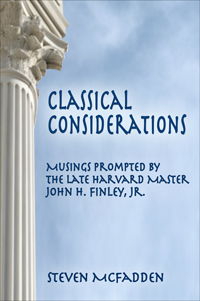
 What does it mean to be a human being? What is the purpose of scientific knowledge, or any rational knowledge?
Understanding of what it means to be a Human Being – in any era of time and any place in the world – is a fundamental wisdom question contemplated in Classical Greece and Classical Native America, as well as hundreds of other traditions around the world.
Becoming a Human Being means rising above base instincts and emotions to reach a place of equanimity and integrity, to rise to an expanded level of consciousness and generativity.
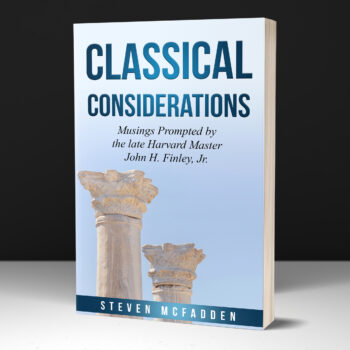
For 51 years Professor John H. Finley, Jr. made the archetypal dilemmas of life compellingly relevant in the lecture halls of Harvard. In the pages of Classical Considerations, his story and his thinking unfolds.
Like shards of pottery, the fragments of Finley’s life and his beloved classics gathered in this digital volume allow readers to put some pieces together, and thereby to experience some of the insight and inspiration that he nurtured at Harvard.
Classical Considerations is available in 10 different eBook, Smartphone and computer formats at Smashwords.com, for Kindle through Amazon.com, and on all Apple devices through the iTunes and iBook stores.


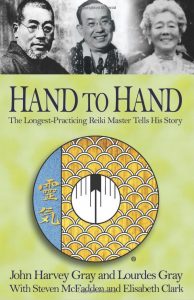 “This long-awaited book by one of the original Reiki masters is a skillful blend of Reiki theory and method, as well as history… a valuable contribution to the study of Reiki in the west and belongs in the library of every student of the healing arts.” – Sacred Pathways


 Reiki Training offers a disciplined foundation in hands-on, human-energy therapy. Everyone can learn. For parents, friends, health-care professionals, massage therapists, homemakers and others can complement their knowledge with understanding and practical skill in the realm of human-energy medicine.



 Snyder revealed himself as one the many elders we had set out to find on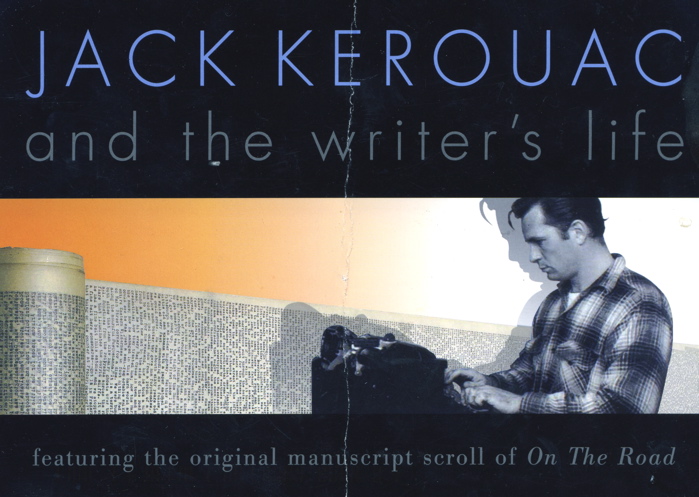
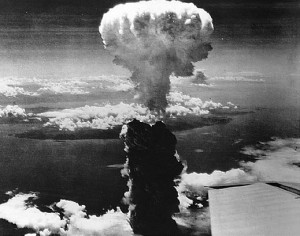 The fire that was ignited 57 years ago on August 6, 1945 when the Enola Gay dropped the first atomic bomb on Hiroshima, Japan, was ceremonially extinguished by a band of pilgrims May 27, 2002 at Big Mountain on Black Mesa in Arizona, in a high desert range sweet with the smell of sagebrush.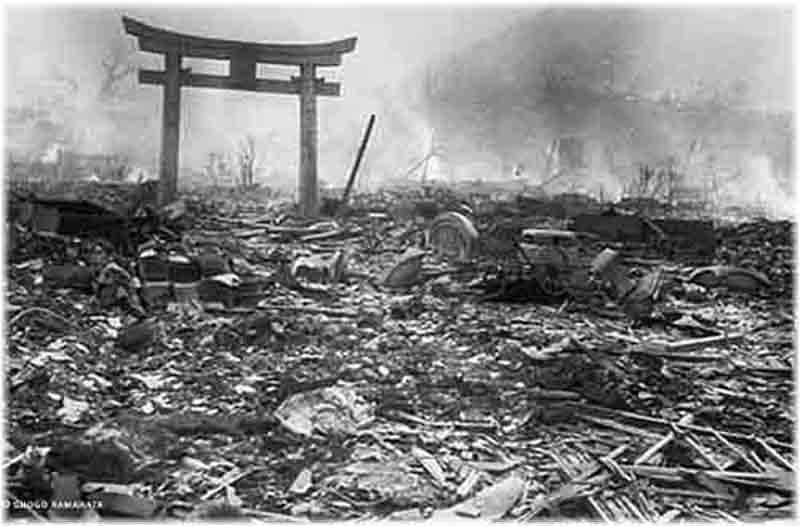


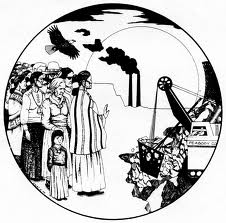 The assault on the material resources of Black Mesa continues. Peabody Coal Co. is planning on expanding operations by opening a new mine, which will ultimately infringe upon Big Mountain itself.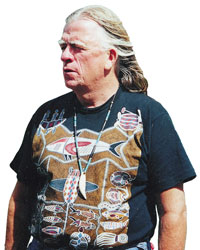
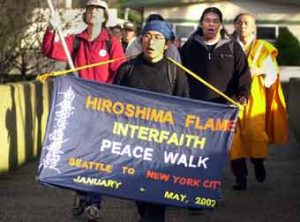 The Hiroshima Flame Interfaith Pilgrimage had its origins in the year 2000 under the inspiration of Tom Dostou while he was in Japan. At that time he was entrusted with a spark of the Hiroshima Flame (the source flame remains burning in Japan). Tom conceived the vision of returning the flame to where it had come from — not as a protest, but as a necessary deed of spiritual redemption, because not only the people of Hiroshima had died, but also many native peoples were poisoned by the uranium dug up, without spiritual permission, on their lands.

 The flame, flickering in a lantern borne by pilgrims on foot, was largely unrecognized and unacknowledged in Los Alamos. Still, the pilgrims completed the work of spiritual redemption they had come to accomplish, and then they walked on toward the East, planning to arrive in New York City on May 12, 2002. Their visit to this place of fire is of marked spiritual significance.
 In the beginning, it is said, the four nations lived together as one and shared their gifts. Then came a time when it was necessary for spiritual growth that the Four Nations disperse to the Four Directions and live apart. Over time they could develop as human beings and master the mysteries of their element for good or ill, according to their free will. Earth, air, fire and water — the peoples went apart.
 The flame the pilgrims carry was ignited 57 years ago and has been tended with prayer ever since. In1945, after the atomic bomb was dropped on Hiroshima, Japan, a man named Tatsuo Yamamoto walked into the ruins of the city to look for friends and family. In shock and anger, he collected some of the embers still smoldering from the bomb and carried them home.
 The nuclear bomb is an ultimate expression of materialism. When the atomic scientists of Los Alamos took the secret of the atom — the fundamental particle of matter — and developed it into a weapon of mass destruction, they unleashed a scathing, wrathful demon of fire rather than a higher angel of warmth and illumination.
 The glyph was carved into the rock face of the outcropping thousands of years ago by the indigenous Pueblo peoples, whose descendents still live nearby. There are such petroglyphs all over North America, serving as signs and signals of importance to native peoples.
 From the place of Avanyu, the walkers proceeded — drumming and chanting each step — about seven miles to Tsankawi, a prehistoric site that is now part of Bandelier National Monument. Tsankawi is a spectacular place high on a mesa overlooking the Jemez Mountains to the West and the Sangre de Christo Mountains to the East.
 The wind people, the messengers, brought the flame home to its point of origin, having purified it with their chants, prayers and incense. They offered it to the people of the city without rancor, recrimination, or challenge. They offered the flame with understanding and hope. And then they walked on.
 Also on that day, to sound an alarm about the rapidly growing danger of a nuclear conflagration, the Bulletin of Atomic Scientists moved their famous Doomsday Clock forward two minutes closer to midnight. The scientists wanted to highlight the dramatically mounting dangers of political instability, the wide availability of nuclear materials, terrorism, and the aggressive unilateral stance of the US government.
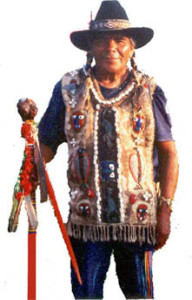 An elder of the Yaqui Indian Nation, and a Nahual (man of power), Cachora has remained a mystery figure for decades. But now he is coming forward from his homeland in the Sonoran Desert of Mexico into the public realm. It is time for this, he says. Chachora says says he is the real man who is portrayed as the enigmatic shaman don Juan in the series of books by Carlos Castaneda: Journey to Ixtlan; The Teachings of Don Juan; and so forth.