This blog post marks the 30th anniversary of the suspended steps of the Sunbow 5 Walk for the Earth (aka Odyssey of the 8th Fire). Those historic steps were pressed into shifting beach sands on February 2, 1996, several miles downcoast of North America’s anciently honored Western Gate on the shore of the Pacific Ocean.
For reasons related to our current moments in time, that long-ago multicultural, multifaith sunbow odyssey remains relevant, resonant, and incomplete.

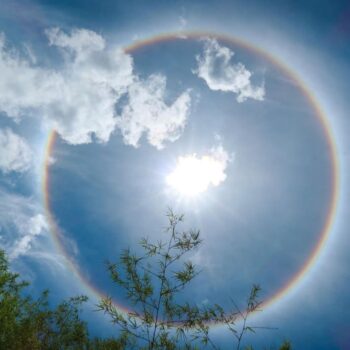
Whirling Rainbow (sunbow)
The sunbow pilgrimage followed the path of the Sun from east to west—in ways similar to the celebrated Walk for Peace now underway from west to east. It serves as metaphor and example for all of us right now as we swiftly progress through turbulence into a new time. Choose it or not, we’re all on personal and collective pathways of change. We’ve been cast onto an uncertain cultural, economic, governmental, environmental, and spiritual journey – an odyssey of our individual and collective souls.
Where are we going? Visions will lead the way, as ever. With cold, dry, controlling visions authored by billionaire techno-bullies now predominating—and hope declining grievously among younger people—we need healthy visions. The true North American story of the 8th Fire represents one such vision: a vision arising from the deepest roots of our land, a vision that embraces and honors all the healthy possibilities inherent in the different colors and faiths of people who have come to inhabit Turtle Island (North America). There are miles to go for all, and many more sparks to be struck.
To mark this 30th anniversary of our long walk, I’ve added singing and orchestration to the Invocation for Odyssey of the 8th Fire. With respect, I invite you to check out my venerable (2007) story-telling web site, and to listen. Epilogue coming later this year. < 8thFire.net >
Nota Bene: The heroic journey-odyssey theme is very much front and center culturally. Check out the trailer for Christopher Nolan’s new film, The Odyssey, set for release as a summer blockbuster, July, 2026.


 We’re in transition, that’s for sure. By that I mean the rate of change around the globe–climate, business, education, technology, etc.–is cracking along at a wildfire pace: in our faces. We’re moving decidedly toward some new state of life.
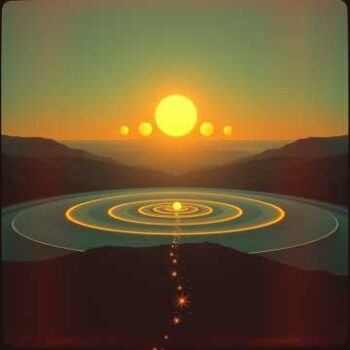
 Moving Around the Spiral
 “According to the way we are taught, and the seeds that are being planted, the new calendar that has begun is to manifest peace–an age of peace. The elders have asked–this is a large council of elders, so they speak to Central and North American people–that the morning after every full moon at about 10 a.m., that we gather flowers and go outside and look to the Sun, to the flowers, and to the heart of the Earth. In so doing, we bring more solar energy and flower wisdom to the Earth, because the new age is an Age of Flowers.
 “The whole issue of allergy,” she says, “is really an issue of the planetary system and not the human system. In some instances the Earth and the people are so out of alignment with one another that anything natural is disturbing to the human body. For years we’ve been taking artificial vitamins, and for years our food has been grown with artificial fertilizers. So the natural kingdom has been made an enemy, and the body and the immune system respond as if nature were an enemy. This is a result of years and years of improper drugging of the crops.

 As viewed from the perspective of the classical four elements (earth, fire, water and air), floral healing approaches can be said to fall within the realm of air, specifically within the realm of Aquarius, which is the third and highest of the Zodiac’s air signs. The classical figure of Aquarius is not pouring out water, but rather waves of energy. Aquarius has long been said to rule electricity, high technology, flying, forward progress. In human beings the Aquarian impulse can be expressed as a cool detached intellectualism, the scientific mind. Aquarius is yang, and can be exceedingly dry.
 “With flower essences,” Richard Katz commented, “we are seeking to bring spiritual light into our lives. Forty years ago, with the nuclear explosion, we split apart matter to create light. Now the generation that was born in that time has matured and is deciding whether to continue to split apart matter to create light or to radiate it from within. Never has the choice been clearer.”
 At this juncture of world history many people sense the compelling forces of change bearing upon civilization–and they may also sense that it is part of their personal soul mission to engage and to help steer the Earth aright toward a clean, just, and peaceful state. For them the Age of Flowers has potential to resonate as an insightful frame of reference, and also as an auspicious soul call audible to the inner ear.