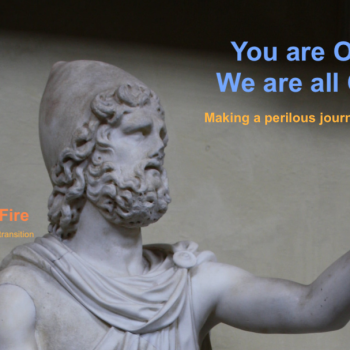
Walking under the sign of the Whirling Rainbow
Nineteen years ago today – June 23, 1995 – a small band of pilgrims set out walking from the Atlantic to the Pacific on an epic journey that I have come to regard, and to write about, as the Odyssey of the 8th Fire.
The saga of their journey is well worth knowing, for it remains critically relevant to the journey all of us are making now through an era of profound change upon our Earth.
As well as the tale of the pilgrims’ travels on foot across Turtle Island (North America), Odyssey of the 8th Fire is the essential story of their meetings with dozens of traditional, learned elders of North America. They gifted the pilgrims with messages to deliver to all the people.
Reading Odyssey of the 8th Fire online is a demanding quest. The story is exceedingly long. Because of this, and because many of the elders who are part of the story noted that their teachings take both time and attention to understand, I recommend this literary pilgrimage be undertaken step by step, over a span of eight months or so.
Odyssey consists of a lengthy Prologue, and then 225 accounts, one for each day of travel. Those journal entries are ordered chronologically.
By engaging this online account of the epic walk one day at a time, a reader can make a steady eight-month literary and spiritual pilgrimage from East to West across Turtle Island (North America). The journey proceeds place to place, elder to elder, teaching to teaching.

“I ask you to listen not just with your minds. I ask you to listen with your hearts, because that is the only way you can receive what it is — what we are giving. These are the teachings of our hearts.
“This walk is going to take eight or nine months. There are lots of elders out there across Turtle Island, and they have many beautiful teachings, many teachings that all the people need now. It is our hope, it is our prayer that they will come forward now that the Eastern Door is open
“It is our prayer that they will meet us as we walk; that they will teach and share what they understand from their hearts. Be patient. Listen to the elders. You need patience to receive these teachings. It doesn’t all come at once. You need patience.”
– Frank Decontie, Algonquin – June 23, 1995 – First Encounter Beach, Massachusetts



 A pioneering book that helped spark the CSA farm movement in the United States has now been published in a German-language edition.
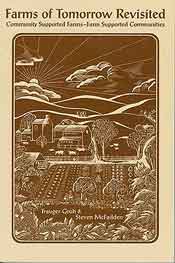 Farms of Tomorrow was published by the