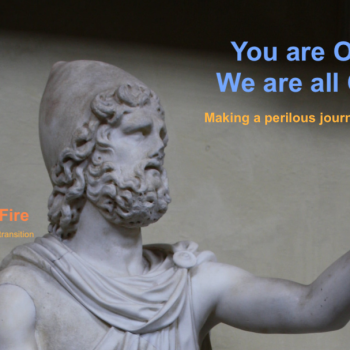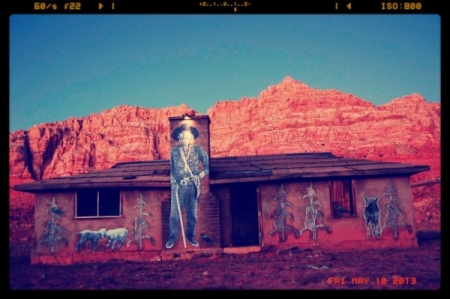
- Big Mountain montage by Jetsonorama & the “No Reservations Required” crew.

For most Americans the Four Corners is just a curiosity on the map where the survey lines that define four states come together and form a classic cross: Arizona, New Mexico, Utah and Colorado. But for many native peoples, Four Corners is a broad and austerely beautiful region bounded by four sacred mountains.*  Four Corners is appreciated as an exquisitely sensitive and foundationally important feminine holy place on the land, a place that serves as an earthly anchoring point for the spiritual heart of North America (Turtle Island).
Today, as has been true for over 50 years, Four Corners is under assault. Today also, as has been true for millennia, Four Corners is under the watch of human beings who have accepted their role as protectors of the land and the life that depends upon the land.
Within the Mountain boundaries of the Four Corners lies the sweeping, majestic prominence of Black Mesa in northeast Arizona. Upon the mesa, in simplicity and humility, stands Big Mountain, a geomantic ground zero. As held in traditional knowings, Four Corners in general and Black Mesa and Big Mountain in particular are understood to represent what we might conceive of as a microcosmic holograph of our entire planet — a subtle, supersensible phenomenon of the region possibly grasped only through legend, direct perception, or quantum mechanics.
What happens in the Four Corners does not stay in the Four Corners, but through the web of life and relationship resonates consequences across and within all of Mother Earth.
 Over the last decades of our era, traditional native peoples at Black Mesa have lived in resistance. Strip-mines have ripped apart the sacred lands, coal-burning power plants have befouled the desert air to send electricity to the Las Vegas Strip, and elsewhere, and mining corporations have dug up the toxic ‘cledge’ (uranium). According to various Creation stories, native peoples were explicitly warned to leave the cledge unmolested; digging yellowcake up, the traditions related, would cause it to arise in the world as nayee, a monster.
In resistance of this ongoing exploitation, there will be a gathering on Black Mesa the week of June 3-9, 2013. The gathering will include workshops and conversations among the Big Mountain/Black Mesa community and other frontline resistance communities from around North America. They will participate in a native youth caucus, cultural sharing, work parties, an elders’ circle, community meals, and concerts with hip hop artists.
This June gathering is being organized by Black Mesa Indigenous Support (BMIS), an all-volunteer, non-native collective committed to long-term, relationship-based, request-based solidarity with the native communities of Black Mesa.
This is not the first such gathering in support of Black Mesa/Big Mountain and surely will not be the last. Thousands of people have learned of Big Mountain over the last 40 years, and hundreds of gatherings have been held in support. This particular gathering is a “big doing” not so much in the sense of size, but rather in the overall context of extreme planetary imbalance or earth changes, and overall patterns of spiritual awakening.
Sovereignty Summer
The Black Mesa gathering in early June happens toward the beginnings of Sovereignty Summer, and thus can be appreciated as a node in a network of awakenings now underway onward through 2013. What is “big” in the ultimate realm of possibilities, is the potential for good that may come from Big Mountain, from Ottawa, and from hundreds of other gatherings and non-violent actions across Turtle Island (North America).
 What unfolds on Black Mesa is part of a social movement, a people-powered uprising for a healthy planet liberated from fossil fuel extraction, exploitative economies, racism, and oppression.
The BMIS collective sets out their ideal by echoing a statement from Honor the Earth: “We believe a sustainable world is predicated on transforming economic, social, and political relationships that have been based on systems of conquest toward systems based on just relationships with each other and with the natural world. We are committed to restoring a paradigm that recognizes our collective humanity and our joint dependence on the Earth.”
General Geomantics
Occupying a spiritual axis for North America, Black Mesa is home to one of the world’s largest and richest coal mines. A site long considered sacred by traditional Hopi and Dine’ (Navajo), the mesa is also home to profitable deposits of gas, petroleum, and uranium.
As understood for millennia, Black Mesa and Big Mountain are inherently, energetically feminine. Yang, masculine digging and drilling for monetary profit and environmental ruin constitute a direct assault on this yin feminine holy center of the land we live on, North America.
In that sense Black Mesa/Big Mountain represent a microcosmic mirror of the deranged yang-masculine dominance, and the ongoing determined debasement of feminine, life-sustaining peoples, persons, substances and ways — as is evidenced all over the planet.
The native elders and the traditional families of Black Mesa appreciate coal as a substance that serves as the liver of the Sacred Female Mountain. When coal is taken from the ground, it no longer can absorb and neutralize impurities in the air and water, the arising thoughts and feelings that circulate in the atmosphere of our planet home.
Even in the face of genocide and ongoing persecution, native peoples have faithfully perpetuated ceremonies intended to give back appreciation and the primal energies of thought, song and dance to help maintain the balance of natural forces of sunlight, rain and winds, and further to reaffirm respect for all life and trust in the Great Spirit. This is how they express it. This is what they do. This is the nature of the call they are sounding, the support they seek.
Igniting a Spiritual Fire
Sovereignty Summer is a term that originated in Canada, arising through the indigenous movement Idle No More. The movement demands sustainable development as well restoration of integrity to sworn treaties. “We believe in healthy, just, equitable and sustainable communities,” the movement reasons, “and (we) have a vision and plan of how to build them. Please join us in creating this vision.”
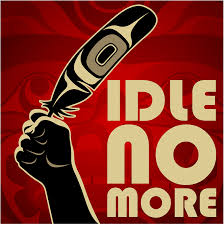 Idle No More has ignited a spiritual fire in the hearts of thousands of human beings to address a range of core matters, including the fundamental issue of protecting the earth that sustains us so life may endure and we may all go forward. They intend to keep striking sparks.
The human beings who sparked Idle No More have networked with Defenders of the Land to make a declaration: “We are in a critical time,” they write, “where lives, lands, waters and Creation are at-risk and they must be protected.” They call the attention of people to the potential of Sovereignty Summer. Meanwhile, in Alberta earlier this month, many native peoples gathered to create and then to sign a historic document, the Turtle Lodge Treaty. Of this treaty we are likely to hear more in the years to come.
Big Medicine is afoot. There is a spiritual energy stirring and a larger awakening is on the horizon as we transition to Sovereignty Summer. The gathering at Big Mountain is one facet or node of this ongoing awakening.
The gathering space at Black Mesa is already full this year. Organizers cannot accommodate anyone else coming. But there are other ways to support the effort to maintain Big Mountain, Black Mesa and the Four Corners, and to support the whole of the earth in a sacred manner. That is the idea animating Sovereignty Summer: to come together not in one particular place, but to establish a spiritually respectful stance where you are called upon the land.
* The four sacred mountains: Mount Blanca in Colorado, Mount Taylor in New Mexico, San Francisco Peaks in Arizona, and Mount Hesperus in Utah.


 Right now a small band of women from the Ojibwe native nation is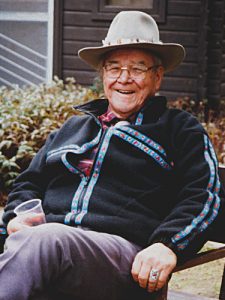
 The wind spiked out over Cape Cod Bay, frothing the blackened waters into angry, spitting caps. A great, bitter wind was upon the land and the sea. Still, the people came. In the face of icy needles cast by the unrelenting gale, 40 people broke from their cars into a wild, scattered search for a place with a scrap of windbreak. They needed protection, for they had arrived to light a sacred fire at First Encounter Beach, just five years before the Millennium.

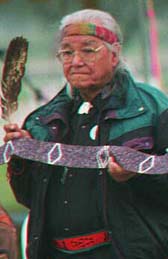
 A belt of beads is the traditional Algonquin device employed to record the solemn and binding agreement they entered into in 1793 with the US and Great Britain. This was a time when the newly formed government of the United States was defining its corporate existence upon Turtle Island and the Canadian nation did not yet exist. Native nations were full and equal partners to the treaty, with the same standing as the United States and Great Britain. But the Algonquins did not use black marks upon paper to keep important records; they used beads woven into beautiful, long-lasting belts.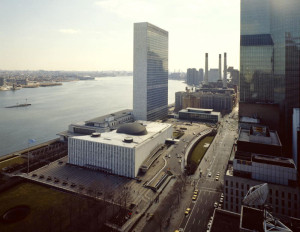

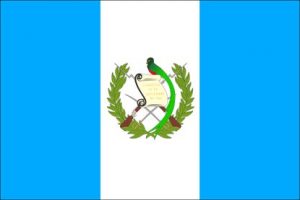 When the war finally wound down in the 1990s, the United Nations Truth Commission conducted an 18-month investigation.* The UN found massive violations of human rights by the government of Guatemala with the complicity of the US government. The UN report stated that acts of “aggressive, racist and extremely cruel” violence descended to the level of genocide directed against the country’s indigenous Mayan population.
 Carlos Barrios says he was born into a Spanish family on El Altiplano, the highlands of Guatemala. His home was in Huehuetenango, also the dwelling place of the Maya Mam tribe. With other Maya and other indigenous tradition keepers, the Mam carry part of the old ways on Turtle Island (North America). They are keepers of time, authorities on remarkable calendars that are ancient, elegant and relevant.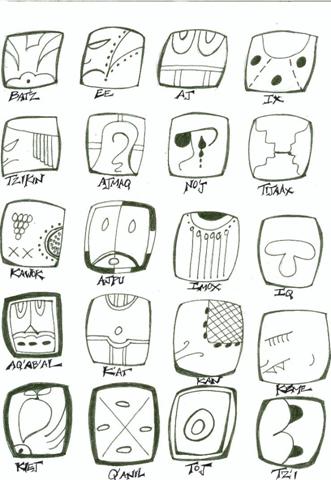
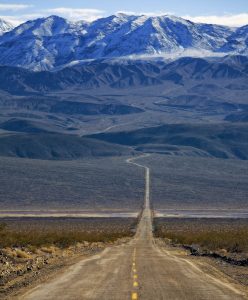 From his understanding of the Mayan tradition and the calendars, Mr. Barrios offered a picture of where we are at and what may lie on the road ahead:
 As he met with audiences in Santa Fe, Mr. Barrios told a story about the most recent Mayan New Year ceremonies in Guatemala. He said that one respected Mam elder, who lives all year in a solitary mountain cave, journeyed to Chichicastenango to speak with the people at the ceremony.
 “An excellent read. Informative without being preachy. Exactly what I have been looking for. Bravo!” – Smashwords Review written by W.E.L. about Native Knowings: Wisdom Keys for One and All

 When our Star appears in the East (about 4:00 AM), the mounds for 12 staffs will be marked and put in a circle with an opening to the East. All nations represented with a staff will circle around the center fire for the entrance of the sacred pipes, to be placed in the Four Directions with prayer and song.
 Honoring the Sacred Path for the Five Finger Ones will be done with a Mountain Song, ending with the Blessing Way. The prayer sticks will be taken to the mountain spirits for their guidance and wisdom, as our journey begins here.


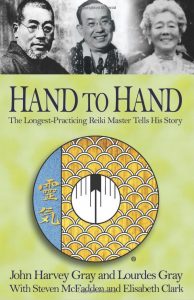 “This long-awaited book by one of the original Reiki masters is a skillful blend of Reiki theory and method, as well as history… a valuable contribution to the study of Reiki in the west and belongs in the library of every student of the healing arts.” – Sacred Pathways