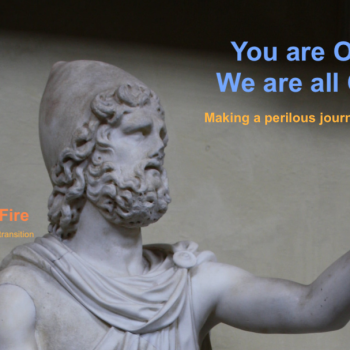
Mythic, illuminated Sirens sing out from eras ancient, present, and forthcoming, We are all being invited once again to make a journey through time, space, and spiritual fire. Big changes are afoot.
Beginning on Christmas Day last, 2024, the hashtag #Odyssey went viral. Oscar-winning director Christopher Nolan (Oppenheimer) had just announced his next project: a film of Homer’s enduring classic, The Odyssey.
The Odyssey hashtag came immediately alive on the Internet, and will likely remain astir at least through 2026 when Nolan’s film will be released. My hope is that in their personal digital journeys, many Net pilgrims will, by use of the hashtag, also come upon the true, online story, Odyssey of the 8th Fire .
 8th Fire is an epic tale of a inspired, contemporary journey by people of all colors and faiths. This odyssey tells of an eight-month walking pilgrimage. The multicultural band of men and women were guided, eventually, by dozens of traditional spiritual elders of North America.
 The long walk took place 30 years ago in 1995-96. It took 230 days to take the steps from the Eastern Door at the Atlantic Ocean toward the Western Gate at the Pacific. Along the way, from sea to shining sea, elders met with the 8th Fire walkers and gave them messages to carry.
Over the last 30 years I’ve remained steady in the view that the long walk of the 8th Fire pilgrims can be regarded as a sample, or an archetypal expression of the great challenging journey that all of us alive are on, right now as the Earth shakes, the winds howl, and governments mutate.
This is an odyssey that we are all on, everyone on Planet Earth. Moving fast now. It appears we are going to go a lot faster, Soon.
What the written story of the 8th Fire Odyssey offers to readers is an opportunity to grasp some of the foundational teachings of this Turtle Island American continent — teachings that have been tried and tested on this continent not just for five or six centuries, but over many thousands of years.
Through this freely-offered nonfiction saga, readers will engage an opportunity to hear and to consider the words of many traditional elders of this Turtle Island continent we now call America.
That has always been my devout intention: to create a bridge of communication and understanding between the ancient, core knowings of this land and our current, forward-leaning civilization. The forthcoming Odyssey film from Christopher Nolan and creative company will help with this, my intuition suggests.
With the wisdom of the elders for support, we are readied for what lies in the present and future. Onward now along our individual and collective odysseys, to and beyond 2025 along the Beauty Way that is indigenous to North America. 

 We’re in transition, that’s for sure. By that I mean the rate of change around the globe–climate, business, education, technology, etc.–is cracking along at a wildfire pace: in our faces. We’re moving decidedly toward some new state of life.


 Thanks to the enterprise and good graces of the New Mexico Book Association (
 My book
  One fundamental understanding of agroecology in general and deep agroecology in particular is that being directly in touch with the earth promotes good physical, mental, and spiritual health for people, animals, plants, and the whole. There’s nothing artificial about that earth-based quality of intelligence, qualities naturally intrinsic to full health.

 The phrase main chance generally refers to the most advantageous prospect available, the opportunity for the greatest progress or gain in any given set of circumstances. I use the phrase now in regard to our tempestuous environmental, climatological, social, and spiritual circumstances.