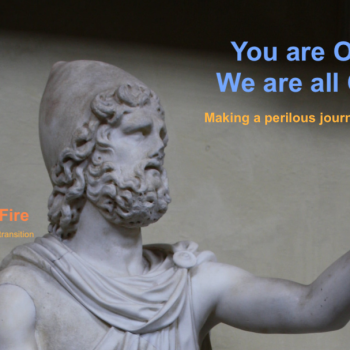
A legendary elder of ancient Greece, the man named Diogenes gained renown by walking through the streets of ancient Athens in broad daylight carrying a lighted lamp. When people would ask him why his lamp was lit in the day, he would reply not that he was looking for an honest man, as is so often reported, but rather that he was “looking for a Human Being.”

Diogenes – was born in Sinope, Turkey (4th Century BCE) but moved to Athens and became the leader of a faction known as The Cynics. Diogenes modeled himself on the example of Hercules, believing that virtue is revealed in action and deeds, not in theory or talk. He lived on the streets and by his wits, without luxuries. Photo of Diogenes statue in Sinope courtesy of Creative Commons.
* * * * * * * *
Diogenes’ quest for Human Beings struck home with me. His search in classical Greece parallels one of the core ethical considerations in classic Native American wisdom ways. For me, someone who has walked hundreds of miles on Native pathways but only a few steps on the marbled hallways of classical Greece, this point of reckoning seems eminently worthy of consideration.
The various cultures that have come to North America over the last 500 years have not yet completed the process of grafting healthfully with the root native culture that has been on the land for many thousands of years. There is a great need for this interweaving to proceed, and here is a foundational point of union.
Understanding of what it means to be a Human Being — in any era of time and any place in the world — is a fundamental wisdom question contemplated in the Americas for millennia.
 Native orators have often given eloquent expression to the idea. Among the well- spoken tradition keepers, I include the late Leon Shenandoah (1915– 1996), an elder and a statesman for the Haudenosaunee (Iroquois) people of The Great Turtle Island (North America).
In the pages of To Become a Human Being, Grandfather Shenandoah says that becoming a Human Being means attaining the highest level in this life, rising above instincts or base emotions to reach a place of equanimity and integrity, recognizing that we are all spiritual beings. A spark of spirit dwells in all life, and a Human Being knows that and acts in the world with that reality held mindfully.
“To become a Human Being is to rise to an expanded level of consciousness by living in physical and spiritual communion with the Earth and the various creatures who share life with us on the land,” Grandfather Shenandoah observed.
Grandfather Shenandoah encouraged everyone to “be the firekeepers that we all are, so that we’re able to instill small fires in each human being and give them hope so that they’ll begin to do good for other human beings.”
 My intent as author of the ebook, Classical Considerations, was to strike such sparks by passing on the teachings of some faithful firekeepers, in particular the late Harvard Master and Classicist, John H. Finley, Jr.
“The doctrine of Horatio Alger, of getting ahead in life, continues to be important,” Finley told me during one of our interviews. “Yet the purpose of mind is not chiefly for you to get some place in society. Our gift is mind; we can see things. That’s what it’s all about. It really is.
“In your brief span, to make sense of all the interesting people you’ve known, all the interesting books you’ve read. This panorama…is increasingly your reward in life.
“After all, the self is both the hero and the villain in life. It is the villain insofar as it reduces the great and beautiful world to the idiotic closet of one’s identity. It is the hero insofar as it tries to go to the window, look out, and see how big the world is and how many people there are and how beautiful the sunlight is.
“It seems to me that waking is far more desirable than dreaming.









 When our Star appears in the East (about 4:00 AM), the mounds for 12 staffs will be marked and put in a circle with an opening to the East. All nations represented with a staff will circle around the center fire for the entrance of the sacred pipes, to be placed in the Four Directions with prayer and song.
 Honoring the Sacred Path for the Five Finger Ones will be done with a Mountain Song, ending with the Blessing Way. The prayer sticks will be taken to the mountain spirits for their guidance and wisdom, as our journey begins here.
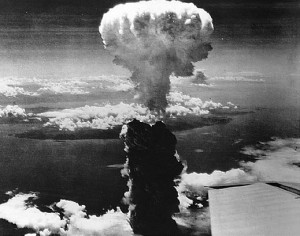 The fire that was ignited 57 years ago on August 6, 1945 when the Enola Gay dropped the first atomic bomb on Hiroshima, Japan, was ceremonially extinguished by a band of pilgrims May 27, 2002 at Big Mountain on Black Mesa in Arizona, in a high desert range sweet with the smell of sagebrush.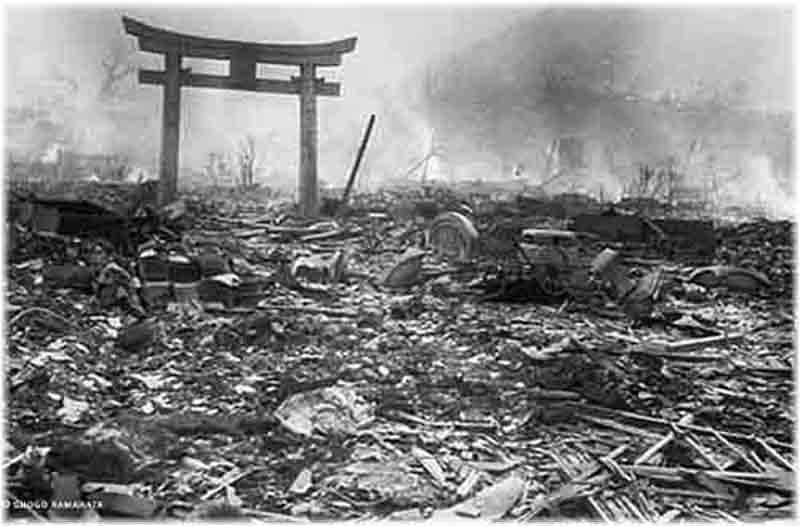


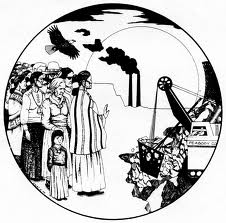 The assault on the material resources of Black Mesa continues. Peabody Coal Co. is planning on expanding operations by opening a new mine, which will ultimately infringe upon Big Mountain itself.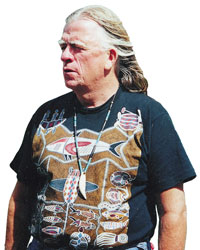
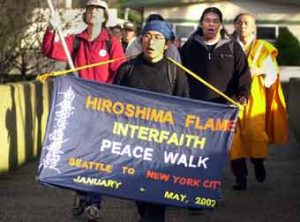 The Hiroshima Flame Interfaith Pilgrimage had its origins in the year 2000 under the inspiration of Tom Dostou while he was in Japan. At that time he was entrusted with a spark of the Hiroshima Flame (the source flame remains burning in Japan). Tom conceived the vision of returning the flame to where it had come from — not as a protest, but as a necessary deed of spiritual redemption, because not only the people of Hiroshima had died, but also many native peoples were poisoned by the uranium dug up, without spiritual permission, on their lands.

 The flame, flickering in a lantern borne by pilgrims on foot, was largely unrecognized and unacknowledged in Los Alamos. Still, the pilgrims completed the work of spiritual redemption they had come to accomplish, and then they walked on toward the East, planning to arrive in New York City on May 12, 2002. Their visit to this place of fire is of marked spiritual significance.
 In the beginning, it is said, the four nations lived together as one and shared their gifts. Then came a time when it was necessary for spiritual growth that the Four Nations disperse to the Four Directions and live apart. Over time they could develop as human beings and master the mysteries of their element for good or ill, according to their free will. Earth, air, fire and water — the peoples went apart.
 The flame the pilgrims carry was ignited 57 years ago and has been tended with prayer ever since. In1945, after the atomic bomb was dropped on Hiroshima, Japan, a man named Tatsuo Yamamoto walked into the ruins of the city to look for friends and family. In shock and anger, he collected some of the embers still smoldering from the bomb and carried them home.
 The nuclear bomb is an ultimate expression of materialism. When the atomic scientists of Los Alamos took the secret of the atom — the fundamental particle of matter — and developed it into a weapon of mass destruction, they unleashed a scathing, wrathful demon of fire rather than a higher angel of warmth and illumination.
 The glyph was carved into the rock face of the outcropping thousands of years ago by the indigenous Pueblo peoples, whose descendents still live nearby. There are such petroglyphs all over North America, serving as signs and signals of importance to native peoples.
 From the place of Avanyu, the walkers proceeded — drumming and chanting each step — about seven miles to Tsankawi, a prehistoric site that is now part of Bandelier National Monument. Tsankawi is a spectacular place high on a mesa overlooking the Jemez Mountains to the West and the Sangre de Christo Mountains to the East.
 The wind people, the messengers, brought the flame home to its point of origin, having purified it with their chants, prayers and incense. They offered it to the people of the city without rancor, recrimination, or challenge. They offered the flame with understanding and hope. And then they walked on.
 Also on that day, to sound an alarm about the rapidly growing danger of a nuclear conflagration, the Bulletin of Atomic Scientists moved their famous Doomsday Clock forward two minutes closer to midnight. The scientists wanted to highlight the dramatically mounting dangers of political instability, the wide availability of nuclear materials, terrorism, and the aggressive unilateral stance of the US government.
 While dwelling amid the high mountains along the North American Continental Divide, Bennie LeBeau of the Eastern Shoshone tribe experienced a torrent of dreams and visions, especially in 1999. The visions directed him to set in motion the plans for a massive Medicine Wheel Ceremony.
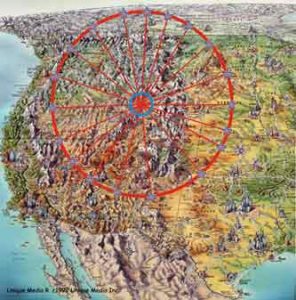 A Medicine Wheel is an ancient spiritual tool with a history of widespread use all over Turtle Island (North America). Stones are set to mark the Four Directions of North, South, East and West, and also of other major points. In this manner, if done with knowledge and respect, a sacred space is defined. Within that space, the people can direct thoughts, feelings and actions toward a unified idea.

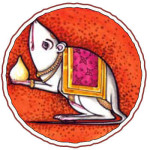 In the Medicine Wheel teachings of Turtle Island the South is a direction sometimes represented by Mouse. Mouse is so small and defenseless against the rest of the world that he must rely on trust and instinct to live. Much larger forces of Spirit are at work in the world, and Mouse understands how humble a creature he is in relation to all this. But good and surprising things can happen when trust leads Mouse to make a bold move for survival, guided by Spirit.
 In the context of Grandfather’s words, the ravaged land all around Turquoise Mountain bespeaks an ugly story. Over many years
  The call for people of all nations, races, and traditions to participate in this massive Medicine Wheel ceremony comes at a time of widespread military conflict, and of profound environmental damage to the earth, the wind, the fire and the water. It is also a time of intense culture war.


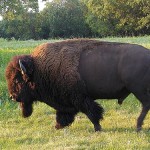 Of note, Yellowstone Park is also the site of a legal, on-going Buffalo slaughter. The Buffalo are killed to prevent them from becoming “too numerous.” In native understandings, Buffalo are widely considered to be healers of the earth. The places where their hooves touch the soil are especially fertile.


 “A lot of the spiritual work people do is just putting whipped cream on top of a bowl of garbage. You’ve got to clean up the garbage first before you add the whipped cream.
 “What happens when you grow old and no longer wish to compete with younger people? Who do you look toward for models? Someone who is old, or someone who is an elder? And what is the difference? How do you become a sage? It’s not necessarily the result of book learning.
 So the story is: a person comes to the wise man and says, ‘how do you get wisdom.’ He says, ‘wisdom comes from good judgment.’ And how do you have good judgment? So the wise one says, ‘from experience.’ And where do you get experience? ‘From bad judgment.’
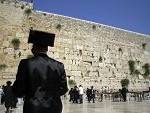 “Rabitizikel is a teenager, and the father is the venerable head of a Hassidic group. Suddenly there appears before them a person who says, ‘Rabbi, I need some help, I’m about to get married and I need some money badly.’ The Rabbi looks at him and says, ‘don’t you know you’re dead, you’ve died already.’ The man says, ‘what are you talking about? They are waiting for me. I need the money, please help me.’ The Rabbi lifts up the man’s coat and shows him that underneath his coat he has shrouds, the shrouds with which he was buried. Suddenly, it dawns on the man what has really happened and he disappears.
 “There was a pearl beyond any price and he had to go find that pearl. The pearl was in Egypt. It was guarded by a dragon, a very fierce dragon. The king called his son and told him that he must do this, and don’t you want to some day assume the role of being a person of majesty? The son said ‘yes, I want to do it.’ The whole dream, the whole notion excited him a great deal — yes, he wants to do the heroic thing.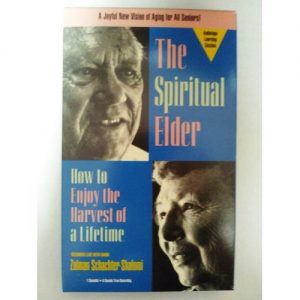
 “I start looking ahead,” Zaida Zalman says, “and suddenly I find I am looking through the rearview mirror. When you ask, ‘what would the future look like,’ I then go into a nostalgic past, a romanticized past, and then go into a tribal thing, and think for a moment, it would look like that. But it’s not going to look like that.