Our classic book Farms of Tomorrow Revisited continues to support the development of healthy farm & food community linkages.

Our classic book Farms of Tomorrow Revisited continues to support the development of healthy farm & food community linkages.
 With all that’s happening in the world in general, and to our farms and food in particular, I was happy to read this positive, edifying review of one of my books on the subject of Community Supported Agriculture (CSA). The book is titled Awakening Community Intelligence: CSA Farms as 21st Century Cornerstones.
I wrote this slender volume – a vision and a call to action – in 2015, immediately after my twin brother Michael died. I felt his spirit urging me to direct in a constructive way the maelstrom of feelings that swarmed me within and without. Awakening Community Intelligence is the result.
The substantive review appears in the current edition of the Journal of Agriculture, Food Systems, and Community Development.
Here’s the review’s first paragraph: “In the slender volume Awakening Community Intelligence, journalist and long-time community supported agriculture (CSA) advocate Steven McFadden argues for the exponential expansion of CSAs. In the face of profound, disruptive challenges in the 21st century—climate change, resource depletion, geopolitical instability—McFadden believes CSAs have the potential to become “community cornerstones” that provide “key points of stability and orientation.” In ten very short chapters, McFadden unfolds his vision of this potential and issues a call to action…”

Don Bustos of Santa Cruz Farm (author photo)
It was a blessed relief to hear the quietly passionate oration of organic farmer Don Bustos as he stood upon the land for 20 minutes to speak amid shifting rays of softening sunlight on an early August evening in Santa Fe, New Mexico. With dignity, he stood for clean food, for community food, and for food sovereignty.
Earlier on this crossquarter day the outpouring of farm news had been grim. We learned that the Dead Zone in the Gulf of Mexico caused by fertilizer and chemical runoff from industrial farming has swollen to an area larger than the state of New Jersey. We learned that despite scientific warnings the EPA declined to ban chlorpyrifos, a highly toxic farm pesticide known to interfere with human hormones, and to diminish IQ in children. We learned of serious labor shortages in the farm fields as immigration officials drive farm workers away from US lands. We learned that dramatic changes for industrial agriculture are essential now to reckon with the intensifying impact of climate change. We learned also that the suicide rate among US farmers is higher than that of the overall US workforce.
Without referencing any of these specific news items, Bustos acknowledged the larger system of which these developments are part. He mentioned the corporate industrial “militarization” of agriculture. Then with clarity and conviction he said that’s not the way to go. “We must grow food with respect. We must grow it in a way that acknowledges Creator and the spirit in the land.”
Bustos talk was part of the Farms Films Food program hosted by the Santa Fe Farmers Market Institute in collaboration with the Center for Contemporary Arts and the Street Food Institute.
The acequia-watered Santa Cruz Farm in Española, New Mexico that Bustos now tends has been in his family since the 1600s. Speaking broadly to encompass all of agriculture, he said that his big goal is “to make it possible that our children can farm on the land for the next 400 years.”
Nowadays Bustos cultivates about 70 crops on 3 ½ acres. At that scale, he’s developed an economic approach that enables him to give attention to the wider world. He trains young people to work the land, and to keep alive the centuries-old traditions of family farming in New Mexico. He’s a champion for community food sovereignty and for food justice at local, state and national levels. In 2015 he received the James Beard Foundation Leadership Award, specifically honored for his work “in support of farmers’ rights and education, and his efforts to include farmers of color in the national food movement.”
When he spoke in Santa Fe this week Bustos said that in his farming he’s guided by three keys: the traditional rituals and practices of northern New Mexico farmers, modern organic cultivation practices, and the Biodynamic Calendar.
“The strongest connection with Creator comes,” he said, “when you have your hands, feet and knees on the soil, and you are working with plants.” “Nature will tell you. You will understand signs so that you know you are on the right path.”
“I still grow and save seeds from our crops to plant the next year,” he said. “Saving open-pollinated, heirloom seeds is really important, but it’s not a silver bullet to solve the problems of agriculture.”
“Food should be grown in healthy soil with healthy water by people who are healthy. Then you have right relationship to the earth. The silver bullet is for everyone to take responsibility for their food by growing it, or supporting the people in their community who grow it for them. That connection to the Earth,” Bustos emphasized, “is important for everyone. It’s one of the Pillars of Food Sovereignty.”

EVERYTHING AT HAND – Massive, impressive cast-iron sculptures by Tom Joyce are on display until Dec. 31 at the Center for Contemporary Arts, site of the Farms Films Food program. (author photo)
The USDA’s Agricultural Marketing Service has this month published a report titled Community Supported Agriculture: New Models for Changing Markets. The report highlights changes – from the 1980s to the present – in what the USDA refers to as the “business model” of Community Supported Agriculture (CSA).
 For anyone interested in local food or food security, the report is worthwhile reading: well researched and written, instructive, and enriched with informative case histories.
But the report moves me to articulate once again what I consider to be an essential point: CSA was not developed as a marketing strategy. Obviously, some companies and farms choose to approach CSA that way, as is their right. Equally obvious, there is of necessity somewhat of a marketing element involved in most CSAs.
But to assert the idea that CSA is a marketing strategy – as the USDA and many land grant institutions routinely do – is to alter the core ideas of CSA. Even though “business model” and “marketing strategy” have become widespread approaches to CSA, in my view emphasizing those concepts shifts the focus from where it needs to be.
CSA farms will likely always be at a disadvantage in the “market” in the realms of price, consumer choice, and convenience. But that’s not what the CSA model was developed to address. CSA was developed by a wide community of people as a way to renew our relationship with the land, with the people who grow our food, and with each other.
Asserting this view now, in light of the trend to define or frame CSA as a business model, will likely be regarded by some people as either anachronistic, or as dewy-eyed idealism. I’m among those who think otherwise. I think it’s essential to keep the focus and the framing of CSA on the core ideas. CSA is not structured to be part of a competitive commercial marketplace, where market forces will always be the determining factor, rather than farm needs, farmer needs, and community needs. It is, after all, not just community supported agriculture, but also agriculture supported communities.
The steady morphing of CSA from a farm-and-community collaboration to a marketing strategy is, in my view and the view of others, off the mark and ultimately inadequate to the challenges of intensifying political and climate turbulence. Something different is required, and that difference has been the ideal and overlighting spirit of CSA: communities and farmers working together on the land to create new ways of living in relation with each other and the natural world which we all depend upon for survival. Ideals, of course, exist in the realm of the mind, and in practice the best we can do is strive toward them.
To survive and perhaps prosper in an era of climate and political turbulence, CSA needs to remain the realm of mutually beneficial community association. That’s a fundamental CSA concept that gets sidelined or obscured when CSA is treated as a marketing strategy.

l
Some of this understanding has found expression in the Community CSA Charter that was developed earlier this year by an ad hoc community initiated by CSA author Elizabeth Henderson.
In a community e-mail discussion of various charter drafts, Anthony Graham (a CSA farmer for 30 years at the Temple-Wilton Community Farm in NH) made this point eloquently: “Our farm members are just that – members who support the farm. We make it clear to them from the start that they are supporting a farm and receiving the produce as a consequence of that support. They are never seen as or referred to as customers and especially not as consumers. Instead the community aspect of our farm lives here very strongly – almost everyone feels some ownership and willingness to share the risk of crop failures as well as the bounty that can allow them to process extra food for the winter.”
He concluded, “Our farmers have always felt that it is important that we have regarded our farm as a community and not as a business – we always try to aim at agriCULTURE rather than agriBUSINESS.”
To endure and perhaps thrive in our extreme era, CSA cannot be redefined to a competitive selling system dependent on “customers.” CSA was never intended for that purpose.
In a CSA working toward the principles embodied in the CSA Charter (as opposed to a customer-food subscription business) people are not “buying boxes of food.” The people who comprise the community (whether a city neighborhood, a town, a workplace or place of worship) are providing direct support to a whole farm or network of farms, and then partaking in a share of the harvest. This is a key distinction.
CSA embodies the potential for a new way of life upon the land for farm, farmers and supporting community. The economic impulses are associative, rather than competitive or exploitive, the impulses that have impelled industrial agriculture to become such a destructive force nationally and globally.
Some progress has been made in the direction of CSA as a new form of economics and relationship with the land, the farmers, and the people who as a community become part of a farm. Much more is possible. And I think much more is necessary.
“Whoever controls the seeds in a culture is going to control life.”
~ Emigdio Ballón, Tesuque Pueblo Farm
My notes from the impressive Mountain West Seed Summit in Santa Fe, New Mexico over March 3-4, 2017 – a gathering of seed savers, and people representing seed hubs and seed companies:
Belle Starr, co-founder of the hosting organization, the Rocky Mountain Seed Alliance, an organization started just three years ago: “We are working to build strong food hubs around the country. The local food movement is huge and growing. But how many are saving seeds? That part is missing.
“What is our duty? Diversity. I hope the thing we carry out of this summit is passion to empower and inspire. That’s how we are going to get diversity. This has to be a grassroots movement. The more people who save seeds, the more resilient the system we create…We hope this will go on for generations.”

Emigdio Ballón, a Quechua native from Bolivia, Agricultural Director for the Pueblo of Tesuque, NM: “The seeds are calling us. They are asking us to help them continue their evolution as they help ours.

Emigdio Ballon (R) speaks with his fellow farmers outside the seed bank at Tesuque Pueblo Farm.
“It’s very difficult for the seeds now. In 2011 we talked about seed security and its relation to food security. That’s when we started our seed bank to protect the seeds handed down to us from time immemorial. Now we are talking also about climate change, and how that is impacting us. How can the seeds sustain us, and our unborn? They need to be protected because of the corporations polluting the earth, and claiming patents over nature. Indigenous people care. Indigenous peoples are protectors.”
Clayton Brascoupe, a Mohawk/Anishnabeg farmer, founder of the Traditional Native America Farmers Association: “What is a seed? Seed is life, mother, embryo, treasure, potential, possibility, relative, our child. All of those things. There is a fundamental, essential relationship that we have.
“We’ve been going along side by side with each other for thousands of years, and now we are in this present generation. We have a treaty, a covenant with the seeds. The seeds are a part of who we are. We have to take care of our relatives, the seeds, and they in turn will take care of us.
“Seeds are the first link in the food chain, and this link is now under threat. Our responsibility is to preserve them for forthcoming generations.”
In remarks to initiate day 2 of the Seed Summit, Bill McDorman, director of the Rocky Mountain Seed Alliance spoke about the importance of developing Seed Hubs in parallel with Food Hubs and other local farm and food initiatives. “There’s a real need globally for many more regional operations. Seeds are the foundation not just of our food system, but of civilization itself…This can save us. Regional organizations are the key.”
Andrew Kimbrell, founder and director of the Center for Food Safety, gave a riveting keynote presentation. He began by mentioning that with the financial backing and technical expertise of entrepreneurs from Silicon Valley, the Center is about to launch an international online network for seed savers.
 He placed this forthcoming network, and the importance of seed saving, in the context of three pending corporate mergers: Bayer-Monsanto, Dupont-Dow, and ChemChina-Syngenta. These mergers, likely to get green-lighted by the Trump-Republican Administration, will place over 60% of the world’s remaining seeds in the corporate control of just three companies. They dominate.
All these multinational corporations are intent on continuing to patent life forms, and to sell allied chemicals as essential, expensive, and polluting inputs to the industrial agriculture system.
The accelerating pace of global climate change and corporate seed and chemical control underscore the imperative need to establish non-corporate seed-saving networks, he said. “We don’t know what seeds we are going to need. But the network will be a key. These are dark times.”
Drawing from some of the material in the well-known book he edited (Fatal Harvest: The Tragedy of Industrial Agriculture) he outlined a history of seeds and agriculture in the USA. “Remember the robber barons of the gilded age?” he asked. “We are in the second phase of that.” A century ago the robber barons made their fortunes in railroads, coal, steel, and oil. As succeeding generations of billionaire barons sought further pots of gold, their gaze fixed upon agriculture.
With hybrid plants, poison chemicals (biocides) and patents, robber barons and their corporations over time mutated the meaning and the reality of seeds. Instead of being a commons that united people in ancient and sacred community traditions of caring for a foundational source of life, seeds became a commercial commodity.
Farmers became trapped on technology treadmills: functionaries basically serving as corporate pass-through operations for commercial seeds, chemicals, machinery, oil and gas. Corporations took culture out of agriculture, and substituted industry. For farmers, indebtedness ruled. Whereas just over a century ago as many as 40% of the population was involved in caring for the land and the seed that everything depends upon, only about 1% of the population now has this connection.
Consider where we are now, he said. Via monoculture and intensive chemical use, we continue to deaden and to lose soil. The nitrogen fertilizer of industrial ag leaches out to waterways, creating massive dead zones in our oceans. We’ve lost 90% of our seed diversity. The Center for Food Safety estimates that 35 to 45 percent of greenhouse gases are generated from industrial ag. Thus, the essential elements of farms and food (soil, water, seeds, industrial livestock, etc.) have become zombies.
This system is already dead, Kimbrell said. “It’s a zombie walking. But it’s still unbelievably dangerous. It’s steadily destroying the planet.”
 “We are the future. Sometimes we look at these dominant forces, and wonder how can we possibly overcome? But the zombie system is already dead.”
Corporations used to wallow in hubris, believing that nature was no match for biotechnology. But it turns out that biotech is no match for nature. The idea that you are going to control the traits of living things is false.
The answer Kimbrell argued, is for our economy to transform into a wholly owned subsidiary of ecology. “We can only use things to the extent that they regenerate themselves.” We have to go local, biodiverse, humane, and socially just, he said.
Fundamental to all of this transformation is seed. None of it makes sense without seed. Seed is the center that we need.
While stating that he sees organics as a floor for the future of agriculture, he reminded the audience that it’s under attack. The Freedom Caucus (about 30 hard-right Republican members of Congress) has targeted the National Organic Program for destruction.
In response to a question from the audience, Kimbrell commented on the upcoming 2018 Farm Bill. “If Dante were alive today,” he said, “The Inferno would be about the farm bill.” He said we need to get environmental groups together with farm groups right now, in 2017. “Unless we get ahead of the game,” he commented, “we are lost.”
Three times during his talk Kimbrell quoted the late Rachel Carson, author of Silent Spring. One example: “I believe natural beauty has a necessary place in the spiritual development of any individual or any society. I believe that whenever we substitute something man-made and artificial for a natural feature of the earth, we have retarded some part of man’s spiritual growth.”
Echoing this insight toward the end of his talk as an encouragement to seed savers and to others working to build a just, healthy and equitable farm and food system, Kimbrell said: “We face the spiritual challenge of moving from a culture of death to a culture of life.”
~ END ~
I’m pleased to share this press release, just developed by a community of people who recognize the importance of community farms (CSAs), and who see the potential for enhancing our environment, improving our diets, supporting our local farmers, and cooperating for mutual benefit with our neighbors. ~ SM
Community Supported Agriculture (CSA) farms across the United States and Canada are setting roots more deeply in the land as they unite this year under a community-developed Charter for CSAs that provides a clear definition of what CSA farms are all about.

Logo for the CSA Charter by Ruth Blackwell
With 30 years of history and development, over 7,500 healthy, sustainable community farms have been established in the US, and many thousands more in Canada. These sustainable farms are directly networked with hundreds of thousands of households in the towns and cities where they are based and provide weekly shares of fresh, healthy, locally-grown food.
Together, regional networks and independent CSAs in the USA and Canada are banding together to launch an innovative and strengthening Charter for CSAs. The Charter will be inaugurated on CSA Sign-up Day, February 24, 2017.
CSAs that endorse the Charter are making a public commitment to uphold the principles and practices delineated in the Charter. It will provide a window of transparency for member households and for farmers, helping define and clarify what CSA farms are all about.
In the words of Elizabeth Henderson, CSA farmer and author of Sharing the Harvest, “CSA is a tremendously flexible concept for consumer-farmer connections. It’s an alternative system of distribution based on community values. The economics of direct sales make this a win-win solution for farmers and farm members. The farmer gets a decent price and the member pays less, since there is no middleman.”
“For the farmer,” she added, “CSA offers the possibility of a broad support group. Those groups are composed of local people who know about the farm, who genuinely care about it’s survival, and who are willing to share the farmer’s risks and rewards.
“In reciprocity, CSA farm members have the opportunity to eat fresh, healthy food, to connect with the earth, to know and trust in the people who grow their food, to deepen their understanding of seasonal eating, to support the local economy, and to take an empowered stance of accepting responsibility for one of our most basic needs.”
Anthony Graham, a farmer for 30 years at the Temple-Wilton Community Farm in New Hampshire, said, “When we started the Temple Wilton Community Farm, we were interested in community and in the ‘culture’ of agriculture. What we were attempting to set up was a way for a community of people to support the existence of a farm through good times and bad by making pledges of financial support over the course of one year. By agreeing to support the existence of the farm our members became co-farmers.”
You can find the full Charter for CSAs in the USA and Canada here, along with background information and a list of the CSAs that endorse it.
For more information, contact Elizabeth Henderson, elizabethhenderson13@gmail.com.
I’ve written this message often before, and I shall write it again. Community Farms (CSAs) are a sober and intelligent response to accelerating political and climate turbulence. Economic turbulence may follow. Time to act.
Regarding our overall situation as urgent, I’ve reported extensively about the ominously active factors bearing upon us all & the potentials of positive community action in collaboration with local farms. I’ve also recorded a ½-hour narrated slide show on these issues for Youtube (Awakening Community Intelligence) freely available to all for personal or community education.

Early every year in both the USA and Canada, CSA Signup Day creates an opportunity for existing CSA farms to expand the community in support of what they are doing: clean land, clean food, enhanced local food security.
CSA signup day is also an opportunity for communities – neighborhoods, workplaces, churches and temples, suburbs, and so forth – to get busy establishing community farms, by the hundreds of thousands. It takes time to get a community farm together, but they can make a big stabilizing difference.
In conjunction with CSA signup day, as of 2017 there is a CSA Charter, which sets out the principles and practices that guide CSA farms in the USA and Canada. That’s a big step forward for evolving the community farm web in North America, in a time when big steps are immediately needed.
My most recent book about the CSA movement is Awakening Community Intelligence: CSA Farms as 21st Century Cornerstones.
Farms of Tomorrow, the book about community supported agriculture that the late 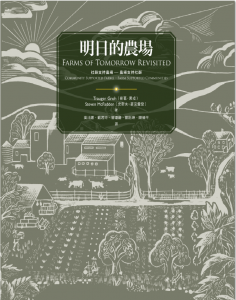 Trauger Groh and I co-authored 27 years ago, has now been translated into Mandarin, the dialect used by 70% of the 1.2 billion human beings who speak Chinese.
When Trauger and I collaborated on the original English-language edition of Farms of Tomorrow in 1989-90 there were perhaps 60 community supported farms (CSAs) in the USA. Now according to the USDA’s 2015 Local Food Census, the number of CSAs is nearly 7,500. There are many thousands more sustainable, organic and biodynamic CSA farms around the world involving hundreds of thousands of households in direct healthy agroecology and food sovereignty. Many of these far-flung community farms are networked through URGENCI, an international NGO based in France.
In the face of the world’s general agricultural, environmental, political and climate turbulence, the steady international, grass-roots development of a sustainable, holistic farm and community model is positive and heartening. These are points I emphasize in a narrated slide show (Awakening Community Intelligence) freely available on Youtube. In it I also sound a call, and offer an urgent argument for why, communities engage now actively to begin establishing hundreds of thousands of new CSA farms.
Eight years after the initial US publication of our book, Trauger and I again examined the ideas, the farms, and the communities at the heart of the growing CSA movement, and we co-authored a revised and greatly expanded edition: Farms of Tomorrow Revisited. This is the volume now translated into Mandarin
 Our book acknowledges that farming is not just a business like any other profit-making business, but a precondition of all human life on earth, and a precondition of all economic activity. As such, farming can be understood as everyone’s responsibility.
The book contains basic essays on principles, structures and ideals for community supported farms. We wrote on pertinent themes: the economic, environmental, spiritual and legal questions faced by CSAs; the development of community; relationship with the land; the role of animals; and the experiences and observations of farm-member families.
As we note in the book, Community Supported Agriculture is not just another new and clever approach to marketing. Rather, CSA is about the necessary renewal of agriculture through its healthy linkage with the human communities that depend on farming for survival. CSA is also about the necessary stewardship of soil, plants, and animals: the essential capital of all human cultures. Our relationship with nature and the ways that we use the land will determine the future of the earth.
By now, more than 30 years after beginning in Japan, Europe, the USA and elsewhere, CSA farms are in every part of the world. Farms of Tomorrow Revisited has been translated into German, Russian, Japanese, Korean, and now the new Mandarin edition. The new translation of our book will join Elizabeth Henderson’s influential CSA book, Sharing the Harvest, which has already been published in Chinese.
The Chinese edition of Farms of Tomorrow Revisited was translated and is published by the Anthroposophy Education Foundation in Taiwan in agreement with the original and current US publisher, the Biodynamic Association. The Chinese edition is being promoted through Facebook.

 Our community circle existed in time for just 91 minutes during Tierra Viva (Farming the Living Earth), the hemisphere-wide conference that was summoned into being by the Biodynamic Association. But over those 91 minutes the 30+ people in the workshop circle brainstormed a resourceful vision for CSA farms going forward.
Our Community CSA Circle took up three challenge questions:
What healthy impulses are trying to emerge related to CSA farms?
How can we cultivate those impulses?
How do communities become awakened to CSA necessities and possibilities?
Overall, the Tierra Viva conference in Santa Fe, New Mexico successfully bridged agrarian wisdom ways of Europe with the indigenous wisdom traditions and innovations of all the Americas. Within the time allotted during the conference, our brief workshop circle successfully conceived of and expressed necessary visionary elements for Community Supported Agriculture (CSA).
In facilitating the CSA workshop I had skilled support from my wife, Elizabeth Wolf. We began by handing out copies of the European CSA Declaration, and also Elizabeth Henderson’s draft proposal for a Community CSA Charter for the USA. Then I offered a talk with slides to explore the history, motivation, context, status, and possibilities for CSA (click here for a narrated Youtube version of the educational slide show).
In my talk I emphasized the extreme conditions we all face regarding climate, economics, industrial agriculture, and politics. These are the hard realities in which CSA farms will either bloom or wither. Finally, the workshop circle of more than 30 people got to work. Via structured group process they developed the following visionary responses to the challenge questions.
1. – What healthy impulses are trying to emerge?
 practical and spiritual benefits arise for participants in CSA farming. CSA puts shareholders in greater tune with nature. This instinctual impulse to connect with the earth that sustains us is inherent in healthy people; consequently farming and gardening are healing and stabilizing for human beings, and of critical importance as we continue to face extreme and intensifying conditions in our digital era. Biodynamic principles and practices support and enhance all of this.
2. – How can we cultivate these impulses?
Encourage opportunities for people to feel they belong to their CSA farm. Let people know they’re not just customers or subscribers, but rather shareholders with an essential stake in the farm. This requires that people actually come to the farm; some of the most successful CSAs (those with a high retention rates) have physical pick-up of shares at the farm or opportunities for members to work at the farm or otherwise engage with the farm.
 “core groups” to create a strong and reliable network of farm support, similar to the way volunteer Boards of Directors serve food coops. While the CSA core group concept hasn’t been popular in CSAs in recent years, it does “take a village” to make a CSA work at the highest possible level. Considering the radically changing circumstances in climate, politics and economics, the core group model – drawing on collective intelligence and resources – is well worth re-considering.
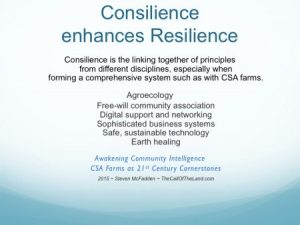 community awareness of environmental issues. CSAs connect people to the earth viscerally. Through that connection people become more firmly rooted in the places where they live and in the natural world, which supports life. Food is a binding impulse that can transcend political orientation. Food is an effective way to invite people into a real community conversation, and to combine their skills and resources to become more effectively and skillfully resilient in the face of the great challenges.
 mmunities often awaken late because of direct crisis, but they can also awaken from intelligent pursuit of models and opportunities. Dialogue can be a big factor in this; thus, it’s important to continue to articulate not just the economic and health dimensions of CSA farms, but also the social and ecological benefits.
* Tierra Viva (Farming the Living Earth) was the North American conference of the Biodynamic Association, November 16-20, 2016 in Santa Fe, New Mexico, USA.
Note: This article originally published in Applied Biodynamics, journal of the Josephine Porter Institute (Issue No. 90, Fall/Winter 2016-17).

As the Sun approached Summer Solstice, my friend Stephen Clarke stopped by to visit. He sat with me at the picnic table by our garden. In the afternoon light we talked.
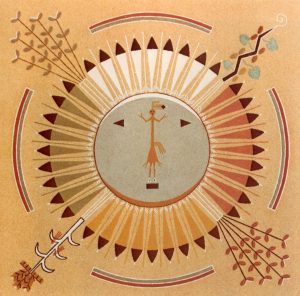
Pollen Boy at the Sun – Chaudron
Stephen spun out for me the tale of his recent journey up onto the Colorado Plateau near the Lukachukai Mountains, close by the imaginary straight line that legally, if not naturally, separates Arizona and New Mexico. Among many elements, this part of the Navajo Reservation is a place of high elevation, white reeds, rich farmland, uranium, tangled history and big sky.
Stephen made his journey to sit with some Navajo friends as part of a week-long Nadáá healing ceremony. He’s an astute observer of matters physical and metaphysical, one of the founding parents of both the Taos and the Santa Fe Waldorf Schools in New Mexico, and also the former proprietor and master mechanic at Mozart’s Garage.
In telling the tale of his visit to Lukachukai, he mentioned how the community of people came together in hard work and good fellowship to abide with one another over a week and to make ceremony expressing timeless ways and courtesies, all woven together within a group energy field of respect and humor many times larger than themselves.
“Native people know how to cooperate in community,” he told me. “It’s silent, it’s unspoken, but it is known and known implicitly by everyone. I see that as the Christ energy in expression. Not as a thought or a feeling, but in action. That’s it for sure. I could see it once again as I sat among the people. The Christ spirit lives in the ethers – the biosphere – as it circulates among people and the natural world.”
When I heard Stephen share his observation it summoned for me the seed thought expressed in Matthew (18:19-20) “…if two of you agree on earth concerning anything that they ask, it will be done for them…For where two or three are gathered together in My name, I am there in the midst of them.”

Stephen Clarke
“Sure,” he agreed. “That fits. Native people know already that the spirit lives in the land and in their relationships with one another. As part of their way, for thousands of years they have had the understanding of spirit life on a practical level.
“There’s a western axiom that ‘the map is not the territory.’ But that’s not so in traditional Native contexts. The land itself is the map and that land map is also indivisibly the territory wherein life unfolds. Physicality and spirituality are not separated by concepts or perceptions, to be worshiped in a metaphysical superstructure high off the ground, but are appreciated as one interpenetrating and mutually revealing reality. Native people have the land as source of spirituality and as the reference point for their spiritual lives.”
Stephen’s story put me in mind of community supported agriculture (CSA), the movement that took root some 30 years ago in the USA with the inspiration of biodynamic understandings, ideals and techniques. I’ve been involved as a reporter and participant since the start, and thus had a chance to observe the development of CSA in the USA over three decades.
Over that span of time many thousands of people in all parts of the world have come to recognize in CSA a vehicle for approaching land, food, labor, environment and community in a healthier way. But as of late the community dimension, and the intrinsic aspect of relationship to the land, have often been marginalized. Efficiency has assumed primacy with institutional efforts to employ CSA as a “market strategy.” In my view, treating CSA as a “market strategy” is not only antithetical to the initial impulses, but also woefully inadequate to the challenges of our time.
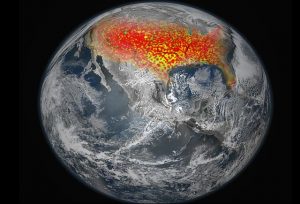 Our era is sharply marked by the mounting, menacing clouds of climate chaos, paralleled by dramatic and urgent shifts in global politics, economics, and social relations. Much more than a market strategy is required. I remain steadfast in my conviction that CSA can play a key role in addressing these issues. It’s time to expand exponentially the CSA vision and reality to hundreds of thousands of community farms around the world, and time also to evolve consciously the community and the associative economic dimensions of CSA.
As Stephen related, Navajo relatives in Lukachukai — with grace and spiritual intelligence, via basic interactions with each other and nature — demonstrated their understanding and appreciation of community and spiritual realities. It’s their way. And their way is part of the strength of the rootstock: the native spiritual, cultural and agricultural knowings that have been cultivated and developed in North America for 30,000 years or more.
 A rootstock is part of a plant, often an underground part, from which new above-ground growth can be produced. Grafting refers to the process by which a plant, sometimes just a stump with an established root system, serves as the base onto which cuttings (scions) from another plant are joined.
The cultural ways that arrived in North America from Europe, Africa, Asia and the far south, have never been deliberately grafted on to the rootstock. Instead, there has been a concerted, systematic, violent and tragic attempt to annihilate the rootstock of native wisdom through protracted campaigns of genocide, wholesale landgrabbing, and systematic treaty violations. That pattern has generated a massive energy field of karma, as yet unreckoned, but now coming into focus as tribes gather at Standing Rock in a historic action to protect the earth for life.
A successful, healthy, conscious grafting of the world’s cultural and spiritual ways to the rootstock of Turtle Island (North America) would, I believe, yield an abundant harvest of goodness, including more respectful, appreciative attitudes toward the land that sustains us all, as well as the agriculture systems we employ to bring forth it’s bounty. Biodynamic agriculture and preparations can play a key role in this critical matter
The initial Biodynamic perceptions and preparations were indigenous to Europe. Now the perceptions and preparations are global, and they are employed in many different ways in many different geographical and cultural contexts, including North America. The Biodynamic impulse can benefit enormously from being more deliberately and skillfully grafted with the rootstock of native knowings. Both will be strengthened. This kind of healthy grafting is certainly a prominent theme in the 2016 North American Biodynamic Conference set for Santa Fe, and rightly so. Much good is likely to arise from this sharing and reciprocity.
But beyond the 2016 conference, fundamental grafting and community questions need to come more into focus. The questions are not just philosophical, but also practical. Considering the status of climate change, they’re also urgent.
 Is there, or could there be, a biodynamic preparation that aids, nurtures and supports the grafting of the world’s wide array of cultural and agricultural traditions to the native rootstock and wisdom ways so inseparably a part of North America?
And what kinds of biodynamic preparations could help magnetize the land and thereby rightly draw to it the interest and dedication of diverse groups of people (communities) who will willingly take on responsibility for caring for it as a farm? In other words, how might Biodynamic understandings and preparations continue to foster the growth and healthy development of CSAs, which can help make an important, positive difference as we all seek to reckon with the momentous changes afoot?
I taled briefly with the Josephine Porter Institute’s Board President, Pat Frazier, about some of these questions. Speaking by cell phone after just having finished milking chores on her Colorado farm, she suggested that as far as community and cultural grafting go, there are indeed intriguing possibilities that could be taken up by biodynamic researchers. But in the present, she said, a good starting point is with a familiar prep that’s already been developed: barrel compost. “Barrel compost is oftentimes created in community,” she said. “It just lends itself to that. It’s easy to make, it joins people together, and it’s transferable to community because once the compost dug out of the pit you can store it, and then share it widely.”
My sense is that both kinds of preparations – a grafting prep and a community prep – could help usher us to the level of strength, courage, intelligence and will necessary to meet the challenges of our era.

Note: I will be facilitating a workshop at the North American Biodynamic Conference in Santa Fe, NM, Nov. 16-20, 2016. The workshop is titled CSA Farms: Awakening Community Intelligence. Stephen Clarke will also be presenting via the conference track for the Agricultural Wisdom of the Americas: Entwining Biodynamic and Indigenous Ways of Working with the Land.
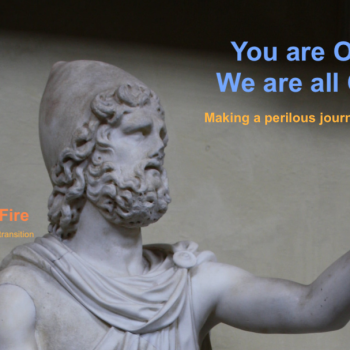 Your actual, real-time Odyssey parallels this Summer’s ‘blockbuster’ film
 New and improved: Classical Considerations
 Behold the Light: Farms, Photons, Futures
 Our Collective Odyssey: Song and Story for the Generations Arising