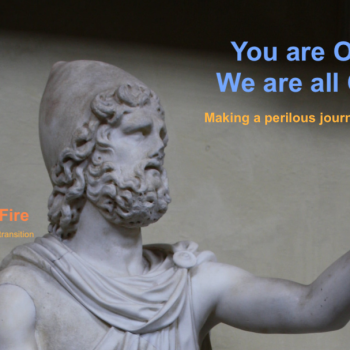
To read Odyssey of the 8th Fire, click here.
With the permission and the encouragement of my friend Manitonquat, I wish to share one of the stories from his book Return to Creation, it’s the story of a Wampanoag teacher who lived many years ago in the Algonquin region we now call southeastern Massachusetts. I’ve been fortunate to have Manitonquat (now 87) as a friend for nearly 40 years. He always tells a good story. With respect, Steven M.
I lie with my back upon the earth. I rest deeply, supported securely on the bosom of the Mother as she turns me toward the Father. The blue depth of my Sky Father’s mind absorbs my own mind.
A few frail puffs of cloud fleet across his face like quizzical expressions. The salt wind from the low tide flats sighs through the marsh grass and rustles the silver poplars in a glimmering dance.
It is good to lie flat on the ground and feel the strength of Mettanokit, our sacred Mother, the earth, radiating her healing energy through our cleansed bodies, filling our thoughts and feelings with her beauty.
The earth seems totally good. The grass, the trees, the rocks, the sand, the river, the ocean, the clouds, the winds, the seagulls, terns, and cormorants sailing and dipping though them – all these seem connected, and I am connected to them all. My body dries warmly with the caressing rays of Nepaushet, glowing golden beyond the sky. What a marvel that it is there, close enough to keep me from freezing, not so close as to burn me up! What a marvel that it exists at all! What a marvel that the earth exists, and that life exists upon it!
What a marvel that I exist and think these thoughts! What a marvel that anything exists, that there is a universe of billions of galaxies with billions of stars and billions of planets in each, and no doubt billions of life forms all struggling to survive and become more conscious. It is very mysterious.
There it is. A vast universe, space, energy, matter, all connected and all following the same natural law. Everything has found a place in it.
And here we are, tiny humankind, one of millions of species of living creatures on one little speck of dust, wondering what our place is and doing some strange things with the brief time of our individual lives: creating death, creating violence, creating famine, creating hatred, loneliness, fear and sickness. How strange!
Pondering the stars, the sun, the earth, the winds and waters and all the other living creatures, I note that everything is working together in a wonderful way. A feeling of perfect trust in Creation pervades my whole being. I have no trouble finding my own path in all this.
But then I look at the human beings, beings capable of love, of beauty and joy. I see humans wrapped in fear, mistrust, and hopelessness. They are angry and frustrated, pursuing self-destruction and destroying the earth along with them.
What an irony that a creature of such intelligence and creativity can appear so stupid and destructive! I recall that the stupid, destructive history of this species is still very recent.
For most of the million or more years that human beings have existed, they have lived in harmony with the natural laws. For most of that time they lived in small circles we call tribes and took care of each other and their environment. They sang and danced and told stories.
Even today in those few areas where civilization has not brought its attendant oppressions upon the natural tribal peoples, they still live that way, close to each other and the natural earth cycles.
In order to consider the complicated causes of the destruction we see today, we need to get in touch with the basic reliability of the universe. We need to experience that simple feeling of rightness that attends our contemplation of existence apart from the confusions of human activity. When We do so, the understanding that pervades our perception of Creation is one of trust. Trust.
It is a lack of trust that lies behind all the destructive behavior of human beings: the wars, the crime, the greed, the suspicion, the barriers, the isolation, the hurt, the inability to love. All of these begin in fear: the fear of not surviving or of not getting enough, the fear of dangerous and malevolent forces one perceives at work in the universe, the fear that beneath the sweetness lurks the truth of poison and evil.
From a human perspective what we need to know is if the Creation is benign or malignant. Is there safety in it? Take a little journey With
me now. Take the magic feather, and we will rise together and soar above the forests here of pine and oak. There below us are the lands of the Pokonoket Wampanoag, the woods, the beaches, the bays, the rivers and lakes where once were the villages of the Acushnet, the Sakonnet, the Pocassett, the Mattapoisett, the Assawompset, the Nemasket, and the Assonet.
There is Lake Watuppa where some of my forebears lived, and just above it our Watuppa Wampanoag Reservation where we have many ceremonies during the year. Beyond is the wide reach of the Taunton River, which our people knew as the Titticut, a major waterway for us, proceeding north from Fall River.
We will come down on Assonet Neck that narrows the river a little beyond Assonet Bay. There is a state park with a little building that houses and protects a large rock. This is known as Dighton Rock. There are marks carved all over the side facing the river.

There are many theories about these petroglyphs saying that they were made by Vikings, Portuguese explorers, even Egyptians. There are dozens of theories.
Of course, our people know they were made by our ancestors, but theories seem to keep the scholars and hobbyists happy, so we let them alone. They never ask us anyway.
There have been additions over the years, but the basic message was set into the rock a long time ago by a prophet of our people. His name was Weetucks.
At that time, it is said, our people had begun to fall away from the Original Instructions explained to them by Maushop who had departed, many millennia before. He had come to feel that the people depended on him too much and that he was impeding their growth. So he called them together and told them they must assume responsibility for each other, for the Earth Mother and all their relatives, the children of the earth. Then he went away towards the rising sun, there to remain until the world’s end.
After many thousands of years the people had become confused because they had neglected the ceremonies and forgotten the stories and the knowledge that Maushop had taught them. The people were quarreling again, and seeking magic because they were afraid. They forgot to care for each other and began to gossip and to quarrel.
There was a young widow who became pregnant and would not say who the father was. People were superstitious. They thought the father might be a magician or a demon, and they shunned her. She lived in the forest, some distance from the village. and kept to herself. When the baby was born it was a boy, and she called him Weetucks. The boy grew very quickly and soon was helping his mother, hunting and fishing and repairing the lodge.

Wampum
When Weetucks was about twelve years old and coming of age, he told his mother that it was time for him to seclude himself alone for a time, in the traditional way. She did not know how he knew this, for he never went into the village or talked to anyone, and anyway the people had all forgotten about such ways.
He was gone for the turning of a moon. People thought he was lost or hurt and searched for him. When he returned he went straight into the village and collapsed on the water path. He was covered with dirt. for he had buried himself in the earth to receive knowledge from the Mother. And he had been on a mountain top to receive knowledge from Father Sky. from Grandfather Sun, from the winds and the distant stars. When the village people saw Weetucks covered with dirt they knew that he had been given his direction on the medicine path. For they remembered that to go back that way into the heart of the Mother and receive her teachings was the traditional beginning of such a journey.
When this occurred with no instruction from an elder it meant that the knowledge came directly from Kiehtan, from the Creation itself. So they knew this boy must have a special knowledge, and when he spoke they came and listened. He spoke of the old ways, though he had been taught them by no man or woman. He taught them about the Original Instructions of the Creator. He spoke of Maushop’s teachings. of the ceremonies that had been forgotten and how they should be done. He showed them again how to heal themselves in the sweat lodge and mud bath ceremonies. He spoke of healing herbs and other knowledge. Some of these things are well-known now, and others are closely guarded secrets to be known and used in a sacred manner only by our medicine people.
Weetucks was visited one night by two spirit guides from the place of the departed ones, who came to take his mother back on the Star Path to the Land of Souls. At that time they spoke to him of the things that would happen to the land and her people in times that would come.
When the ceremonies for his mother had been completed, Weetucks gathered all the people to tell them of the prophecies he had been given. He said that Hobomocko’s whisper of fear would one day spread across the world, and it would bring disease, violence, and starvation over all the earth. Many would die in confusion and ignorance, but those who remembered the sacred teachings, the Original Instructions, would be able to save their children and heal the earth. Many would lose their way, take a wrong turning, leave the sacred path, yet they would still be able, if they understood in time, to retrace their steps and return to the way of Creation.
Those who returned to Creation would raise theIr children in the right way. These children would begin a whole new world, a world in harmony with all Creation, a world of people guided only by their heart’s joy in love and beauty. He showed the people the rock on which he had carved the story of the Great Spirit creating and giving instructions to all beings.
On the right side are two human beings~ at the culmination of Creation, one listening and returning upon the sacred path. and the other preparing to continue on a path that leads to his own destruction. shown by a bolt of lightning ready to strike.
This was the last message of Weetucks. There was a great feast. Many people had come to hear the prophecies, including the Turkey People from across the bay, who had sometimes been enemies, but now made a new peace with our people. The celebration lasted all through the night with much rejoicing and merriment.
Before dawn the people followed Weetucks to the shores of the Turkey Bay where he bade them farewell. As the sun rose behind them. Weetucks walked across the waves towards the western heavens and was never seen again.
It’s a curious fact that the Hopi people of the southwest also have an ancient carving of prophecy on a rock and its message is much the same. That is what the carvings on Dighton Rock are really about, unknown to all the scholars and archaeologists.
That is not all of the message of the Dighton Rock. but it is not time now to reveal more. I am instructed to tell this part of the prophecy now, as it is in keeping with other prophecies of the peoples of Turtle Island, such as the Hopi message of the Great Purification, the Lakota story of the White Buffalo, and the Anishnabe prophecies of the Seven Fires.
These prophecies are being told now because it is believed that some will hear and heed. Some from every race and nation will begin to retrace their footsteps and find the sacred path again.
For any of you who may find it hard to believe such old tales from a people who are strange to you, let me speak briefly about the 1968
report of the Club of Rome. This club is comprised of scores of the foremost scientists of the world, from every area of learning, who studied the trends of the first six decades of the twentieth century and projected them into the future. This scientific prophecy reads just like our own. Famine, disease, violence, all increasing in our lifetime into the greatest destruction humanity has yet experienced, more devastating to more people than the fire, the ice, or the floods of past eras.
Scientist Isaac Asimov wrote in an editorial in his magazine a few years ago, that he thought we had a less than fifty percent chance of surviving the next thirty years.
But you can be your own prophet. Look at what is happening today in the world all around us. Topsoil is washing away, water tables are receding under the earth. Water and air are becoming more polluted. There is acid rain and a hole in the ozone layer. This is the first time since this world was formed that the relationship between the Earth and the sun has been changed, and it changes more each day. Population is increasing. Famine and starvation grow as more and more of the earth is owned by fewer and fewer people. Fear and mistrust are rising on every hand. Families are breaking up, isolation increases, generation gaps widen, children are abandoned, abused, neglected.
People try to escape through drugs or actual suicide. The courts and prisons cannot keep up with the rising rate of crime, which is itself becoming more and more violent. Terrorism is the political mode of the times, between nations, races, religions. Terror stalks the streets of the major citIes of the civilized world. Governmental intelligence agencies plot assassinations and the overthrow of governments. Multinational industrial cartels squeeze the last life’s blood out of the earth and her tribal and peasant peoples, while the military complex fingers its triggers and demands more sophisticated weapons of destruction.
You don’t have to be a scientist or a visionary to see where all of this must inevitably lead. And no one who has the public’s attention, no political leader, no voice of authority and respect, has put forward any workable solution to all this.

Manitonquat (Medicine Story)
Under these conditions I do not find it strange that there is such apathy and frustration, such hopelessness and barely suppressed anger among people today. I do not find it surprising that young people turn to drugs or cults or the immediate thrills of sensual pleasures or to amassing wealth and courting fame.
And yet when I speak to you here and now, whenever and wherever I speak, at ceremonies, gatherings, on radio and television, the message I bring is one of hope.
The message I bear, from prophecy, vision, and instruction by the traditions of my elders, is that it is not too late for those who listen and heed. Humankind has created all of the problems which it now faces, and humankind can solve them, if we but will.
The same genius that has created weapons of incredible destruction and has probed beyond the earth to the very stars could certainly find a way to bring the peoples of earth together for their own survival.
But it is as though we were in a burning house and all the people in it, instead of trying to put out the fire, were just redecorating their rooms and even robbing each other to do it.
There is no doubt in my mind that millions of people will not be able to survive the holocaust that we are even now preparing for
ourselves. There is also no doubt in my mind that anyone can still find the Sacred Path of the Creator, and that each of us who does has the power to create with others a society of harmony and joy, wiser and stronger for the lessons of this age of terror and confusion.
It is hard, in a world that already has so much suffering in it, to think that it will soon be worse beyond our imagining. But because it is hard, we should not refuse to see it, to look at it, think about it, and to take action in our lives. People speak of political problems, economic problems, sociological problems, psychological problems, and everyone has a pet theory of how to solve his or her own pet problems. Those are just bandages on the sores of a diseased body.
A deeper remedy must be found for the inner cause of the disease. The disease is caused by oppressive and hurtful social systems. We do not see the fundamentally oppressive nature of these systems because all of society teaches and fosters basic philosophical and spiritual errors. At the deepest level the disease is spiritual.
Spirituality as I conceive it is simply the relationship of all things in the universe. Instead of thinking only of ourselves, we must consider our families, our children, our unborn generations, our planet and all the beings who share it with us, as well as the star-beings throughout the cosmos, and the connections among all of these. Where it must all begin is with trust.
Unless we trust that the Creation is good, that it works, that we are good, and that we can learn to live in a good way in this Creation, we give ourselves over to force or to despair. When we do not trust, we resort to force for protection, to police and armies, and we set up a counterforce.
But once we have this trust, we need only to discover the way that Creation works, find the path and follow it. It is the way of harmony, the way of cooperation with natural law.
Fortunately, we have many guides who have followed that path before us and many who are following it now. And we have the guide of the heart within us. There is an old native saying that every step we take upon the Earth Mother should be as a prayer. Now, a prayer is just a way of becoming really conscious, really tuning in to all the relationships of everything in existence.

Wampum carving
To make every step a prayer is simply to be totally conscious in every act we do. Most of us spend most of our waking hours half asleep, only dimly aware of our feelings, to say nothing of what is going on in the world and of the connections between things. Whatever we do has a meaning and an effect. We can ask ourselves, if I am really conscious, what effect will this action have upon Creation? How will it affect me, affect my family and my community? How will it affect the planet? How will it affect the future and the generations to come?
Our elders have passed down to us a guide for doing this. Our people call this the Original Instructions. Let us consider those instructions next. Let us begin to retrace our steps and find the Sacred Path again.
As we go, let us walk in a sacred manner by letting each step be as a prayer. In this way we will find the Path of Beauty, the Path of the Heart, and return to Creation once more.
(Excerpt from Chapter 3, Return to Creation – Copyright 1991 by Manitonquat).
I’m pleased to share this press release, just developed by a community of people who recognize the importance of community farms (CSAs), and who see the potential for enhancing our environment, improving our diets, supporting our local farmers, and cooperating for mutual benefit with our neighbors. ~ SM
Community Supported Agriculture (CSA) farms across the United States and Canada are setting roots more deeply in the land as they unite this year under a community-developed Charter for CSAs that provides a clear definition of what CSA farms are all about.
With 30 years of history and development, over 7,500 healthy, sustainable community farms have been established in the US, and many thousands more in Canada. These sustainable farms are directly networked with hundreds of thousands of households in the towns and cities where they are based and provide weekly shares of fresh, healthy, locally-grown food.
Together, regional networks and independent CSAs in the USA and Canada are banding together to launch an innovative and strengthening Charter for CSAs. The Charter will be inaugurated on CSA Sign-up Day, February 24, 2017.
CSAs that endorse the Charter are making a public commitment to uphold the principles and practices delineated in the Charter. It will provide a window of transparency for member households and for farmers, helping define and clarify what CSA farms are all about.
In the words of Elizabeth Henderson, CSA farmer and author of Sharing the Harvest, “CSA is a tremendously flexible concept for consumer-farmer connections. It’s an alternative system of distribution based on community values. The economics of direct sales make this a win-win solution for farmers and farm members. The farmer gets a decent price and the member pays less, since there is no middleman.”
“For the farmer,” she added, “CSA offers the possibility of a broad support group. Those groups are composed of local people who know about the farm, who genuinely care about it’s survival, and who are willing to share the farmer’s risks and rewards.
“In reciprocity, CSA farm members have the opportunity to eat fresh, healthy food, to connect with the earth, to know and trust in the people who grow their food, to deepen their understanding of seasonal eating, to support the local economy, and to take an empowered stance of accepting responsibility for one of our most basic needs.”
Anthony Graham, a farmer for 30 years at the Temple-Wilton Community Farm in New Hampshire, said, “When we started the Temple Wilton Community Farm, we were interested in community and in the ‘culture’ of agriculture. What we were attempting to set up was a way for a community of people to support the existence of a farm through good times and bad by making pledges of financial support over the course of one year. By agreeing to support the existence of the farm our members became co-farmers.”
You can find the full Charter for CSAs in the USA and Canada here, along with background information and a list of the CSAs that endorse it.
For more information, contact Elizabeth Henderson, elizabethhenderson13@gmail.com.
I’ve written this message often before, and I shall write it again. Community Farms (CSAs) are a sober and intelligent response to accelerating political and climate turbulence. Economic turbulence may follow. Time to act.
Regarding our overall situation as urgent, I’ve reported extensively about the ominously active factors bearing upon us all & the potentials of positive community action in collaboration with local farms. I’ve also recorded a ½-hour narrated slide show on these issues for Youtube (Awakening Community Intelligence) freely available to all for personal or community education.

Early every year in both the USA and Canada, CSA Signup Day creates an opportunity for existing CSA farms to expand the community in support of what they are doing: clean land, clean food, enhanced local food security.
CSA signup day is also an opportunity for communities – neighborhoods, workplaces, churches and temples, suburbs, and so forth – to get busy establishing community farms, by the hundreds of thousands. It takes time to get a community farm together, but they can make a big stabilizing difference.
In conjunction with CSA signup day, as of 2017 there is a CSA Charter, which sets out the principles and practices that guide CSA farms in the USA and Canada. That’s a big step forward for evolving the community farm web in North America, in a time when big steps are immediately needed.
My most recent book about the CSA movement is Awakening Community Intelligence: CSA Farms as 21st Century Cornerstones.
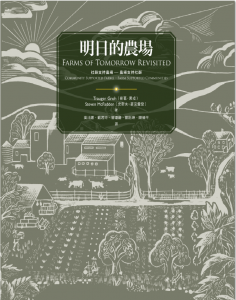
Farms of Tomorrow, the book about community supported agriculture that the late
Trauger Groh and I co-authored 27 years ago, has now been translated into Mandarin, the dialect used by 70% of the 1.2 billion human beings who speak Chinese.
When Trauger and I collaborated on the original English-language edition of Farms of Tomorrow in 1989-90 there were perhaps 60 community supported farms (CSAs) in the USA. Now according to the USDA’s 2015 Local Food Census, the number of CSAs is nearly 7,500. There are many thousands more sustainable, organic and biodynamic CSA farms around the world involving hundreds of thousands of households in direct healthy agroecology and food sovereignty. Many of these far-flung community farms are networked through URGENCI, an international NGO based in France.
In the face of the world’s general agricultural, environmental, political and climate turbulence, the steady international, grass-roots development of a sustainable, holistic farm and community model is positive and heartening. These are points I emphasize in a narrated slide show (Awakening Community Intelligence) freely available on Youtube. In it I also sound a call, and offer an urgent argument for why, communities engage now actively to begin establishing hundreds of thousands of new CSA farms.
Eight years after the initial US publication of our book, Trauger and I again examined the ideas, the farms, and the communities at the heart of the growing CSA movement, and we co-authored a revised and greatly expanded edition: Farms of Tomorrow Revisited. This is the volume now translated into Mandarin
Our book acknowledges that farming is not just a business like any other profit-making business, but a precondition of all human life on earth, and a precondition of all economic activity. As such, farming can be understood as everyone’s responsibility.

The book contains basic essays on principles, structures and ideals for community supported farms. We wrote on pertinent themes: the economic, environmental, spiritual and legal questions faced by CSAs; the development of community; relationship with the land; the role of animals; and the experiences and observations of farm-member families.
As we note in the book, Community Supported Agriculture is not just another new and clever approach to marketing. Rather, CSA is about the necessary renewal of agriculture through its healthy linkage with the human communities that depend on farming for survival. CSA is also about the necessary stewardship of soil, plants, and animals: the essential capital of all human cultures. Our relationship with nature and the ways that we use the land will determine the future of the earth.
By now, more than 30 years after beginning in Japan, Europe, the USA and elsewhere, CSA farms are in every part of the world. Farms of Tomorrow Revisited has been translated into German, Russian, Japanese, Korean, and now the new Mandarin edition. The new translation of our book will join Elizabeth Henderson’s influential CSA book, Sharing the Harvest, which has already been published in Chinese.
The Chinese edition of Farms of Tomorrow Revisited was translated and is published by the Anthroposophy Education Foundation in Taiwan in agreement with the original and current US publisher, the Biodynamic Association. The Chinese edition is being promoted through Facebook.

Our community circle existed in time for just 91 minutes during Tierra Viva (Farming the Living Earth), the hemisphere-wide conference that was summoned into being by the Biodynamic Association. But over those 91 minutes the 30+ people in the workshop circle brainstormed a resourceful vision for CSA farms going forward.
Our Community CSA Circle took up three challenge questions:
What healthy impulses are trying to emerge related to CSA farms?
How can we cultivate those impulses?
How do communities become awakened to CSA necessities and possibilities?
Overall, the Tierra Viva conference in Santa Fe, New Mexico successfully bridged agrarian wisdom ways of Europe with the indigenous wisdom traditions and innovations of all the Americas. Within the time allotted during the conference, our brief workshop circle successfully conceived of and expressed necessary visionary elements for Community Supported Agriculture (CSA).
In facilitating the CSA workshop I had skilled support from my wife, Elizabeth Wolf. We began by handing out copies of the European CSA Declaration, and also Elizabeth Henderson’s draft proposal for a Community CSA Charter for the USA. Then I offered a talk with slides to explore the history, motivation, context, status, and possibilities for CSA (click here for a narrated Youtube version of the educational slide show).
In my talk I emphasized the extreme conditions we all face regarding climate, economics, industrial agriculture, and politics. These are the hard realities in which CSA farms will either bloom or wither. Finally, the workshop circle of more than 30 people got to work. Via structured group process they developed the following visionary responses to the challenge questions.
1. – What healthy impulses are trying to emerge?
practical and spiritual benefits arise for participants in CSA farming. CSA puts shareholders in greater tune with nature. This instinctual impulse to connect with the earth that sustains us is inherent in healthy people; consequently farming and gardening are healing and stabilizing for human beings, and of critical importance as we continue to face extreme and intensifying conditions in our digital era. Biodynamic principles and practices support and enhance all of this.2. – How can we cultivate these impulses?

Encourage opportunities for people to feel they belong to their CSA farm. Let people know they’re not just customers or subscribers, but rather shareholders with an essential stake in the farm. This requires that people actually come to the farm; some of the most successful CSAs (those with a high retention rates) have physical pick-up of shares at the farm or opportunities for members to work at the farm or otherwise engage with the farm.
“core groups” to create a strong and reliable network of farm support, similar to the way volunteer Boards of Directors serve food coops. While the CSA core group concept hasn’t been popular in CSAs in recent years, it does “take a village” to make a CSA work at the highest possible level. Considering the radically changing circumstances in climate, politics and economics, the core group model – drawing on collective intelligence and resources – is well worth re-considering.
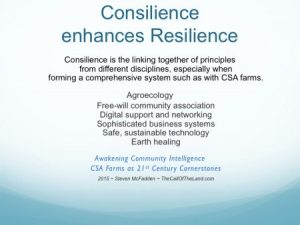
community awareness of environmental issues. CSAs connect people to the earth viscerally. Through that connection people become more firmly rooted in the places where they live and in the natural world, which supports life. Food is a binding impulse that can transcend political orientation. Food is an effective way to invite people into a real community conversation, and to combine their skills and resources to become more effectively and skillfully resilient in the face of the great challenges.
mmunities often awaken late because of direct crisis, but they can also awaken from intelligent pursuit of models and opportunities. Dialogue can be a big factor in this; thus, it’s important to continue to articulate not just the economic and health dimensions of CSA farms, but also the social and ecological benefits.
* Tierra Viva (Farming the Living Earth) was the North American conference of the Biodynamic Association, November 16-20, 2016 in Santa Fe, New Mexico, USA.
Note: This article originally published in Applied Biodynamics, journal of the Josephine Porter Institute (Issue No. 90, Fall/Winter 2016-17).
![]()
As the Sun approached Summer Solstice, my friend Stephen Clarke stopped by to visit. He sat with me at the picnic table by our garden. In the afternoon light we talked.

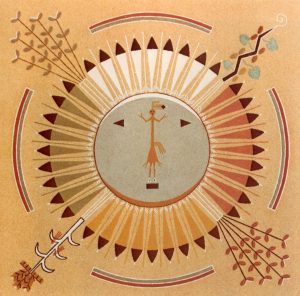
Pollen Boy at the Sun – Chaudron
Stephen spun out for me the tale of his recent journey up onto the Colorado Plateau near the Lukachukai Mountains, close by the imaginary straight line that legally, if not naturally, separates Arizona and New Mexico. Among many elements, this part of the Navajo Reservation is a place of high elevation, white reeds, rich farmland, uranium, tangled history and big sky.
Stephen made his journey to sit with some Navajo friends as part of a week-long Nadáá healing ceremony. He’s an astute observer of matters physical and metaphysical, one of the founding parents of both the Taos and the Santa Fe Waldorf Schools in New Mexico, and also the former proprietor and master mechanic at Mozart’s Garage.
In telling the tale of his visit to Lukachukai, he mentioned how the community of people came together in hard work and good fellowship to abide with one another over a week and to make ceremony expressing timeless ways and courtesies, all woven together within a group energy field of respect and humor many times larger than themselves.
“Native people know how to cooperate in community,” he told me. “It’s silent, it’s unspoken, but it is known and known implicitly by everyone. I see that as the Christ energy in expression. Not as a thought or a feeling, but in action. That’s it for sure. I could see it once again as I sat among the people. The Christ spirit lives in the ethers – the biosphere – as it circulates among people and the natural world.”
When I heard Stephen share his observation it summoned for me the seed thought expressed in Matthew (18:19-20) “…if two of you agree on earth concerning anything that they ask, it will be done for them…For where two or three are gathered together in My name, I am there in the midst of them.”
“Sure,” he agreed. “That fits. Native people know already that the spirit lives in the land and in their relationships with one another. As part of their way, for thousands of years they have had the understanding of spirit life on a practical level.
“There’s a western axiom that ‘the map is not the territory.’ But that’s not so in traditional Native contexts. The land itself is the map and that land map is also indivisibly the territory wherein life unfolds. Physicality and spirituality are not separated by concepts or perceptions, to be worshiped in a metaphysical superstructure high off the ground, but are appreciated as one interpenetrating and mutually revealing reality. Native people have the land as source of spirituality and as the reference point for their spiritual lives.”
Stephen’s story put me in mind of community supported agriculture (CSA), the movement that took root some 30 years ago in the USA with the inspiration of biodynamic understandings, ideals and techniques. I’ve been involved as a reporter and participant since the start, and thus had a chance to observe the development of CSA in the USA over three decades.
Over that span of time many thousands of people in all parts of the world have come to recognize in CSA a vehicle for approaching land, food, labor, environment and community in a healthier way. But as of late the community dimension, and the intrinsic aspect of relationship to the land, have often been marginalized. Efficiency has assumed primacy with institutional efforts to employ CSA as a “market strategy.” In my view, treating CSA as a “market strategy” is not only antithetical to the initial impulses, but also woefully inadequate to the challenges of our time.
Our era is sharply marked by the mounting, menacing clouds of climate chaos, paralleled by dramatic and urgent shifts in global politics, economics, and social relations. Much more than a market strategy is required. I remain steadfast in my conviction that CSA can play a key role in addressing these issues. It’s time to expand exponentially the CSA vision and reality to hundreds of thousands of community farms around the world, and time also to evolve consciously the community and the associative economic dimensions of CSA.
As Stephen related, Navajo relatives in Lukachukai — with grace and spiritual intelligence, via basic interactions with each other and nature — demonstrated their understanding and appreciation of community and spiritual realities. It’s their way. And their way is part of the strength of the rootstock: the native spiritual, cultural and agricultural knowings that have been cultivated and developed in North America for 30,000 years or more.
A rootstock is part of a plant, often an underground part, from which new above-ground growth can be produced. Grafting refers to the process by which a plant, sometimes just a stump with an established root system, serves as the base onto which cuttings (scions) from another plant are joined.
The cultural ways that arrived in North America from Europe, Africa, Asia and the far south, have never been deliberately grafted on to the rootstock. Instead, there has been a concerted, systematic, violent and tragic attempt to annihilate the rootstock of native wisdom through protracted campaigns of genocide, wholesale landgrabbing, and systematic treaty violations. That pattern has generated a massive energy field of karma, as yet unreckoned, but now coming into focus as tribes gather at Standing Rock in a historic action to protect the earth for life.
A successful, healthy, conscious grafting of the world’s cultural and spiritual ways to the rootstock of Turtle Island (North America) would, I believe, yield an abundant harvest of goodness, including more respectful, appreciative attitudes toward the land that sustains us all, as well as the agriculture systems we employ to bring forth it’s bounty. Biodynamic agriculture and preparations can play a key role in this critical matter
The initial Biodynamic perceptions and preparations were indigenous to Europe. Now the perceptions and preparations are global, and they are employed in many different ways in many different geographical and cultural contexts, including North America. The Biodynamic impulse can benefit enormously from being more deliberately and skillfully grafted with the rootstock of native knowings. Both will be strengthened. This kind of healthy grafting is certainly a prominent theme in the 2016 North American Biodynamic Conference set for Santa Fe, and rightly so. Much good is likely to arise from this sharing and reciprocity.
But beyond the 2016 conference, fundamental grafting and community questions need to come more into focus. The questions are not just philosophical, but also practical. Considering the status of climate change, they’re also urgent.
Is there, or could there be, a biodynamic preparation that aids, nurtures and supports the grafting of the world’s wide array of cultural and agricultural traditions to the native rootstock and wisdom ways so inseparably a part of North America?

And what kinds of biodynamic preparations could help magnetize the land and thereby rightly draw to it the interest and dedication of diverse groups of people (communities) who will willingly take on responsibility for caring for it as a farm? In other words, how might Biodynamic understandings and preparations continue to foster the growth and healthy development of CSAs, which can help make an important, positive difference as we all seek to reckon with the momentous changes afoot?
I taled briefly with the Josephine Porter Institute’s Board President, Pat Frazier, about some of these questions. Speaking by cell phone after just having finished milking chores on her Colorado farm, she suggested that as far as community and cultural grafting go, there are indeed intriguing possibilities that could be taken up by biodynamic researchers. But in the present, she said, a good starting point is with a familiar prep that’s already been developed: barrel compost. “Barrel compost is oftentimes created in community,” she said. “It just lends itself to that. It’s easy to make, it joins people together, and it’s transferable to community because once the compost dug out of the pit you can store it, and then share it widely.”
My sense is that both kinds of preparations – a grafting prep and a community prep – could help usher us to the level of strength, courage, intelligence and will necessary to meet the challenges of our era.

Note: I will be facilitating a workshop at the North American Biodynamic Conference in Santa Fe, NM, Nov. 16-20, 2016. The workshop is titled CSA Farms: Awakening Community Intelligence. Stephen Clarke will also be presenting via the conference track for the Agricultural Wisdom of the Americas: Entwining Biodynamic and Indigenous Ways of Working with the Land.
As we are rocked by repeated waves of climate change, and sharp shifts in politics, economics, and society, something durable is called for – something strong, wise, rooted in the land, waiting at last to find a home in our souls.
The core native knowings that have been part of culture and agriculture on this land for 10,000 years or more can enhance our capacity to respond adroitly to the dissolving and shattering forces aroused in our era. For the sake of integrity and resilience, it’s time finally to consciously graft the variety of cultures that have come to roost on North America with the rootstock.

Grafting – wikipedia commons
Grafting refers to the process by which a plant serves as the base (rootstock) onto which cuttings from other plants are joined (the scions). Grafting ensures a strong, healthy and productive crown, arising from a mature root system. It’s also a useful metaphor.
The rainbow array of cultural and agricultural ways that have entered onto the continent from Europe, Africa, Asia and southern latitudes, have never been grafted to the rootstock of Turtle Island (North America). Instead there has been an ongoing violent, systematic effort to annihilate rootstock ways through genocide, land theft, and treaty violations. That pattern has generated a massive energy field of karma, as yet unreckoned.
Now, in an era of pervasive change, it’s both an auspicious and a decisive time for the individuals, groups, states and nations of North America to face the historic and contemporary reality by learning more deeply about, respecting actively, and engaging more constructively with the cultural and agricultural rootstock of the land we now share.
As it happens, a grafting impulse is one of the unifying themes woven into the fabric of the upcoming North American Biodynamic Farming Conference* ~ Tierra Viva (Farming the Living Earth). The conference will draw together a multitude of the diverse cultural and agricultural wisdom streams that are part of modern life in the Americas. Come November the conference will create time and space for fusion on the high mountain plains – the altiplano if you will – of Santa Fe, New Mexico.
The biodynamic farming and gardening movement is one of many natural scions available for grafting to North America’s cultural and agricultural rootstock. But I feel that biodynamics in particular is a propitious domain for such fusion. A forerunner of organics, biodynamics embraces metaphysical realities that organics chooses not to factor in, and strives to work intelligently with subtle forces. When biodynamics was germinating as an agricultural discipline back in the 1920s, teacher Rudolf Steiner encouraged farmers to make use of an ancient principle from the indigenous knowings native to Europe and elsewhere: “Spirit is never without matter, matter never without spirit.”
Native peoples indigenous to the Americas have likewise long appreciated this foundational truth, and held it in the forefront as they refined a culture and agriculture particular to this place, North America, over 10,000 years or more. Rather than using abstract intellectual constructs such as quantum field theory or general relativity, native knowings are conveyed in elegant, tangible metaphors, such as the teaching of the Sacred Hoop (Circle of Life), or the teaching that we have a fundamental responsibility to take care of the earth, for she is indeed our mother (Tierra Madre, Pachamama).
With presenters from the four directions and a rich mix of cultures, grafting will be in the atmosphere at Tierra Viva. Among the farmers, gardeners and grafters whose voices will sound, Larry and Deborah Littlebird of Santo Domingo Pueblo, peacemaker Patricia Ann Davis of the Navajo/Dineh Nation, Emigdio Ballon of Tesuque Pueblo, Dr. Jose Ma Anguiano Cardenas from Nayarit, México, Karen Washington from Rise & Root farm in New York City, Helmy Abouleish from Egypt, Sally Fox of Verditas Farm, and author/chef Deborah Madison from Galisteo, New Mexico.
Cultural and Agricultural Wisdom of the Americas
The rootstock cultural and agricultural knowings of North America constitute basic understandings for long-term survival on this land. The knowings have been gained not over mere centuries, but over many thousands of years. In light of our present circumstances, these basic knowings are both relevant and essential.
For some time healthy natural grafting processes have been progressing in the array of agroecological movements toward clean, wholesome land, water and food, such as good food, slow food, organic food, food justice, food sovereignty, and a variety of First Nations initiatives. These are all positive and promising, but just a fraction of the food system.
Where grafting is acutely needed is in the industrialized, chemicalized, genetically manipulated and patented realms of corporate culture and agriculture. They dominate our food system. And that food system has become one of the most ecologically destructive forces on our planet, a leading contributor to climate chaos. The agriculture system’s dependence on dense, lifeless minerals and an array of poisons, exists in parasitic parallel with an increasingly dense and sick culture at large.
The structure of the dominant food system has origins that extend back through history at least to genocide of native people and theft of their land, to slavery on farms and plantations, to the corporate forces which have driven hundreds of thousands of farm families off the land, to our current wholesale dependence upon, and exploitation of farm workers. All that has to be faced, reckoned with, and resolved, or it remains toxic – toxic in a turbulent era.
But the potential is there for the dominant food system to begin intelligently and skillfully grafting its culture and agriculture to the rootstock. A good starting point would be embracing the teaching of the Seventh Generation – to take into consideration the impact that every corporate project or action will have on our children’s children’s children unto the seventh generation. When a person or a corporation is sure decisions and actions will not harm, but rather will bring benefit to that seventh generation, then it’s time to act. What a profound difference that simple graft could make if taken sincerely.
The healing proposition of grafting has for centuries been eloquently told through the hemisphere-wide saga of The Condor and the Eagle as they are joined via the agency of the Quetzal. It’s an uplifting story, and it expresses a core understanding held by many traditional people in North, South and Central America. Simply hearing the story and paying attention to it creates a healthy bond of understanding.
In keeping with both traditional and emerging understandings, the North American Biodynamic conference in Santa Fe holds promise for further cultural and agricultural grafting progress.
~ END ~
*Note: I‘m a member of the Biodynamic Association, and also one of the presenters at the upcoming Tierra Viva conference. Having had years of involvement with CSA farms and food coops, as well as having had the opportunity to walk thousands miles with native wisdom keepers, I’m strongly drawn to exploration of the cultural and agricultural grafting theme. At the conference I’ll facilitate a workshop titled CSA Farms: Awakening Community Intelligence. ~ S.M.
July 27, 2016 – With sorrow, I note the death this morning of my friend and colleague Trauger Groh, 83, of the Temple-Wilton Community Farm in New Hampshire, one of the oldest continuously operating CSAs in the USA. Trauger is survived by his wife, Alice, and their two adult children, Nicola and Theo, by his daughters in Germany (Daniela, Brigida, Christina, and Patricia), seven grand children, and five great grandchildren. Trauger is also survived by the community farm, still thriving and poised to go forward on the paths he helped to lay out over 30 years ago.
To honor Trauger (1932-2016) and his many contributions to the world at large and in particular to farm communities around the world, I offer the following appreciation. It’s something I wrote earlier this year for the Biodynamic Association.
In the late 1980s I had the good fortune to meet Trauger Groh in New Hampshire, and to engage wholeheartedly with him on the subject of farms and the fundamental role they play in human existence. It took only an hour or two for me to recognize that I was associating with an Agrarian Adept.

Trauger Groh
The word adept derives from Latin, adeptus, meaning one who has attained the highest level of knowledge and skill in a field of endeavor. In olden times the term was applied to accomplished alchemists, or in a general metaphysical sense to an initiate who had mastered the Mysteries.
To me it seems altogether natural and fitting to attach adept as an epithet to convey respect to both Trauger and his wife Alice Bennett Groh, and to his longtime agrarian compatriots, Anthony Graham and Lincoln Geiger. Together they helped initiate a profound form of healing for land, plants, animals and people: Community Supported Agriculture (CSA). This form will endure, I feel, to benefit future generations.
Having worked most closely with Trauger over the years, I want to bring forward some words of appreciation for him and his contributions. He has been an important teacher for me, and for thousands of other people. A biodynamic farmer for over 40 years, Trauger has also lectured worldwide on farm-related issues, biodynamics, and Anthroposophy. His presentations have informed and inspired people in beneficially enduring ways.
Beginning his career in Northern Germany at Buschberg Farm in the 1960s, Trauger studied thoroughly the concepts of biodynamic farming and community co-op programs. In concert with his farm colleagues of that era, he actively cultivated anthroposophic and biodynamic understandings. Together they recognized that new economic, social and agricultural forms were essential. Under the intensifying shadow of corporate industrial agriculture, they strove to create a wider, village-like arrangement based on free-will associations of households with the farm.
Trauger then brought his experience, insight and leadership to the USA in the 1980s, where he made his contributions to the founding of CSA in North America. It’s now 30 growing seasons since Trauger, Anthony, Lincoln and community initiated the biodynamic Temple-Wilton Community Farm in Southern New Hampshire.
CSA arose in the world in response what might be termed a community supported impulse, something that, as Lincoln Geiger once observed, was in the ethers 30 and 40 years ago. Many people were sensing and responding to that impulse with creative innovation. Trauger was among the first and most eloquent exponents of the emerging CSA concepts.
As I entered into a series of deep and far-ranging conversations with him, Trauger gradually articulated the core ideas that found expression not only in CSA farms, but also in the books we eventually co-authored: Farms of Tomorrow in 1990, and Farms of Tomorrow Revisited in 1998. Trauger insisted that both of those editions include the lengthy, but essential subtitle: Community Supported Farms, Farm Supported Communities. He wanted to emphasize the absolute importance of that reciprocal relationship.
Because so many of the ideas articulated by Trauger made a deep and lasting impression on me, and on the wider world as well, I want to rearticulate a few of them in capsule form. They are ideas likely to continue informing the world for years to come.
As Trauger later wrote in his autobiography (Personal Recollections: Remembering My Life and Those Who Mean So Much to Me, 2010), “That farms flourish must be the concern of everyone, not just the individuals working as farmers.”
The idea was for the community to support the whole farm, not just to be occasional consumers buying sacks of carrots, or lettuce or squash. Rather than an agriculture supported by government subsidies, private profits, or martyrs to the cause, CSA pioneers strove to create organizational forms that would provide direct, free will support for farm and farmers from the people who eat their food. That way the farm is in a position to reciprocate and to support the community.
The efforts of CSA pioneers were aimed at the basic economy of finding ways to free farmers to do the tasks that are right for the farm, the people, and the earth. This remains a lofty ideal that many farms and communities of today continue to reach toward, but it’s a concept often overlooked by groups promoting CSA as a “marketing strategy.”

Temple Wilton Community Farm
As Trauger recognized early on, there is fundamental goodness inherent in the coming together of human beings in community and bonded together by a group will to reckon intelligently with the great challenges before us: climate change, environmental degradation, economic instability, and social upheaval. Thanks to Trauger’s articulate expression of the key ideas, many people came to recognize in biodyanmics and CSA forms of agriculture that reach beyond the cultivation of pesticide-free crops, and which reckon also with the challenges of inner development. It is a service to humanity and to the earth.
In his teaching and writing over the years, Trauger elucidated and amplified Rudolf Steiner’s observations concerning modern food lacking the forces that human beings need to develop moral impulses fitting for this era of history and for what lies ahead.
As biodynamic farmers understand, Steiner’s statements asserted that moral impulses are fundamental in human nature. He saw that a foundation of morality and goodness lies at the core of the human soul, but that over the course of evolution human beings have diverged from an instinctual foundation of goodness, allowing what is wrong, hurtful, immoral and evil to be expressed.
“This,” Steiner taught, “is a problem of nutrition. Nutrition as it is today does not supply the strength necessary for manifesting the spirit in physical life. A bridge can no longer be built from thinking to will and action. Food plants no longer contain the forces people need for this.”
Taking this up as a part of his life work, Trauger engaged the issue with resolve: “How can our diet support not only our physical health, but also the development of our spiritual faculties so that they function in the best way?” Farmers have the potential to bridge earth and sky since they can influence the drawing down of cosmic forces and the drawing up of earth forces. Biodynamics strives to engage this interaction intelligently.
Trauger actively and adroitly advanced the case of biodynamic agriculture, and helped greatly in the striving to re-establish the concept of agriculture serving to cultivate a world permeated by life and a life-giving spirit.
By now, 30 years after beginning in Europe, Japan, the USA and elsewhere, CSA farms are in every part of the world. The books I co-authored with Trauger (Farms of Tomorrow and Farms of Tomorrow Revisited) have been translated into German, Russian, Japanese, Korean and other languages. This year they are also being translated into Mandarin (Chinese) thanks to the efforts of Waldorf and Biodynamic communities in Taiwan. Much more lies ahead.
When I spoke with Alice Bennett Groh in the aftermath of a 2014 honoring ceremony for the Temple-Wilton Community farmers sponsored by the Peterborough Grange in New Hampshire, she made an important observation about the work of Trauger, his agrarian colleagues, and their community: “It is unusual, to say the least, maybe even miraculous, that in these times of great social struggle that something that we approached with idealism and dedication has prospered and has had such a profound effect in the world.”
Thanks to the pioneering efforts of Trauger Groh, his agrarian compatriots, and thousands of farm communities, those profound effects will continue to resonate basic goodness for many years to come. ~ Steven McFadden
– END –
In lieu of flowers the Groh family requests that gifts be made to High Mowing School, Pine Hill Waldorf School, and the Temple-Wilton Community Farm.

Would you rather participate in a nightmare or a vision? The nightmare is here and intensifying: climate chaos. Each person, each family, and each community has to reckon with it some way. Community farms (CSAs) are a clean, intelligent and strategic response.
As daily news reports awaken public awareness of profound changes in our climate, economics as well as in our environmental and social well-being, I’m sounding a call for the establishment of hundreds of thousands more sustainable farms on the model of Community Supported Agriculture (CSA).
Over the last three decades hundreds of thousands of people in the US and all parts of the world have come to recognize in CSA a vehicle for approaching land, food, labor, environment, and community in a healthier way.
CSA farms amplify food security, and involve diverse communities of people (from neighborhoods, churches and businesses) in sustainable farming activities that increase food security while building healthy soil to trap greenhouse gases.
According to the USDA, as many as 12,000 new CSA farms have been established in the USA since 1986, directly linking people with the farmers who grow their food. Many thousands more CSA farms have taken root internationally.
I’ve been writing about CSA farms since their inception in the USA in the late 1980s. With Trauger Groh, I’m co-author of the first two books on CSA farms (Farms of Tomorrow in 1990, and Farms of Tomorrow Revisited in 1998). I’m also the author of The Call of the Land: An Agrarian Primer, and Awakening Community Intelligence: CSA Farms as 21st Century Cornerstones.
In late 2015 I was honored to be the keynote speaker at the Midwest CSA Conference. Later this year I’ll present a workshop on CSA farms at the upcoming Tierra Viva (Farming the Living Earth) conference of the Biodynamic Association, to be held at the Santa Fe Convention Center, November 16-20, 2016). My intention is to keep sounding the call both near and far.
As I’ve reported, “In an era with increasing shadows of climate, environmental and social complications, it’s time to expand exponentially the CSA vision and reality. The opportunity is before us to establish hundreds of thousands of CSA farms in nations around the world, and to thereby employ a proven, egalitarian model to address the radically changing circumstances in our environment, climate, economics, and social relationships.”
Behold the Light: Farms, Photons, Futures
Our Collective Odyssey: Song and Story for the Generations Arising
Musical Invocation: Odyssey of the 8th Fire
Marvelous Meme Museum Makes Memories