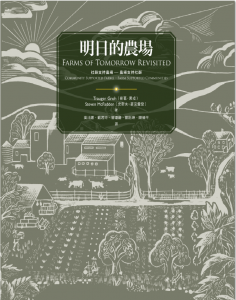
As of 2025 one of the classic books about the CSA movement—Farms of Tomorrow Revisited—has been translated and published in the Spanish language as Las Granjas del Mañana Revisitadas: Comunidad apoyada por Granjas, Granja apoyada por Comunidades.
 Nearly 40 years ago I was the Organic Outlook columnist for a rural newspaper when I met a farmer setting down roots the next town over, Trauger Groh (1932-2016). Trauger and his colleagues Lincoln Geiger and Anthony Graham were founding one of the first CSAs in the nation: the Temple-Wilton Community Farm in New Hampshire.
Recognizing the importance of the seeds the first CSAs were planting, Trauger and teamed up to write Farms of Tomorrow in 1990, published by the Biodynamic Association.
Eight years later we returned to the subject and wrote Farms of Tomorrow Revisited (1998) to consider what farmers and communities were actually experiencing and learning. That’s the version of the book now translated as Las Granjas del Mañana Revisitadas by Martin Alonso of StayTrue Organics in Argentina.
Along with other CSA books, educational materials, and organizations, our books have helped to spark and to support well over 8,000 CSAs (est.) in the USA, and many thousands more worldwide.

Journalist Steven McFadden stands before a poster for Farms of Tomorrow, and also one for Farms of Tomorrow Revisited.
Whether in English or Spanish, the subtitles for our books express a main point of focus: “Community Supported Farms, and Farm Supported Communities.” The phrase reversal in the subtitle highlights an key point. In recent years CSA has often been promoted as a “marketing model,” whereas Trauger and I—along with many others—envisioned CSA as a “community model.” Consequently, in our writing we actively explored social, environmental, and spiritual dimensions of this emerging form.
Our explorations remain healthfully provocative now in 2025, and beyond, especially the explorations of “associative economy,” “parallel polis,” and the preservation of farmland via innovative trusts, that young farmers might be enabled to fulfill their vocations.
Note: In early February 2025 I participated in an online zoom conversation about CSA with the publisher of Las Granjas del Manana. The English-language recording of that zoom call is at this link; the Spanish-language recording is at this link.
In a review of the English-language version of our book, Resurgence Magazine commented “It is rare to come across any practical farming guide that sets out, from its inception, a set of principles that embrace social, spiritual and economic concerns on completely equal terms…The wisdom and clarity of philosophy are striking throughout.”
As Bill T. put it in an Amazon review: “The concepts of community supported agriculture (CSA) grab at the imagination: reconnect with the land and farmer, know exactly where your food is coming from…”
In yet another review published in the Journal of Applied Communications, Mickie Swisher wrote “For those who have little or no previous experience with community-based agriculture, this book brings together information and resources in one place. Even for those who think that community-based agriculture is either unimportant or unrealistic, Groh and McFadden’s book is worth reading. It will, at the least, stimulate thought. With luck, it will produce action.”
The actions now needed – actions that Las Granjas del Mañana Revisitadas can help stimulate – are the further development and networking of clean, healthy, just CSA farms in thousands more communities, both Spanish and English speaking, along with the many other languages of the world.









 With all that’s happening in the world in general, and to our farms and food in particular, I was happy to read this positive, edifying


 Our book acknowledges that farming is not just a business like any other profit-making business, but a precondition of all human life on earth, and a precondition of all economic activity. As such, farming can be understood as everyone’s responsibility.
 Our community circle existed in time for just 91 minutes during Tierra Viva (Farming the Living Earth), the hemisphere-wide conference that was summoned into being by the
  practical and spiritual benefits arise for participants in CSA farming. CSA puts shareholders in greater tune with nature. This instinctual impulse to connect with the earth that sustains us is inherent in healthy people; consequently farming and gardening are healing and stabilizing for human beings, and of critical importance as we continue to face extreme and intensifying conditions in our digital era. Biodynamic principles and practices support and enhance all of this.
 “core groups” to create a strong and reliable network of farm support, similar to the way volunteer Boards of Directors serve food coops. While the CSA core group concept hasn’t been popular in CSAs in recent years, it does “take a village” to make a CSA work at the highest possible level. Considering the radically changing circumstances in climate, politics and economics, the core group model – drawing on collective intelligence and resources – is well worth re-considering.
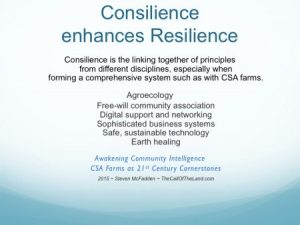 community awareness of environmental issues. CSAs connect people to the earth viscerally. Through that connection people become more firmly rooted in the places where they live and in the natural world, which supports life. Food is a binding impulse that can transcend political orientation. Food is an effective way to invite people into a real community conversation, and to combine their skills and resources to become more effectively and skillfully resilient in the face of the great challenges.
 mmunities often awaken late because of direct crisis, but they can also awaken from intelligent pursuit of models and opportunities. Dialogue can be a big factor in this; thus, it’s important to continue to articulate not just the economic and health dimensions of CSA farms, but also the social and ecological benefits.