For your consideration, here’s a meme I created, based upon the true tales at the heart of my epic, nonfiction saga of North America, Odyssey of the 8th Fire,
Upholding the Pillars of Food Sovereignty

Don Bustos of Santa Cruz Farm (author photo)
It was a blessed relief to hear the quietly passionate oration of organic farmer Don Bustos as he stood upon the land for 20 minutes to speak amid shifting rays of softening sunlight on an early August evening in Santa Fe, New Mexico. With dignity, he stood for clean food, for community food, and for food sovereignty.
Earlier on this crossquarter day the outpouring of farm news had been grim. We learned that the Dead Zone in the Gulf of Mexico caused by fertilizer and chemical runoff from industrial farming has swollen to an area larger than the state of New Jersey. We learned that despite scientific warnings the EPA declined to ban chlorpyrifos, a highly toxic farm pesticide known to interfere with human hormones, and to diminish IQ in children. We learned of serious labor shortages in the farm fields as immigration officials drive farm workers away from US lands. We learned that dramatic changes for industrial agriculture are essential now to reckon with the intensifying impact of climate change. We learned also that the suicide rate among US farmers is higher than that of the overall US workforce.
Without referencing any of these specific news items, Bustos acknowledged the larger system of which these developments are part. He mentioned the corporate industrial “militarization” of agriculture. Then with clarity and conviction he said that’s not the way to go. “We must grow food with respect. We must grow it in a way that acknowledges Creator and the spirit in the land.”
Bustos talk was part of the Farms Films Food program hosted by the Santa Fe Farmers Market Institute in collaboration with the Center for Contemporary Arts and the Street Food Institute.
The acequia-watered Santa Cruz Farm in Española, New Mexico that Bustos now tends has been in his family since the 1600s. Speaking broadly to encompass all of agriculture, he said that his big goal is “to make it possible that our children can farm on the land for the next 400 years.”
Nowadays Bustos cultivates about 70 crops on 3 ½ acres. At that scale, he’s developed an economic approach that enables him to give attention to the wider world. He trains young people to work the land, and to keep alive the centuries-old traditions of family farming in New Mexico. He’s a champion for community food sovereignty and for food justice at local, state and national levels. In 2015 he received the James Beard Foundation Leadership Award, specifically honored for his work “in support of farmers’ rights and education, and his efforts to include farmers of color in the national food movement.”
When he spoke in Santa Fe this week Bustos said that in his farming he’s guided by three keys: the traditional rituals and practices of northern New Mexico farmers, modern organic cultivation practices, and the Biodynamic Calendar.
“The strongest connection with Creator comes,” he said, “when you have your hands, feet and knees on the soil, and you are working with plants.” “Nature will tell you. You will understand signs so that you know you are on the right path.”
“I still grow and save seeds from our crops to plant the next year,” he said. “Saving open-pollinated, heirloom seeds is really important, but it’s not a silver bullet to solve the problems of agriculture.”
“Food should be grown in healthy soil with healthy water by people who are healthy. Then you have right relationship to the earth. The silver bullet is for everyone to take responsibility for their food by growing it, or supporting the people in their community who grow it for them. That connection to the Earth,” Bustos emphasized, “is important for everyone. It’s one of the Pillars of Food Sovereignty.”

EVERYTHING AT HAND – Massive, impressive cast-iron sculptures by Tom Joyce are on display until Dec. 31 at the Center for Contemporary Arts, site of the Farms Films Food program. (author photo)
A Fresh Breath of Storytelling Wind: Reviving the Legend of the Rainbow Warriors
Once oft’ told, the story that I came to know as the legend of the rainbow warriors has in recent years been drowned in the ceaseless tsunami of online information. The tale has slipped beneath the digital flood at a time when its vision is sorely needed.
It’s time to invoke a great whirling surge of Nilch’i Diyin (Holy Wind) into the story, and thereby help it rise back to the surface
The rainbow legend has been glimpsed in vision and then articulated in myriad ways for hundreds of years in various parts of the world, often as well on Turtle Island (North America). The story is told from a spectrum of perspectives, given life by storytellers using music, words, art and dance to animate the tale in their own creative way.
In brief, the legend relates that when the world becomes desperately dirty, sick and chaotic with divisive hate agents at work in realms of race and religion, many people will recognize that they are destroying themselves and the earth they depend upon for survival. With spiritual insight and support, the rainbow warriors — people of all colors, cultures and spiritual outlooks — will respond creatively with insight, intelligence, honesty, caring, sharing and respect. Through personal example and positive, peaceful means, this rainbow network of awakened souls will establish a golden era of peace.
Often mocked as pixie-dust fantasy or outright condemned as fakelore rather than folklore, the rainbow legend persists because it has deep roots, and because it echoes a venerable theme in storytelling: paradise lost, paradise regained. We are squandering paradise in our modern world. Is it therefore surprising that there should arise hopeful tales of a time when a better world may be attained?

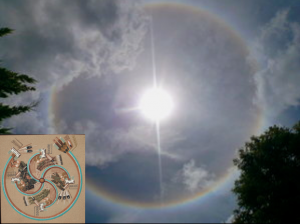
Whirling Rainbow (author’s collection)
Mythologist Joseph Campbell noted that a society that does not have a myth to support it and give it coherence goes into dissolution. “That is what’s happening to us.” Campbell wrote in Transformations of Myth Through Time. And that, I feel, is why it is worthwhile to tell the rainbow tales again in yet another way, to contribute a picture of what I regard as a coherent and positive mythic dimension of understanding for our times.
For 200 years or more a dominant myth in the developing world has been an interpretation of the American Dream suggesting that most people can attain wealth by taking from the land and sea at an industrial scale with a mechanical consciousness, and that happiness will follow from profit. This myth is relentlessly reinforced by advertising images. Yet the unbridled pursuit of these versions of the myth, often by people deep in sleep, has plunged us into a nightmare of environmental devastation, economic upheaval, ethical bankruptcy, and cultural confusion.
As I write more than 40 wars are raging around our world, and another 200 or more armed conflicts are underway. The US National Oceanic and Atmospheric Administration (NOAA) has reported that “the weather is noticeably more chaotic.” Our world is home to more than 7.5 billion human beings. Well over one billion of those human beings are hungry or starving.
In the midst of these stark realities, various myths or frames are conjured via the broadcast voices of demagogues, and the bloody, fear-provoking images so common in movies, music and computer games — the fear-driven myth that the world is hate-filled and chaotic beyond redemption. For many people, in the absence of something more wholesome, such barren and toxic visions become embedded in the psyche as working myths, albeit often unconsciously. Yet the rainbow tales are as possible as the visions of a global death spiral. The enactment of our future is up to us.
The Environment of the Soul
I’ve encountered a spectrum of rainbow myths, beginning in the 1970s when I read the book Warriors of the Rainbow, by William Willoya and Vinson Brown, and then in dozens of other readings and listenings. As is the custom among storytellers and as a lifelong journalist, I passed on the tales I heard later in my own words at gatherings, and in my writing.
My 1992 book Legend of the Rainbow Warriors was an exercise in creative nonfiction. The book relates many of the ancient versions of the rainbow warriors legend, uniting a chorus of voices. It cites seers such as Black Elk and Crazy Horse of the Lakota, Quetzalcoatl of the Toltec, Weetucks of the Wampanoag, Plenty Coups of the Crow, White Buffalo Calf Woman of the Plains, Eyes of Fire of the Cree, Ku’Kulkan, Quetzalcoatl and Montezuma of the of the south direction, the Peacemaker of the Haudenosaunee, Padmasambhava of Tibet, and Alinta of Australia. I included in my book some of the teachings that I’d absorbed over the years from Grandfather William Commanda, Don Estevan Tamayo, Arvol Looking Horse, Martin Gashweseoma and Thomas Banyacya, Oh Shinnah Fastwolf, Slow Turtle, Sun Bear, Reuben Snake, Cachora, Grandmother Doris Minkler, Manitonquat, Don Jose Matsuwa, Dona Josepha Medrano, and others. Though they lived at different times and in different places, they shared a sense of what would unfold.
Legend of the Rainbow Warriors was my effort as a journalist to create an account of one of the core myths of the Americas, and to also explore of how that myth might be playing out in real time.
Do the voices and the rainbow tales add up to something that is ultimately, absolutely verifiably true? That is for you, the reader, to consider and to create. Mythologist Joseph Campbell looked at it this way: “A myth is something that has never happened, but that is happening all the time.”
Those devoted solely to measurable evidence run the risk of missing the point altogether. The rainbow tales are both myth and mystery. Myth creates the opportunity of inspiration, a chance to become aware of something the intellect has not the scope to grasp: access to “the supersensensible environment of the soul” as poet William Butler Yeats expressed it. To this the myth adds a note of mystery: spiritual truths knowable not through reason alone, rather but through contemplation or revelation.
My friend the late Leon Secatero, To’hajiilee Chapter of the Navajo Nation, explained to me that he appreciated these teachings not as prophecies, but rather as knowings.
Leon’s friend and colleague, Don Alejandro Cirilo Perez of Guatemala, elaborated on that insight. Longtime President of the Maya Elders Council and a initiated Daykeeper, Don Alejandro told me: “There is truth in the teachings about the rainbow and the rainbow people. People from all of the Americas will unite with people from all the other nations, and they will realize that we are all family, brothers and sisters. This is not my personal vision, but a cosmic vision presented by all the elders – a vision that we all share.”
A Kitchen Table Telling
I’ve heard 40 or more tellings of rainbow mythology over the decades. On the afternoon of May 13, 2006, I heard another convincing rendition while traveling with my friends Stephen Clarke, and Carlos White Eagle. We were seated at the kitchen table in a rustic ranch house in Haystack, New Mexico, visiting with Navajo Grandfather Martin Martinez, his wife Janice, and their daughter, Kay.

Grandfather Martinez at the 2004 Sodizin Ceremony on Tzoodzil (Mt. Taylor, NM).
Grandfather, in his 90’s and nearing his transition on the Beauty Way, had life experience as a rancher, a rodeo rider, a Code Talker in World War II, and for many long, honorable years as a community leader, a traditional Singer, and the ceremonial keeper of Tzoodzil — the Blue Bead or Turquoise Mountain, now called Mount Taylor. Rising majestically under the blue skies of New Mexico, Tzoodzil is the South Mountain among the Four Holy Mountains that mark the Four Corners of Turtle Island (North America)
As we sat around the kitchen table in the family ranch house, Grandfather told us a story. He spoke in Navajo, and his daughter Kay translated. We smoked a pipe in a sacred manner, and Grandfather said he could remember long ago when he was a boy hearing some of the Medicine elders talk. The Medicine elders told him that during his lifetime there would come a dark era when many problems would arise on Earth. For many people it would seem as though there was no hope.
At that time, the elders told him, the rainbow people would arrive. These rainbow people would find a way to bring healing. The elders told him that it would be a good and important — and that he would see it come true. Grandfather told us that he had never experienced that teaching in fullness until our moments at the kitchen table, and that he was happy to be in ceremony with us, some of the rainbow people. He offered us his warm smile, and three totems. Then he settled in contentment.
Basic Wisdom
An underlying premise of the rainbow legends is that there is a basic wisdom that can help solve the world’s problems. This wisdom does not belong to any one race, religion or culture, but is a tradition of caring, sharing, and sacred light and sound that has existed throughout human experience and that has been expressed by many human beings, certainly including the saints spoken of in the world’s formal spiritual institutions, as well as thousands of other human beings of less formal renown.
We are in a time when many millions – actually billions – of people can and are by circumstances called to give the archetype expression in their lives. Thus the challenge is laid down before us all: live up to the promise.
In light of the legend, my understanding is that rainbow people choose themselves and then strive to live with exalted physical, moral and ethical courage, appreciating that the problems and weapons of the world have been made by the human mind, thus they can be unmade. Rainbow warriors and rainbow walkers need to cultivate compassion, a fundamental attribute of human beings, which will gift them with energy and the power to take action. They will also have to develop insight and intelligence, which will guide them to apply the power of compassion via skillful means.
Rainbow warriors and walkers do no harm, inflict no pain, and cause no suffering. They work to set things right by good example. Their lives are about having integrity, being brave, and standing forthrightly but peacefully for all that supports life. Their quest is for safety, sanity, and respect. According to the legend, ultimately they are triumphant. So the story has been told to me. So in my way I tell it to you.
![]()
Dedicated to the Unconsoled
Dedicated to the Unconsoled – These were among the final words of novelist Arundhati Roy last night when she spoke at the #Lensic Theater in Santa Fe. She was telling us about the 20 years of personal and planetary life that have unfolded into creating her new book The Ministry of Utmost Happiness (June, 2017).
Offering an eye-and-spirit opening array of perspectives on India and the world at large, Roy quoted her friend and colleague John Berger (Ways of Seeing): “This is for those who have learned to divorce hope from reason.”
Roy spoke and conversed eloquently for almost two hours before a packed house, courtesy of her radiant, penetrating intelligence, her talent in fiction and nonfiction, and her charismatic warmth. The good work of the #Lannan Foundation made it all happen
The author shared in particular her ways of seeing developments in India where Hindu fundamentalism has taken a strong corporate-backed, yang militaristic grip on the institutions of power. I could not help but recognize in this a parallel with developments in the USA and Russia, as well as in some Muslim nations. All of this fear-based culture choking unfolds swiftly now in the context of poisonous misogynistic attitudes lacking in all honor or worthiness, in extreme need of redemption.
Roy read passages from several of her books, including her acclaimed novel, The God of Small Things (1997). And she commented both obliquely and directly on the broad picture of global affairs, offering fresh, penetrating and soul-filled ways of seeing.
“We are in a very disturbing place,” she said. “We are pressed up against the wall. There is a different kind of power at work. We need to win the battle of the spirit, the battle of the heart. What we need today for survival is long-term vision…
…and we need a feral howl.”
Our Long Walk as Human Beings
Return to Creation ~ Teachings of Weetucks
With the permission and the encouragement of my friend Manitonquat, I wish to share one of the stories from his book Return to Creation, it’s the story of a Wampanoag teacher who lived many years ago in the Algonquin region we now call southeastern Massachusetts. I’ve been fortunate to have Manitonquat (now 87) as a friend for nearly 40 years. He always tells a good story. With respect, Steven M.
Return to Creation
by Manitonquat
I lie with my back upon the earth. I rest deeply, supported securely on the bosom of the Mother as she turns me toward the Father. The blue depth of my Sky Father’s mind absorbs my own mind.
A few frail puffs of cloud fleet across his face like quizzical expressions. The salt wind from the low tide flats sighs through the marsh grass and rustles the silver poplars in a glimmering dance.
It is good to lie flat on the ground and feel the strength of Mettanokit, our sacred Mother, the earth, radiating her healing energy through our cleansed bodies, filling our thoughts and feelings with her beauty.
The earth seems totally good. The grass, the trees, the rocks, the sand, the river, the ocean, the clouds, the winds, the seagulls, terns, and cormorants sailing and dipping though them – all these seem connected, and I am connected to them all. My body dries warmly with the caressing rays of Nepaushet, glowing golden beyond the sky. What a marvel that it is there, close enough to keep me from freezing, not so close as to burn me up! What a marvel that it exists at all! What a marvel that the earth exists, and that life exists upon it!
What a marvel that I exist and think these thoughts! What a marvel that anything exists, that there is a universe of billions of galaxies with billions of stars and billions of planets in each, and no doubt billions of life forms all struggling to survive and become more conscious. It is very mysterious.
There it is. A vast universe, space, energy, matter, all connected and all following the same natural law. Everything has found a place in it.
And here we are, tiny humankind, one of millions of species of living creatures on one little speck of dust, wondering what our place is and doing some strange things with the brief time of our individual lives: creating death, creating violence, creating famine, creating hatred, loneliness, fear and sickness. How strange!
Pondering the stars, the sun, the earth, the winds and waters and all the other living creatures, I note that everything is working together in a wonderful way. A feeling of perfect trust in Creation pervades my whole being. I have no trouble finding my own path in all this.
But then I look at the human beings, beings capable of love, of beauty and joy. I see humans wrapped in fear, mistrust, and hopelessness. They are angry and frustrated, pursuing self-destruction and destroying the earth along with them.
What an irony that a creature of such intelligence and creativity can appear so stupid and destructive! I recall that the stupid, destructive history of this species is still very recent.
For most of the million or more years that human beings have existed, they have lived in harmony with the natural laws. For most of that time they lived in small circles we call tribes and took care of each other and their environment. They sang and danced and told stories.
Even today in those few areas where civilization has not brought its attendant oppressions upon the natural tribal peoples, they still live that way, close to each other and the natural earth cycles.
In order to consider the complicated causes of the destruction we see today, we need to get in touch with the basic reliability of the universe. We need to experience that simple feeling of rightness that attends our contemplation of existence apart from the confusions of human activity. When We do so, the understanding that pervades our perception of Creation is one of trust. Trust.
It is a lack of trust that lies behind all the destructive behavior of human beings: the wars, the crime, the greed, the suspicion, the barriers, the isolation, the hurt, the inability to love. All of these begin in fear: the fear of not surviving or of not getting enough, the fear of dangerous and malevolent forces one perceives at work in the universe, the fear that beneath the sweetness lurks the truth of poison and evil.
From a human perspective what we need to know is if the Creation is benign or malignant. Is there safety in it? Take a little journey With
me now. Take the magic feather, and we will rise together and soar above the forests here of pine and oak. There below us are the lands of the Pokonoket Wampanoag, the woods, the beaches, the bays, the rivers and lakes where once were the villages of the Acushnet, the Sakonnet, the Pocassett, the Mattapoisett, the Assawompset, the Nemasket, and the Assonet.
There is Lake Watuppa where some of my forebears lived, and just above it our Watuppa Wampanoag Reservation where we have many ceremonies during the year. Beyond is the wide reach of the Taunton River, which our people knew as the Titticut, a major waterway for us, proceeding north from Fall River.
We will come down on Assonet Neck that narrows the river a little beyond Assonet Bay. There is a state park with a little building that houses and protects a large rock. This is known as Dighton Rock. There are marks carved all over the side facing the river.

There are many theories about these petroglyphs saying that they were made by Vikings, Portuguese explorers, even Egyptians. There are dozens of theories.
Of course, our people know they were made by our ancestors, but theories seem to keep the scholars and hobbyists happy, so we let them alone. They never ask us anyway.
There have been additions over the years, but the basic message was set into the rock a long time ago by a prophet of our people. His name was Weetucks.
At that time, it is said, our people had begun to fall away from the Original Instructions explained to them by Maushop who had departed, many millennia before. He had come to feel that the people depended on him too much and that he was impeding their growth. So he called them together and told them they must assume responsibility for each other, for the Earth Mother and all their relatives, the children of the earth. Then he went away towards the rising sun, there to remain until the world’s end.
After many thousands of years the people had become confused because they had neglected the ceremonies and forgotten the stories and the knowledge that Maushop had taught them. The people were quarreling again, and seeking magic because they were afraid. They forgot to care for each other and began to gossip and to quarrel.
There was a young widow who became pregnant and would not say who the father was. People were superstitious. They thought the father might be a magician or a demon, and they shunned her. She lived in the forest, some distance from the village. and kept to herself. When the baby was born it was a boy, and she called him Weetucks. The boy grew very quickly and soon was helping his mother, hunting and fishing and repairing the lodge.

Wampum
When Weetucks was about twelve years old and coming of age, he told his mother that it was time for him to seclude himself alone for a time, in the traditional way. She did not know how he knew this, for he never went into the village or talked to anyone, and anyway the people had all forgotten about such ways.
He was gone for the turning of a moon. People thought he was lost or hurt and searched for him. When he returned he went straight into the village and collapsed on the water path. He was covered with dirt. for he had buried himself in the earth to receive knowledge from the Mother. And he had been on a mountain top to receive knowledge from Father Sky. from Grandfather Sun, from the winds and the distant stars. When the village people saw Weetucks covered with dirt they knew that he had been given his direction on the medicine path. For they remembered that to go back that way into the heart of the Mother and receive her teachings was the traditional beginning of such a journey.
When this occurred with no instruction from an elder it meant that the knowledge came directly from Kiehtan, from the Creation itself. So they knew this boy must have a special knowledge, and when he spoke they came and listened. He spoke of the old ways, though he had been taught them by no man or woman. He taught them about the Original Instructions of the Creator. He spoke of Maushop’s teachings. of the ceremonies that had been forgotten and how they should be done. He showed them again how to heal themselves in the sweat lodge and mud bath ceremonies. He spoke of healing herbs and other knowledge. Some of these things are well-known now, and others are closely guarded secrets to be known and used in a sacred manner only by our medicine people.
Weetucks was visited one night by two spirit guides from the place of the departed ones, who came to take his mother back on the Star Path to the Land of Souls. At that time they spoke to him of the things that would happen to the land and her people in times that would come.
When the ceremonies for his mother had been completed, Weetucks gathered all the people to tell them of the prophecies he had been given. He said that Hobomocko’s whisper of fear would one day spread across the world, and it would bring disease, violence, and starvation over all the earth. Many would die in confusion and ignorance, but those who remembered the sacred teachings, the Original Instructions, would be able to save their children and heal the earth. Many would lose their way, take a wrong turning, leave the sacred path, yet they would still be able, if they understood in time, to retrace their steps and return to the way of Creation.
Those who returned to Creation would raise theIr children in the right way. These children would begin a whole new world, a world in harmony with all Creation, a world of people guided only by their heart’s joy in love and beauty. He showed the people the rock on which he had carved the story of the Great Spirit creating and giving instructions to all beings.
On the right side are two human beings~ at the culmination of Creation, one listening and returning upon the sacred path. and the other preparing to continue on a path that leads to his own destruction. shown by a bolt of lightning ready to strike.
This was the last message of Weetucks. There was a great feast. Many people had come to hear the prophecies, including the Turkey People from across the bay, who had sometimes been enemies, but now made a new peace with our people. The celebration lasted all through the night with much rejoicing and merriment.
Before dawn the people followed Weetucks to the shores of the Turkey Bay where he bade them farewell. As the sun rose behind them. Weetucks walked across the waves towards the western heavens and was never seen again.
It’s a curious fact that the Hopi people of the southwest also have an ancient carving of prophecy on a rock and its message is much the same. That is what the carvings on Dighton Rock are really about, unknown to all the scholars and archaeologists.
That is not all of the message of the Dighton Rock. but it is not time now to reveal more. I am instructed to tell this part of the prophecy now, as it is in keeping with other prophecies of the peoples of Turtle Island, such as the Hopi message of the Great Purification, the Lakota story of the White Buffalo, and the Anishnabe prophecies of the Seven Fires.
These prophecies are being told now because it is believed that some will hear and heed. Some from every race and nation will begin to retrace their footsteps and find the sacred path again.
For any of you who may find it hard to believe such old tales from a people who are strange to you, let me speak briefly about the 1968
report of the Club of Rome. This club is comprised of scores of the foremost scientists of the world, from every area of learning, who studied the trends of the first six decades of the twentieth century and projected them into the future. This scientific prophecy reads just like our own. Famine, disease, violence, all increasing in our lifetime into the greatest destruction humanity has yet experienced, more devastating to more people than the fire, the ice, or the floods of past eras.
Scientist Isaac Asimov wrote in an editorial in his magazine a few years ago, that he thought we had a less than fifty percent chance of surviving the next thirty years.
But you can be your own prophet. Look at what is happening today in the world all around us. Topsoil is washing away, water tables are receding under the earth. Water and air are becoming more polluted. There is acid rain and a hole in the ozone layer. This is the first time since this world was formed that the relationship between the Earth and the sun has been changed, and it changes more each day. Population is increasing. Famine and starvation grow as more and more of the earth is owned by fewer and fewer people. Fear and mistrust are rising on every hand. Families are breaking up, isolation increases, generation gaps widen, children are abandoned, abused, neglected.
People try to escape through drugs or actual suicide. The courts and prisons cannot keep up with the rising rate of crime, which is itself becoming more and more violent. Terrorism is the political mode of the times, between nations, races, religions. Terror stalks the streets of the major citIes of the civilized world. Governmental intelligence agencies plot assassinations and the overthrow of governments. Multinational industrial cartels squeeze the last life’s blood out of the earth and her tribal and peasant peoples, while the military complex fingers its triggers and demands more sophisticated weapons of destruction.
You don’t have to be a scientist or a visionary to see where all of this must inevitably lead. And no one who has the public’s attention, no political leader, no voice of authority and respect, has put forward any workable solution to all this.

Manitonquat (Medicine Story)
Under these conditions I do not find it strange that there is such apathy and frustration, such hopelessness and barely suppressed anger among people today. I do not find it surprising that young people turn to drugs or cults or the immediate thrills of sensual pleasures or to amassing wealth and courting fame.
And yet when I speak to you here and now, whenever and wherever I speak, at ceremonies, gatherings, on radio and television, the message I bring is one of hope.
The message I bear, from prophecy, vision, and instruction by the traditions of my elders, is that it is not too late for those who listen and heed. Humankind has created all of the problems which it now faces, and humankind can solve them, if we but will.
The same genius that has created weapons of incredible destruction and has probed beyond the earth to the very stars could certainly find a way to bring the peoples of earth together for their own survival.
But it is as though we were in a burning house and all the people in it, instead of trying to put out the fire, were just redecorating their rooms and even robbing each other to do it.
There is no doubt in my mind that millions of people will not be able to survive the holocaust that we are even now preparing for
ourselves. There is also no doubt in my mind that anyone can still find the Sacred Path of the Creator, and that each of us who does has the power to create with others a society of harmony and joy, wiser and stronger for the lessons of this age of terror and confusion.
It is hard, in a world that already has so much suffering in it, to think that it will soon be worse beyond our imagining. But because it is hard, we should not refuse to see it, to look at it, think about it, and to take action in our lives. People speak of political problems, economic problems, sociological problems, psychological problems, and everyone has a pet theory of how to solve his or her own pet problems. Those are just bandages on the sores of a diseased body.
A deeper remedy must be found for the inner cause of the disease. The disease is caused by oppressive and hurtful social systems. We do not see the fundamentally oppressive nature of these systems because all of society teaches and fosters basic philosophical and spiritual errors. At the deepest level the disease is spiritual.
Spirituality as I conceive it is simply the relationship of all things in the universe. Instead of thinking only of ourselves, we must consider our families, our children, our unborn generations, our planet and all the beings who share it with us, as well as the star-beings throughout the cosmos, and the connections among all of these. Where it must all begin is with trust.
Unless we trust that the Creation is good, that it works, that we are good, and that we can learn to live in a good way in this Creation, we give ourselves over to force or to despair. When we do not trust, we resort to force for protection, to police and armies, and we set up a counterforce.
But once we have this trust, we need only to discover the way that Creation works, find the path and follow it. It is the way of harmony, the way of cooperation with natural law.
Fortunately, we have many guides who have followed that path before us and many who are following it now. And we have the guide of the heart within us. There is an old native saying that every step we take upon the Earth Mother should be as a prayer. Now, a prayer is just a way of becoming really conscious, really tuning in to all the relationships of everything in existence.

Wampum carving
To make every step a prayer is simply to be totally conscious in every act we do. Most of us spend most of our waking hours half asleep, only dimly aware of our feelings, to say nothing of what is going on in the world and of the connections between things. Whatever we do has a meaning and an effect. We can ask ourselves, if I am really conscious, what effect will this action have upon Creation? How will it affect me, affect my family and my community? How will it affect the planet? How will it affect the future and the generations to come?
Our elders have passed down to us a guide for doing this. Our people call this the Original Instructions. Let us consider those instructions next. Let us begin to retrace our steps and find the Sacred Path again.
As we go, let us walk in a sacred manner by letting each step be as a prayer. In this way we will find the Path of Beauty, the Path of the Heart, and return to Creation once more.
(Excerpt from Chapter 3, Return to Creation – Copyright 1991 by Manitonquat).
R.I.P. Trauger Groh, Agrarian Adept
July 27, 2016 – With sorrow, I note the death this morning of my friend and colleague Trauger Groh, 83, of the Temple-Wilton Community Farm in New Hampshire, one of the oldest continuously operating CSAs in the USA. Trauger is survived by his wife, Alice, and their two adult children, Nicola and Theo, by his daughters in Germany (Daniela, Brigida, Christina, and Patricia), seven grand children, and five great grandchildren. Trauger is also survived by the community farm, still thriving and poised to go forward on the paths he helped to lay out over 30 years ago.
To honor Trauger (1932-2016) and his many contributions to the world at large and in particular to farm communities around the world, I offer the following appreciation. It’s something I wrote earlier this year for the Biodynamic Association.
Trauger Groh, Agrarian Adept
In the late 1980s I had the good fortune to meet Trauger Groh in New Hampshire, and to engage wholeheartedly with him on the subject of farms and the fundamental role they play in human existence. It took only an hour or two for me to recognize that I was associating with an Agrarian Adept.

Trauger Groh
The word adept derives from Latin, adeptus, meaning one who has attained the highest level of knowledge and skill in a field of endeavor. In olden times the term was applied to accomplished alchemists, or in a general metaphysical sense to an initiate who had mastered the Mysteries.
To me it seems altogether natural and fitting to attach adept as an epithet to convey respect to both Trauger and his wife Alice Bennett Groh, and to his longtime agrarian compatriots, Anthony Graham and Lincoln Geiger. Together they helped initiate a profound form of healing for land, plants, animals and people: Community Supported Agriculture (CSA). This form will endure, I feel, to benefit future generations.
Having worked most closely with Trauger over the years, I want to bring forward some words of appreciation for him and his contributions. He has been an important teacher for me, and for thousands of other people. A biodynamic farmer for over 40 years, Trauger has also lectured worldwide on farm-related issues, biodynamics, and Anthroposophy. His presentations have informed and inspired people in beneficially enduring ways.
Beginning his career in Northern Germany at Buschberg Farm in the 1960s, Trauger studied thoroughly the concepts of biodynamic farming and community co-op programs. In concert with his farm colleagues of that era, he actively cultivated anthroposophic and biodynamic understandings. Together they recognized that new economic, social and agricultural forms were essential. Under the intensifying shadow of corporate industrial agriculture, they strove to create a wider, village-like arrangement based on free-will associations of households with the farm.
Trauger then brought his experience, insight and leadership to the USA in the 1980s, where he made his contributions to the founding of CSA in North America. It’s now 30 growing seasons since Trauger, Anthony, Lincoln and community initiated the biodynamic Temple-Wilton Community Farm in Southern New Hampshire.
CSA arose in the world in response what might be termed a community supported impulse, something that, as Lincoln Geiger once observed, was in the ethers 30 and 40 years ago. Many people were sensing and responding to that impulse with creative innovation. Trauger was among the first and most eloquent exponents of the emerging CSA concepts.
As I entered into a series of deep and far-ranging conversations with him, Trauger gradually articulated the core ideas that found expression not only in CSA farms, but also in the books we eventually co-authored: Farms of Tomorrow in 1990, and Farms of Tomorrow Revisited in 1998. Trauger insisted that both of those editions include the lengthy, but essential subtitle: Community Supported Farms, Farm Supported Communities. He wanted to emphasize the absolute importance of that reciprocal relationship.
Because so many of the ideas articulated by Trauger made a deep and lasting impression on me, and on the wider world as well, I want to rearticulate a few of them in capsule form. They are ideas likely to continue informing the world for years to come.
- Our relationship with nature and the ways that we use the land will determine the future of the earth.
- Farming is not just a business like any other profit-making business, but a precondition of human life on earth. As such, farming is everyone’s responsibility.
- Community Supported Agriculture (CSA) is not just another new and clever approach to marketing. Rather, CSA is about the necessary renewal of agriculture through its healthy linkage with the human community that depends on farming for survival.
- CSA is also about the necessary stewardship of soil, plants, and animals: the essential capital of human cultures.
As Trauger later wrote in his autobiography (Personal Recollections: Remembering My Life and Those Who Mean So Much to Me, 2010), “That farms flourish must be the concern of everyone, not just the individuals working as farmers.”
The idea was for the community to support the whole farm, not just to be occasional consumers buying sacks of carrots, or lettuce or squash. Rather than an agriculture supported by government subsidies, private profits, or martyrs to the cause, CSA pioneers strove to create organizational forms that would provide direct, free will support for farm and farmers from the people who eat their food. That way the farm is in a position to reciprocate and to support the community.
The efforts of CSA pioneers were aimed at the basic economy of finding ways to free farmers to do the tasks that are right for the farm, the people, and the earth. This remains a lofty ideal that many farms and communities of today continue to reach toward, but it’s a concept often overlooked by groups promoting CSA as a “marketing strategy.”

Temple Wilton Community Farm
As Trauger recognized early on, there is fundamental goodness inherent in the coming together of human beings in community and bonded together by a group will to reckon intelligently with the great challenges before us: climate change, environmental degradation, economic instability, and social upheaval. Thanks to Trauger’s articulate expression of the key ideas, many people came to recognize in biodyanmics and CSA forms of agriculture that reach beyond the cultivation of pesticide-free crops, and which reckon also with the challenges of inner development. It is a service to humanity and to the earth.
In his teaching and writing over the years, Trauger elucidated and amplified Rudolf Steiner’s observations concerning modern food lacking the forces that human beings need to develop moral impulses fitting for this era of history and for what lies ahead.
As biodynamic farmers understand, Steiner’s statements asserted that moral impulses are fundamental in human nature. He saw that a foundation of morality and goodness lies at the core of the human soul, but that over the course of evolution human beings have diverged from an instinctual foundation of goodness, allowing what is wrong, hurtful, immoral and evil to be expressed.
“This,” Steiner taught, “is a problem of nutrition. Nutrition as it is today does not supply the strength necessary for manifesting the spirit in physical life. A bridge can no longer be built from thinking to will and action. Food plants no longer contain the forces people need for this.”
Taking this up as a part of his life work, Trauger engaged the issue with resolve: “How can our diet support not only our physical health, but also the development of our spiritual faculties so that they function in the best way?” Farmers have the potential to bridge earth and sky since they can influence the drawing down of cosmic forces and the drawing up of earth forces. Biodynamics strives to engage this interaction intelligently.
Trauger actively and adroitly advanced the case of biodynamic agriculture, and helped greatly in the striving to re-establish the concept of agriculture serving to cultivate a world permeated by life and a life-giving spirit.
By now, 30 years after beginning in Europe, Japan, the USA and elsewhere, CSA farms are in every part of the world. The books I co-authored with Trauger (Farms of Tomorrow and Farms of Tomorrow Revisited) have been translated into German, Russian, Japanese, Korean and other languages. This year they are also being translated into Mandarin (Chinese) thanks to the efforts of Waldorf and Biodynamic communities in Taiwan. Much more lies ahead.
When I spoke with Alice Bennett Groh in the aftermath of a 2014 honoring ceremony for the Temple-Wilton Community farmers sponsored by the Peterborough Grange in New Hampshire, she made an important observation about the work of Trauger, his agrarian colleagues, and their community: “It is unusual, to say the least, maybe even miraculous, that in these times of great social struggle that something that we approached with idealism and dedication has prospered and has had such a profound effect in the world.”
Thanks to the pioneering efforts of Trauger Groh, his agrarian compatriots, and thousands of farm communities, those profound effects will continue to resonate basic goodness for many years to come. ~ Steven McFadden
– END –
In lieu of flowers the Groh family requests that gifts be made to High Mowing School, Pine Hill Waldorf School, and the Temple-Wilton Community Farm.
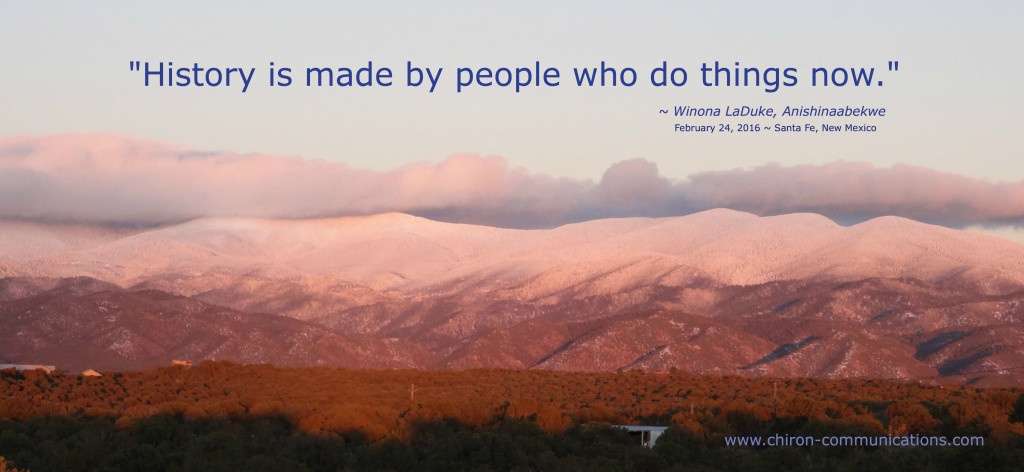
History is made by people who do things now.
Elizabeth and I went to the Lensic Theater in Santa Fe, New Mexico last night to hear Winona LaDuke and Mililani Trask speak as part of the Lannan Foundation’s programs on cultural freedom. Among the many insightful and rousing remarks they shared with the audience, one seemed to me particularly well suited for a meme:

True Saga Commemorates an Epic American Spiritual Quest
Twenty years have come and gone, and thus I am moved to acknowledge and commemorate a great adventure for our era, and the telling of the true tale of that adventure as Odyssey of the 8th Fire.
The 8th Fire saga tells the real story of a great, long prayer walk in 1995-96 from the Atlantic to the Pacific. The story arises from the deepest roots of our land, but takes place in the present and the future. In it, circles upon circles, spiritual elders make a great and generous giveaway of the teachings they carry.
The actual writing of this epic-length, nonfiction story of the 2,500 mile prayer pilgrimage for the earth took place some 11 years after the final steps of the walk. I wrote Odyssey of the 8th Fire over the course of 225 consecutive days beginning in early summer 2007 and finishing in the deep of winter 2008.

Elizabeth- 2015
At the time my wife Elizabeth Wolf and I were living on Calle Contento in Santa Fe, New Mexico. Over those intensely demanding 225 days, Elizabeth provided intellectual, emotional, creative and spiritual support in a thousand ways, and thereby made possible the writing and online publication of the epic, nonfiction saga Odyssey of the 8th Fire. While holding down a fulltime job at Blessingway Authors Services, she remained close to this project as my Muse, critic, and companion from the first word through the last. Her multitude of contributions made an enormous and enduring difference.
Thank you darling Elizabeth for making it possible to spin out in words this ambitious spiritual saga along the Beauty Way, and to make of it a great giveaway for the people. ~ S.M.
Here’s just a short take from the 8th Fire account of the final day of the long Walk for the Earth:
Day 225 – TWENTY YEARS AGO TODAY – February 2, 1996 – Odyssey of the 8th Fire
“We are a part of all that we have met. Yet, experience is an arch wherethro gleams that untravl’d world whose margin fades forever and forever when we move.” ~ Odysseus to Athena, at the end of The Odyssey

Whirling Rainbow Skysign & Sandpainting
…Evelyn Commanda, representing the Algonquin peoples, held one end of the Seven Fires Wampum Belt, and Liz Dominguez, representing Chumash peoples, held the other end. Together, slowly and solemnly, they walked the belt out into the Pacific Ocean, where in a sacred manner they washed it with the waves…
…we were a circle of nearly 80 people representing all the colors of humanity, and many of its spiritual traditions.
We began to express ourselves, to pray. One of the things we gave thanks for on the beach was the tremendous support we enjoyed as we walked. So many wonderful people stopped, or went out of their way somehow to ensure that we succeeded as best we could. So many people responded, and helped us along.
Some people became very interested in the depth and specificity of the prophecies we carried, while others didn’t care very much about that kind of information at all. They just felt we were doing something worthwhile by walking, and that’s all they needed to know. They acted out of basic human goodness. Now in our final ceremony, we sent our gratitude and good feelings to Creator and all the helpers with our song and prayer for all…
Link to the full account of Day 225 of the Odyssey of the 8th Fire.
What they greatly thought, they nobly dared
2015 – This year marks the 20th anniversary of the start of the great prophetic, multicultural Sunbow pilgrimage from the Atlantic to the Pacific in 1995 under guidance of traditional native wisdom keepers and the skysign of the Whirling Rainbow.
The journey began — and remains — the Odyssey of the 8th Fire. I’m honored to have had the opportunity to tell this epic tale freely on the web, and grateful for the help that came to support me in doing it.
As the meme below attests, I’m moved this 20th anniversary year to beat upon the drum, to write, and to otherwise let people know about the journey that took place and that in my mind remains unfinished. That’s a key. Via the Odyssey of the 8th Fire everyone has an opportunity to make a parallel literary and spiritual pilgrimage across Turtle Island (North America). From that journey, I feel, much is to be gained.