For your consideration:
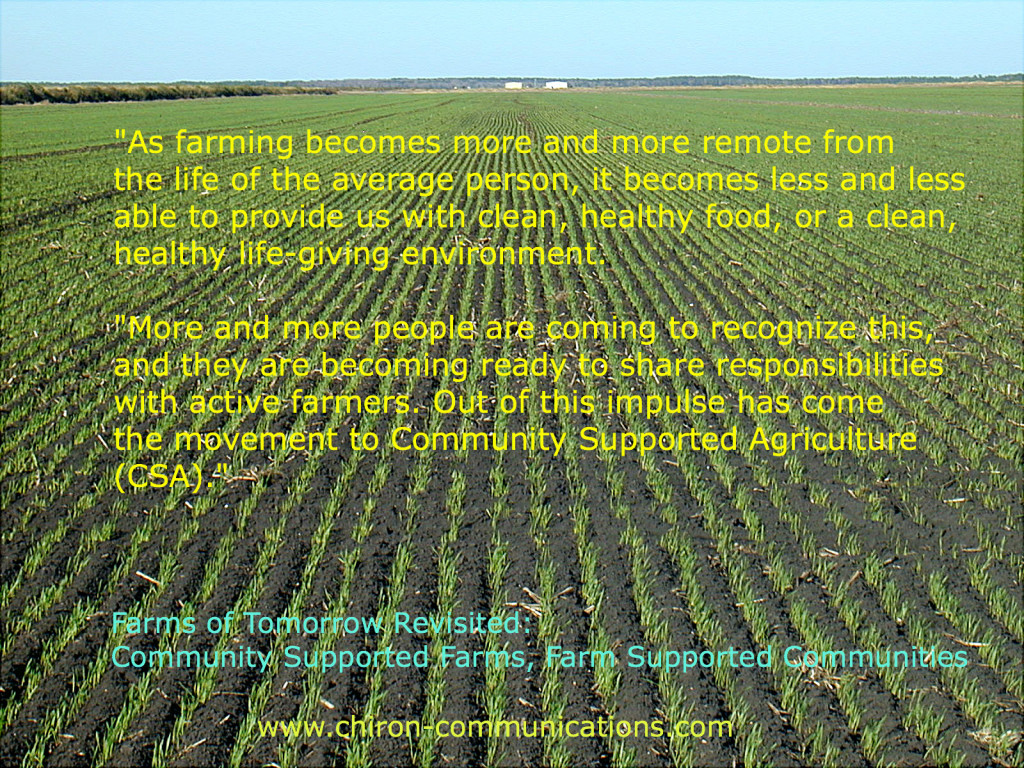
A meme I created this morning with a short quote from the books I co-authored with Trauger Groh:
For your consideration:
A meme I created this morning with a short quote from the books I co-authored with Trauger Groh:
For dozens of reasons, it’s time to convene in America’s heartland a conference of farmers involved in Community-Supported Agriculture (CSA).
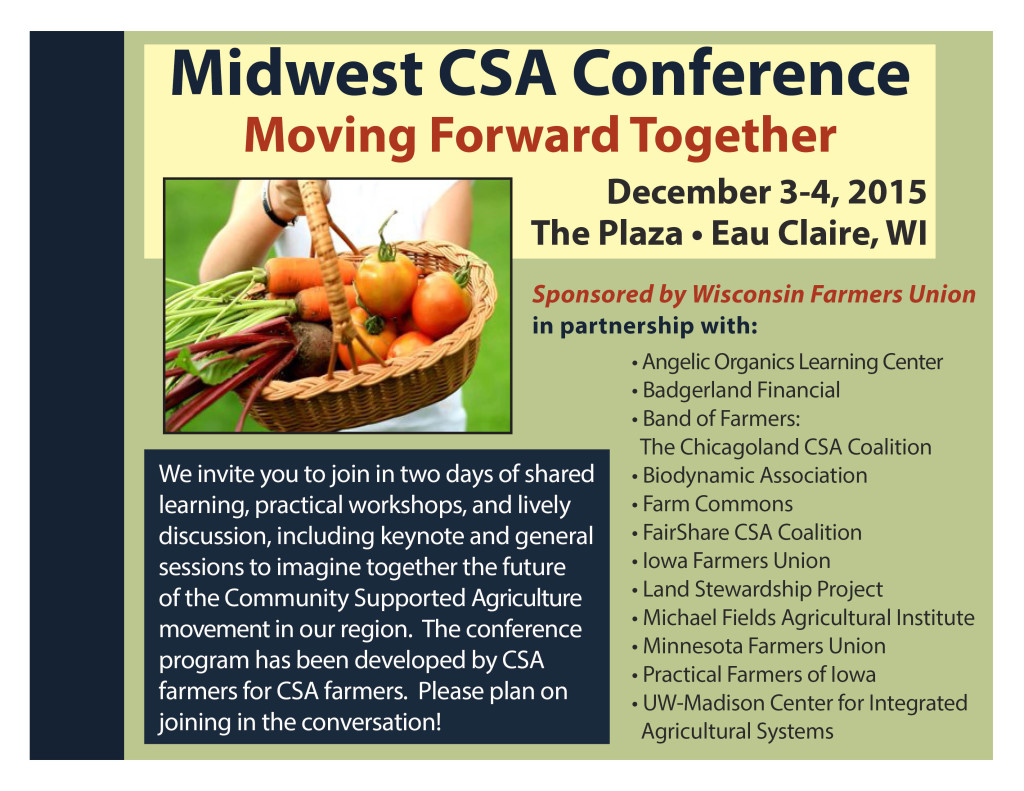
Thanks to the artful community collaboration of 15 farm organizations* – anchored by the Wisconsin Farmers Union – just such a gathering will happen December 3-4, 2015, in Eau Claire, Wisconsin: The Midwest CSA Conference: Moving Forward Together…
…CSA is a unique model and thus deserves it’s own special gathering every couple of years to refresh the vision. Are CSA farms just a passing agrarian fantasy, or can they serve as enduring cornerstones for community and ecosystem renewal in our region and beyond? CSA is continuing to evolve as a resilient model in an era of rapid change…
At the conference I will have an opportunity to give a keynote talk: Awakening Community Intelligence: CSA Farms as 21st Century Cornerstones.
The rest of the story about the CSA conference is here in my blog for Mother Earth News.
 I’m pleased to announce publication of my new book, Awakening Community Intelligence: CSA Farms as Community Cornerstones. Both print and eBook editions are now available on Amazon.com.
Over the last decades many thousands of people in all parts of the world have come to recognize in Community Supported Agriculture (CSA) a vehicle for approaching land, food, labor, environment and community in a healthier way. Now – in an era with increasing shadows of environmental catastrophe – it’s time to expand exponentially the CSA vision and reality.
The opportunity is before us to establish hundreds of thousands of CSA farms in nations around the world, and to thereby employ a proven, egalitarian model to address the radically changing circumstances in our environment, climate, economics, and social relationships.
Awakening Community Intelligence lays out the vision, and sounds a call to action.
Our civilization is now reckoning with profound disruptions associated with climate change, resource depletion and geopolitical instability. We must respond to our circumstances, or be overwhelmed.
Both globally and locally, we absolutely require intelligent strategies to reduce our vulnerability, to build resilience, and to reckon with the increasing disruptions. CSA farms stand out as promising models with a noteworthy track record. If the CSA model is in fact realized in hundreds of thousands of permutations in diverse communities around the globe, it can make a consequential difference in a host of sane, safe, and superior ways.
As a journalist, I’ve been writing about CSA since its inception in the USA in the late 1980s, and I continue to see possibilities. With Trauger Groh, I’m co-author of the first two books on CSA: Farms of Tomorrow and Farms of Tomorrow Revisited. My other books include The Call of the Land, Profiles in Wisdom, Classical Considerations, and the epic nonfiction saga of contemporary America, Odyssey of the 8th Fire.
The ebook Awakening Community Intelligence is available now in all formats for digital devices and computers from Smashwords. And it’s also available in print and digital editions on Amazon.com, and versions for iBooks via the links below:


I’m pleased to announce that I’ve finished writing a new book, and that it’s coming soon. All the details will be announced on this blog.
Over the last decades many thousands of people in all parts of the world have come to recognize in Community Supported Agriculture (CSA) a vehicle for approaching land, food, labor, environment and community in a healthier way. Now – in an era with increasing shadows of environmental catastrophe – it’s time to expand exponentially the CSA vision and reality.

The opportunity is before us to establish hundreds of thousands of CSA farms in nations around the world, and to thereby employ a proven, egalitarian model to address the radically changing circumstances in our environment, climate, economics, and social relationships. This book lays out the vision eloquently.
As a journalist I’ve been writing about CSA since its inception in the USA in the late 1970s. This new book is a visionary call to action.
I’m pleased to announce the publication of a major new two-volume encyclopedia, Achieving Sustainability: Visions, Principles, and Practices (Macmillan). My chapter on Community Supported Agriculture (CSA) is among the many elements of this comprehensive resource.
 Sustainable development is essential to our future.
Designed to increase understanding, inform actions, enrich academic assignments, and enhance research, Macmillan’s Achieving Sustainability: Visions, Principles, And Practices is a reference work intended to meet the needs of students and educators in high schools, community colleges, and four-year colleges, as well as the interested layperson.
Aimed at readers who are not experts in the field, the material is relevant to courses in natural sciences, social sciences, and the humanities.
This title presents and analyzes the underpinnings of the multi-disciplinary concept of sustainability. A two-volume encyclopedia containing more than 130 signed entries, Achieving Sustainability covers economic and environmental ideas, as well as governance, demographic, and socio-cultural aspects of the concept.
 Community Supported Agriculture (CSA) is an agrarian movement that arose in America starting in the 1980s. In an era of general farm consolidation and industrialization, CSA has continued to develop. By now there are many thousands of farms and many hundreds of thousands of households networked directly with local farms.
The initial vision of CSA arose in the context of wide recognition of the necessity for renewal of agriculture through its healthy linkage with the human community that depends on farming for survival. The vision united farmers and consumers in an agrarian relationship for the health of people and planet, and explicitly recognized the necessary stewardship of soil, plants, and animals: the essential capital of human cultures. CSA emerged as a web of relationships.
Recently I had an opportunity to engage in conversation about the movement and its future with two renowned CSA farmers: Jean-Paul Courtens of Roxbury Farm in New York, and Allan Balliett of Fresh and Local CSA in Shepherdstown, West Virginia.
My thanks to Allan for creating and hosting BDnow Podcast 017 (The Future of CSA), and to Jean Paul for sharing his experience and insight.
As it happens, I must demur on the matter of “foremost…philosopher,” which is a descriptor applied to me in the podcast. CSA farms arose as a community supported concept. “The idea of CSA was in the air in the late 1980s.” Many different people were contributing to the thoughts and practices, including Jan Vander Tuin, John Root, Jr., Andrew Lorand, Robyn Van En, Elizabeth Henderson, Anthony Graham, Lincoln Geiger, and Alice Groh. Trauger Groh – my coauthor on Farms of Tomorrow and Farms of Tomorrow Revisited – had a profound and eloquent grasp of farming and of the budding CSA vision. My role with CSA in those days, and ongoingly, has been not to philosophize, but rather to listen closely and then to write about what I learn.

#csa #organicfarmers #organic #agrarian
 A pioneering book that helped spark the CSA farm movement in the United States has now been published in a German-language edition.
Farms of Tomorrow, the first book on Community Supported Agriculture (CSA), authored by Trauger Groh and Steven McFadden back in 1989-90 when they were neighbors in New Hampshire, has just been published in a German translation, Hofe der Zukunft.
Journalist McFadden, a resident of Lincoln, Nebraska for the last several years, is the author of 12 other nonfiction titles including Profiles in Wisdom, and The Call of the Land. The various editions of the farm book he co-authored with farmer and philosopher Trauger Groh have helped to catalyze the development of CSA in America.
CSAs are farms and food distribution systems that directly unite farmers and consumers in an agrarian relationship for the health of people and planet. Consumer households invest in shares of a farm’s harvest in advance, and the farm reciprocates with weekly supplies of fresh, clean locally grown food.
By now there are well over 8,500 CSAs in the USA, and many thousands more in other nations, including Canada, France, Australia, Israel, and China. The steady growth and development of these new farms in the USA has come through an era beginning in the 1980s when traditional family farms have continued to decline for a host of reasons, and to be swallowed by increasingly larger operations.
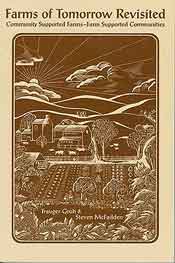 Farms of Tomorrow was published by the Biodynamic Farming and Gardening Association in English since 1990; the 2nd edition of the book, Farms of Tomorrow Revisited was published in 1998, with many new chapters including one by Marcie Ostrom on CSA coalitions. The book has also been published in Japanese, and Russian translations. Now, nearly a quarter century after the CSA farm book first came out, it’s available in a handsome new German translation, Hofe der Zukunft.
German farmer and scholar Wolfgang Stranz worked for over a year to translate Farms of Tomorrow, and to write a special new chapter for readers in Germany and Austria.
As Resurgence Magazine noted in a review, “it is rare to come across any practical farming guide that sets out, from its inception, a set of principles that embrace social, spiritual, and economic concerns on completely equal terms. The wisdom and clarity of philosophy are striking throughout.” CSA is a dynamic movement at the heart of agricultural renewal.
The German-language edition of the book, Hofe der Zukunft, is available here.
The English-language edition of Farms of Tomorrow Revisited, published by the Biodynamic Association, is available in print and for the Kindle ebook readers at Amazon.com, in print through Steiner Books, and for all Apple devices in the iBook and iTunes stores.

 I was there in New Hampshire a year ago in September 2012, just a few miles away when dairyman Lincoln Geiger was badly hurt by a trampling bull.
That Sunday they airlifted him to a hospital in Boston to reckon with life-threatening injuries. But Lincoln’s spirit was strong and he moved through the wounds and the shock, and the many phases of recovery to come back to the land.
“I was given a new outlook on the world, Lincoln later explained, “by what I now call a form of initiation. My whole sense of reality shifted from an objective view of nature and the environmental movement, to a deeply caring heart-centered understanding.
“I now feel that the way to engage people to improve our world is with an intelligence that emanates through the heart. We need to ensoul nature and all its creatures and feel like guests, friends, or part of the familywhen in the presence of the forest or the garden or the herd. That is the attitude that comes from the warmth of the soul through the wisdom of the heart.”
From the very beginning Lincoln has been one of the core farmers at the remarkable Temple-Wilton Community Farm. One of the first two Community Supported Agriculture farms (CSAs) in America, it is still growing strong nearing thirty growing seasons.
In a blog post recounting his recent visit to the farm, Robert Karp of the Biodynamic Association noted that the Temple-Wilton Community Farm, “keeps showing the way” for thousands of other CSA farms across the nation and around the world.

A day-and-a-half before his fateful encounter with the bull, Lincoln came and sat beside me in the barn loft at Stonewall Farm Center, just west of Keene. He shared a grace with our conference of people talking about implementing greater food security for the Monadnock Region of New Hampshire.
Lincoln sat as part of a circle of 40 of us or so — all Twentyfirst Century agrarians alive with a sense of doing something foundationally important in the world. After dinner, to offer a blessing, he talked with us for about ten minutes.
He began by telling the story of how on a spring day he had climbed aboard the farm’s tractor and set about mowing the high fields. He never noticed the place in the deep grasses where a fawn lay hidden, and so to his dismay and anguish he found that the blades of his mower had badly injured the fawn.
Within two weeks he had hit four fawns and felt the deer were trying to teach him something monumental. “The day I hit the last fawn I was super alert to make sure there would be no accident. I stood on the tractor platform the whole time I was mowing. About a third into the 10-acre field I saw a deer standing about 200 feet from me. I stopped the tractor, got off and noticed that the deer was looking at me and then looked down and then back at me.
“I felt right away that she was standing by her fawn. I turned off the tractor and headed straight towards the deer. She ran away, I kept walking and soon there in front of me lay a beautiful fawn. I just stood with it for a while, then I called my dairy partner Andrew and our apprentice Sara to come to the field with a cage or something to hold the fawn while I finished mowing.
“I picked up the fawn, it was totally calm and carried it to the bottom of the field. Andrew and Sara came but had no cage, they brought it into the Forrest and let it go. I kept on mowing and just as I was finishing the last couple of swaths, as I look back, there it is with its hoof cut off an inch up. I cried out loud, turned off the tractor and picked it up in my arms again. My heart was broken so bad I can’t tell you. I brought my little friend into the forest, I knew it would never make it. I laid it on a large stone and crushed its beautiful head with a rock.
“Then I cracked open inside and screamed loudly for the world to hear our pain and our love,” Lincoln told me. Time went by. To bring some light and healing to all that arose with the death of the fawns, to respond give some beauty back to the world Lincoln wrote graces.
At Stonewall Farm a year ago, Lincoln spoke one of those graces aloud for the circle:
Thank you Earth so soft and strong
Thank you meadow filled with song
Thank you mountain, forest and stream
By you we rest and find our dream
Thank you creatures wild and tame
Your trust we love and hope to gain
Thank you for your milk and fleece
And for your meat that we may eat
Thank you root and leaf and seed
We’ll not forget your wondrous deed
You hold the earth
You catch the rain
You fill the world with air again
Thank you wind for bringing rain
Please help our friends who are in pain
For us who thirst and cry from hunger
Please bring hope, life and wonder
Thank you moon for guidance and grace
For heart bent flowers
With dew drop lace
Thank you sun as day begins
For golden light
By angel wings
With thankful hearts
and open hands
We ask to share your loving lands.
– Lincoln Geiger, Temple-Wilton Farm
As of Thanksgiving 2013, Lincoln writes: “I am well and full of living.” The Temple-Wilton Community Farm is also well and full of living, as attested to by yet another article about the farm’s place in the history and the destiny of the CSA movement, complete with some wonderful photos. The story – The First CSAs – is published on page 10 of the John Deere company magazine, The Furrow.
“Nebraska leads the nation in organic livestock numbers and is one of the leading producers of grass-fed beef. In time we will lead the nation in producing and marketing humanely raised livestock.” – Kevin Fulton, rancher
by Steven McFadden – July 24, 2013

Out of the smoldering rhetorical and legislative rubble of recent years, a band of farmers – the Nebraska Farmers Union – has stepped forward in a joint venture with the Humane Society of the United States (HSUS) in an effort to blaze new, cooperative market trails that lead to increased opportunities for small and mid-size farmers, as well as to more humane livestock care.
Most Americans eat meat of one kind or another (96% of us). Questions about where our meat came from, how the animals were treated when alive, and how they were killed and prepared for our tables, are fundamental. They matter a lot, and in a lot of ways. Thus this joint venture between two groups that might well stand in opposition to each other is a model of national and perhaps international significance.
Nine billion animals are raised for the table each year in the USA. The experience the animals live out on a farm or endure in mass, industrial confinement has economic, environmental, health and moral ramifications…
 The elemental wherewithal of our farms and our food is in motion. Whirlwinds of change bear upon our land, air, water and climate. Fundamental forces have shouldered their way front and center. The land calls urgently.
As reported worldwide this month, scientific evidence shows that the level of the most important heat-trapping gas in the atmosphere, carbon dioxide (CO2), has mounted far beyond the danger zone. Heat is rising. Consequences are evident.
CO2 has now reached an average daily level above 400 parts per million, a level the Earth has not experienced for three million years. That was during an epoch called the Pliocene.
The overwhelming majority of scientists understand that this current rise in CO2 portends epic changes.
“Our food systems, our cities, our people and our very way of life developed within a stable range of climatic conditions on Earth,” former Vice President Al Gore observed in the wake of the CO2 report. “Without immediate and decisive action, these favorable conditions on Earth could become a memory.”
Following the front-page news about the rapid deterioration of the earth’s climate, came two other hard news stories that underscore the matter of food vulnerability: news of the disease-driven collapse of the staple food crop for more than 500 million human beings in Africa, and news of grave troubles for citrus fruits in America and around the world.
Climate change and crop disease are serious business. Here the land is not just calling, it’s shrieking.

In Africa the cassava plant – which produces a large, edible root – is succumbing to brown streak disease. Africa already suffers debilitating food shortages. Because casava is the staple food for the continent, this plant disease is calamitous.
Meanwhile, the citrus industry is grappling with an infernal bacterial disease that has now killed millions of plants in the southeastern United States and is threatening to spread across the entire country. The disease has also been found in Asia, Africa, and South America.
Citrus Greening, also called Yellow Dragon Disease (Huanglongbing), is fatal. The bacteria devastate trees, rendering bitter, misshapen oranges, then death for the entire organism. There is no known cure.
“This year (2012-13) was a real kick in the gut,” Florida’s agriculture commissioner told The New York Times. “It is now everywhere, and it’s just as bad as the doomsayers said it would be.”
* * * * * * * *
When I absorb this short stack of climate and food news — just a fraction of the farm and food factors in flux — I realize that we must dig in now more resolutely to build a clean, respectful, sacred and sustainable foundation for civilization. That’s the direction forward.
Many thousands of local, organic agrarian farm-and-food initiatives have arisen across the Americas in the last 25 years. They offer a wide array of working models. Those models can and should be replicated and emulated far and wide. They represent intelligent and promising responses to the imperative call of the land.
 Organic farms and the cooperative food systems they are entwined with (the whole, broad range of 21st century agrarian initiatives) have manifold positive responses to the central issues, and a track record of evidence. They sequester carbon in the land and thereby mitigate CO2, helping stabilize climate. They offer clean, fresh food directly to people who live near the source. They provide dignified work in nature. They knit together healthy webs of relationship, both personal and digital, around concerns of a foundational nature to every human being. They teach essential ethical values. They establish oases of radiant environmental health. And they bring large numbers of people into a more direct and equitable relationship with the human beings who grow their food, and the land it is grown upon.
21st century agrarian initiatives also provide wholesome anchoring points (network nodes) for the brittle high-tech, digital-wave culture emerging so dynamically in our world. We are just at the beginning of that, really.
This 21st century agrarian initiatives – the many thousands of urban farms, CSAs, co-ops, community kitchens, church farms, and city gardens of all sizes shapes and descriptions – constitute core elements of a more wise and respectful human response to the imperative call of the land.
The cooperative development of clean local food systems is in no way a boutique idea or a passing fad. It is a key element of modern food security, and it is emerging not just as prudent but also as essential. It is also about the renewal of our overall human relationship with the earth that sustains us.
 Your actual, real-time Odyssey parallels this Summer’s ‘blockbuster’ film
 New and improved: Classical Considerations
 Behold the Light: Farms, Photons, Futures
 Our Collective Odyssey: Song and Story for the Generations Arising