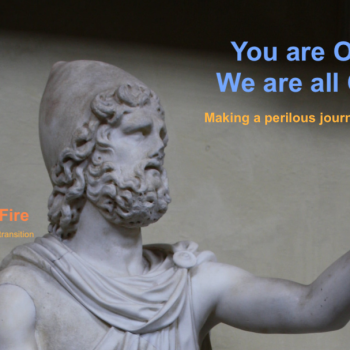
For your consideration, here’s a meme I created, based upon the true tales at the heart of my epic, nonfiction saga of North America, Odyssey of the 8th Fire,
A Fresh Breath of Storytelling Wind: Reviving the Legend of the Rainbow Warriors
Once oft’ told, the story that I came to know as the legend of the rainbow warriors has in recent years been drowned in the ceaseless tsunami of online information. The tale has slipped beneath the digital flood at a time when its vision is sorely needed.
It’s time to invoke a great whirling surge of Nilch’i Diyin (Holy Wind) into the story, and thereby help it rise back to the surface
The rainbow legend has been glimpsed in vision and then articulated in myriad ways for hundreds of years in various parts of the world, often as well on Turtle Island (North America). The story is told from a spectrum of perspectives, given life by storytellers using music, words, art and dance to animate the tale in their own creative way.
In brief, the legend relates that when the world becomes desperately dirty, sick and chaotic with divisive hate agents at work in realms of race and religion, many people will recognize that they are destroying themselves and the earth they depend upon for survival. With spiritual insight and support, the rainbow warriors — people of all colors, cultures and spiritual outlooks — will respond creatively with insight, intelligence, honesty, caring, sharing and respect. Through personal example and positive, peaceful means, this rainbow network of awakened souls will establish a golden era of peace.
Often mocked as pixie-dust fantasy or outright condemned as fakelore rather than folklore, the rainbow legend persists because it has deep roots, and because it echoes a venerable theme in storytelling: paradise lost, paradise regained. We are squandering paradise in our modern world. Is it therefore surprising that there should arise hopeful tales of a time when a better world may be attained?

Whirling Rainbow (author’s collection)
Mythologist Joseph Campbell noted that a society that does not have a myth to support it and give it coherence goes into dissolution. “That is what’s happening to us.” Campbell wrote in Transformations of Myth Through Time. And that, I feel, is why it is worthwhile to tell the rainbow tales again in yet another way, to contribute a picture of what I regard as a coherent and positive mythic dimension of understanding for our times.
For 200 years or more a dominant myth in the developing world has been an interpretation of the American Dream suggesting that most people can attain wealth by taking from the land and sea at an industrial scale with a mechanical consciousness, and that happiness will follow from profit. This myth is relentlessly reinforced by advertising images. Yet the unbridled pursuit of these versions of the myth, often by people deep in sleep, has plunged us into a nightmare of environmental devastation, economic upheaval, ethical bankruptcy, and cultural confusion.
As I write more than 40 wars are raging around our world, and another 200 or more armed conflicts are underway. The US National Oceanic and Atmospheric Administration (NOAA) has reported that “the weather is noticeably more chaotic.” Our world is home to more than 7.5 billion human beings. Well over one billion of those human beings are hungry or starving.
In the midst of these stark realities, various myths or frames are conjured via the broadcast voices of demagogues, and the bloody, fear-provoking images so common in movies, music and computer games — the fear-driven myth that the world is hate-filled and chaotic beyond redemption. For many people, in the absence of something more wholesome, such barren and toxic visions become embedded in the psyche as working myths, albeit often unconsciously. Yet the rainbow tales are as possible as the visions of a global death spiral. The enactment of our future is up to us.
The Environment of the Soul
I’ve encountered a spectrum of rainbow myths, beginning in the 1970s when I read the book Warriors of the Rainbow, by William Willoya and Vinson Brown, and then in dozens of other readings and listenings. As is the custom among storytellers and as a lifelong journalist, I passed on the tales I heard later in my own words at gatherings, and in my writing.
My 1992 book Legend of the Rainbow Warriors was an exercise in creative nonfiction. The book relates many of the ancient versions of the rainbow warriors legend, uniting a chorus of voices. It cites seers such as Black Elk and Crazy Horse of the Lakota, Quetzalcoatl of the Toltec, Weetucks of the Wampanoag, Plenty Coups of the Crow, White Buffalo Calf Woman of the Plains, Eyes of Fire of the Cree, Ku’Kulkan, Quetzalcoatl and Montezuma of the of the south direction, the Peacemaker of the Haudenosaunee, Padmasambhava of Tibet, and Alinta of Australia. I included in my book some of the teachings that I’d absorbed over the years from Grandfather William Commanda, Don Estevan Tamayo, Arvol Looking Horse, Martin Gashweseoma and Thomas Banyacya, Oh Shinnah Fastwolf, Slow Turtle, Sun Bear, Reuben Snake, Cachora, Grandmother Doris Minkler, Manitonquat, Don Jose Matsuwa, Dona Josepha Medrano, and others. Though they lived at different times and in different places, they shared a sense of what would unfold.
Legend of the Rainbow Warriors was my effort as a journalist to create an account of one of the core myths of the Americas, and to also explore of how that myth might be playing out in real time.
Do the voices and the rainbow tales add up to something that is ultimately, absolutely verifiably true? That is for you, the reader, to consider and to create. Mythologist Joseph Campbell looked at it this way: “A myth is something that has never happened, but that is happening all the time.”
Those devoted solely to measurable evidence run the risk of missing the point altogether. The rainbow tales are both myth and mystery. Myth creates the opportunity of inspiration, a chance to become aware of something the intellect has not the scope to grasp: access to “the supersensensible environment of the soul” as poet William Butler Yeats expressed it. To this the myth adds a note of mystery: spiritual truths knowable not through reason alone, rather but through contemplation or revelation.
My friend the late Leon Secatero, To’hajiilee Chapter of the Navajo Nation, explained to me that he appreciated these teachings not as prophecies, but rather as knowings.
Leon’s friend and colleague, Don Alejandro Cirilo Perez of Guatemala, elaborated on that insight. Longtime President of the Maya Elders Council and a initiated Daykeeper, Don Alejandro told me: “There is truth in the teachings about the rainbow and the rainbow people. People from all of the Americas will unite with people from all the other nations, and they will realize that we are all family, brothers and sisters. This is not my personal vision, but a cosmic vision presented by all the elders – a vision that we all share.”
A Kitchen Table Telling
I’ve heard 40 or more tellings of rainbow mythology over the decades. On the afternoon of May 13, 2006, I heard another convincing rendition while traveling with my friends Stephen Clarke, and Carlos White Eagle. We were seated at the kitchen table in a rustic ranch house in Haystack, New Mexico, visiting with Navajo Grandfather Martin Martinez, his wife Janice, and their daughter, Kay.

Grandfather Martinez at the 2004 Sodizin Ceremony on Tzoodzil (Mt. Taylor, NM).
Grandfather, in his 90’s and nearing his transition on the Beauty Way, had life experience as a rancher, a rodeo rider, a Code Talker in World War II, and for many long, honorable years as a community leader, a traditional Singer, and the ceremonial keeper of Tzoodzil — the Blue Bead or Turquoise Mountain, now called Mount Taylor. Rising majestically under the blue skies of New Mexico, Tzoodzil is the South Mountain among the Four Holy Mountains that mark the Four Corners of Turtle Island (North America)
As we sat around the kitchen table in the family ranch house, Grandfather told us a story. He spoke in Navajo, and his daughter Kay translated. We smoked a pipe in a sacred manner, and Grandfather said he could remember long ago when he was a boy hearing some of the Medicine elders talk. The Medicine elders told him that during his lifetime there would come a dark era when many problems would arise on Earth. For many people it would seem as though there was no hope.
At that time, the elders told him, the rainbow people would arrive. These rainbow people would find a way to bring healing. The elders told him that it would be a good and important — and that he would see it come true. Grandfather told us that he had never experienced that teaching in fullness until our moments at the kitchen table, and that he was happy to be in ceremony with us, some of the rainbow people. He offered us his warm smile, and three totems. Then he settled in contentment.
Basic Wisdom
An underlying premise of the rainbow legends is that there is a basic wisdom that can help solve the world’s problems. This wisdom does not belong to any one race, religion or culture, but is a tradition of caring, sharing, and sacred light and sound that has existed throughout human experience and that has been expressed by many human beings, certainly including the saints spoken of in the world’s formal spiritual institutions, as well as thousands of other human beings of less formal renown.
We are in a time when many millions – actually billions – of people can and are by circumstances called to give the archetype expression in their lives. Thus the challenge is laid down before us all: live up to the promise.
In light of the legend, my understanding is that rainbow people choose themselves and then strive to live with exalted physical, moral and ethical courage, appreciating that the problems and weapons of the world have been made by the human mind, thus they can be unmade. Rainbow warriors and rainbow walkers need to cultivate compassion, a fundamental attribute of human beings, which will gift them with energy and the power to take action. They will also have to develop insight and intelligence, which will guide them to apply the power of compassion via skillful means.
Rainbow warriors and walkers do no harm, inflict no pain, and cause no suffering. They work to set things right by good example. Their lives are about having integrity, being brave, and standing forthrightly but peacefully for all that supports life. Their quest is for safety, sanity, and respect. According to the legend, ultimately they are triumphant. So the story has been told to me. So in my way I tell it to you.
![]()
Our Long Walk as Human Beings
Notes on the Mountain West Seed Summit
“Whoever controls the seeds in a culture is going to control life.”
~ Emigdio Ballón, Tesuque Pueblo Farm
My notes from the impressive Mountain West Seed Summit in Santa Fe, New Mexico over March 3-4, 2017 – a gathering of seed savers, and people representing seed hubs and seed companies:
Belle Starr, co-founder of the hosting organization, the Rocky Mountain Seed Alliance, an organization started just three years ago: “We are working to build strong food hubs around the country. The local food movement is huge and growing. But how many are saving seeds? That part is missing.
“What is our duty? Diversity. I hope the thing we carry out of this summit is passion to empower and inspire. That’s how we are going to get diversity. This has to be a grassroots movement. The more people who save seeds, the more resilient the system we create…We hope this will go on for generations.”
![]()
Emigdio Ballón, a Quechua native from Bolivia, Agricultural Director for the Pueblo of Tesuque, NM: “The seeds are calling us. They are asking us to help them continue their evolution as they help ours.

Emigdio Ballon (R) speaks with his fellow farmers outside the seed bank at Tesuque Pueblo Farm.
“It’s very difficult for the seeds now. In 2011 we talked about seed security and its relation to food security. That’s when we started our seed bank to protect the seeds handed down to us from time immemorial. Now we are talking also about climate change, and how that is impacting us. How can the seeds sustain us, and our unborn? They need to be protected because of the corporations polluting the earth, and claiming patents over nature. Indigenous people care. Indigenous peoples are protectors.”
Clayton Brascoupe, a Mohawk/Anishnabeg farmer, founder of the Traditional Native America Farmers Association: “What is a seed? Seed is life, mother, embryo, treasure, potential, possibility, relative, our child. All of those things. There is a fundamental, essential relationship that we have.
“We’ve been going along side by side with each other for thousands of years, and now we are in this present generation. We have a treaty, a covenant with the seeds. The seeds are a part of who we are. We have to take care of our relatives, the seeds, and they in turn will take care of us.
“Seeds are the first link in the food chain, and this link is now under threat. Our responsibility is to preserve them for forthcoming generations.”
In remarks to initiate day 2 of the Seed Summit, Bill McDorman, director of the Rocky Mountain Seed Alliance spoke about the importance of developing Seed Hubs in parallel with Food Hubs and other local farm and food initiatives. “There’s a real need globally for many more regional operations. Seeds are the foundation not just of our food system, but of civilization itself…This can save us. Regional organizations are the key.”
Andrew Kimbrell, founder and director of the Center for Food Safety, gave a riveting keynote presentation. He began by mentioning that with the financial backing and technical expertise of entrepreneurs from Silicon Valley, the Center is about to launch an international online network for seed savers.
He placed this forthcoming network, and the importance of seed saving, in the context of three pending corporate mergers: Bayer-Monsanto, Dupont-Dow, and ChemChina-Syngenta. These mergers, likely to get green-lighted by the Trump-Republican Administration, will place over 60% of the world’s remaining seeds in the corporate control of just three companies. They dominate.
All these multinational corporations are intent on continuing to patent life forms, and to sell allied chemicals as essential, expensive, and polluting inputs to the industrial agriculture system.
The accelerating pace of global climate change and corporate seed and chemical control underscore the imperative need to establish non-corporate seed-saving networks, he said. “We don’t know what seeds we are going to need. But the network will be a key. These are dark times.”
Drawing from some of the material in the well-known book he edited (Fatal Harvest: The Tragedy of Industrial Agriculture) he outlined a history of seeds and agriculture in the USA. “Remember the robber barons of the gilded age?” he asked. “We are in the second phase of that.” A century ago the robber barons made their fortunes in railroads, coal, steel, and oil. As succeeding generations of billionaire barons sought further pots of gold, their gaze fixed upon agriculture.
With hybrid plants, poison chemicals (biocides) and patents, robber barons and their corporations over time mutated the meaning and the reality of seeds. Instead of being a commons that united people in ancient and sacred community traditions of caring for a foundational source of life, seeds became a commercial commodity.
Farmers became trapped on technology treadmills: functionaries basically serving as corporate pass-through operations for commercial seeds, chemicals, machinery, oil and gas. Corporations took culture out of agriculture, and substituted industry. For farmers, indebtedness ruled. Whereas just over a century ago as many as 40% of the population was involved in caring for the land and the seed that everything depends upon, only about 1% of the population now has this connection.
Consider where we are now, he said. Via monoculture and intensive chemical use, we continue to deaden and to lose soil. The nitrogen fertilizer of industrial ag leaches out to waterways, creating massive dead zones in our oceans. We’ve lost 90% of our seed diversity. The Center for Food Safety estimates that 35 to 45 percent of greenhouse gases are generated from industrial ag. Thus, the essential elements of farms and food (soil, water, seeds, industrial livestock, etc.) have become zombies.
This system is already dead, Kimbrell said. “It’s a zombie walking. But it’s still unbelievably dangerous. It’s steadily destroying the planet.”
“We are the future. Sometimes we look at these dominant forces, and wonder how can we possibly overcome? But the zombie system is already dead.”
Corporations used to wallow in hubris, believing that nature was no match for biotechnology. But it turns out that biotech is no match for nature. The idea that you are going to control the traits of living things is false.
The answer Kimbrell argued, is for our economy to transform into a wholly owned subsidiary of ecology. “We can only use things to the extent that they regenerate themselves.” We have to go local, biodiverse, humane, and socially just, he said.
Fundamental to all of this transformation is seed. None of it makes sense without seed. Seed is the center that we need.
While stating that he sees organics as a floor for the future of agriculture, he reminded the audience that it’s under attack. The Freedom Caucus (about 30 hard-right Republican members of Congress) has targeted the National Organic Program for destruction.
In response to a question from the audience, Kimbrell commented on the upcoming 2018 Farm Bill. “If Dante were alive today,” he said, “The Inferno would be about the farm bill.” He said we need to get environmental groups together with farm groups right now, in 2017. “Unless we get ahead of the game,” he commented, “we are lost.”
Three times during his talk Kimbrell quoted the late Rachel Carson, author of Silent Spring. One example: “I believe natural beauty has a necessary place in the spiritual development of any individual or any society. I believe that whenever we substitute something man-made and artificial for a natural feature of the earth, we have retarded some part of man’s spiritual growth.”
Echoing this insight toward the end of his talk as an encouragement to seed savers and to others working to build a just, healthy and equitable farm and food system, Kimbrell said: “We face the spiritual challenge of moving from a culture of death to a culture of life.”
~ END ~
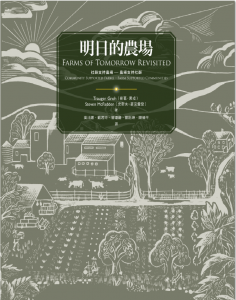
Farms of Tomorrow published in Mandarin Chinese Translation
Farms of Tomorrow, the book about community supported agriculture that the late
Trauger Groh and I co-authored 27 years ago, has now been translated into Mandarin, the dialect used by 70% of the 1.2 billion human beings who speak Chinese.
When Trauger and I collaborated on the original English-language edition of Farms of Tomorrow in 1989-90 there were perhaps 60 community supported farms (CSAs) in the USA. Now according to the USDA’s 2015 Local Food Census, the number of CSAs is nearly 7,500. There are many thousands more sustainable, organic and biodynamic CSA farms around the world involving hundreds of thousands of households in direct healthy agroecology and food sovereignty. Many of these far-flung community farms are networked through URGENCI, an international NGO based in France.
In the face of the world’s general agricultural, environmental, political and climate turbulence, the steady international, grass-roots development of a sustainable, holistic farm and community model is positive and heartening. These are points I emphasize in a narrated slide show (Awakening Community Intelligence) freely available on Youtube. In it I also sound a call, and offer an urgent argument for why, communities engage now actively to begin establishing hundreds of thousands of new CSA farms.
Eight years after the initial US publication of our book, Trauger and I again examined the ideas, the farms, and the communities at the heart of the growing CSA movement, and we co-authored a revised and greatly expanded edition: Farms of Tomorrow Revisited. This is the volume now translated into Mandarin
Our book acknowledges that farming is not just a business like any other profit-making business, but a precondition of all human life on earth, and a precondition of all economic activity. As such, farming can be understood as everyone’s responsibility.
The book contains basic essays on principles, structures and ideals for community supported farms. We wrote on pertinent themes: the economic, environmental, spiritual and legal questions faced by CSAs; the development of community; relationship with the land; the role of animals; and the experiences and observations of farm-member families.
As we note in the book, Community Supported Agriculture is not just another new and clever approach to marketing. Rather, CSA is about the necessary renewal of agriculture through its healthy linkage with the human communities that depend on farming for survival. CSA is also about the necessary stewardship of soil, plants, and animals: the essential capital of all human cultures. Our relationship with nature and the ways that we use the land will determine the future of the earth.
By now, more than 30 years after beginning in Japan, Europe, the USA and elsewhere, CSA farms are in every part of the world. Farms of Tomorrow Revisited has been translated into German, Russian, Japanese, Korean, and now the new Mandarin edition. The new translation of our book will join Elizabeth Henderson’s influential CSA book, Sharing the Harvest, which has already been published in Chinese.
The Chinese edition of Farms of Tomorrow Revisited was translated and is published by the Anthroposophy Education Foundation in Taiwan in agreement with the original and current US publisher, the Biodynamic Association. The Chinese edition is being promoted through Facebook.

Grafting the Food System to America’s Rootstock
As we are rocked by repeated waves of climate change, and sharp shifts in politics, economics, and society, something durable is called for – something strong, wise, rooted in the land, waiting at last to find a home in our souls.
The core native knowings that have been part of culture and agriculture on this land for 10,000 years or more can enhance our capacity to respond adroitly to the dissolving and shattering forces aroused in our era. For the sake of integrity and resilience, it’s time finally to consciously graft the variety of cultures that have come to roost on North America with the rootstock.

Grafting – wikipedia commons
Grafting refers to the process by which a plant serves as the base (rootstock) onto which cuttings from other plants are joined (the scions). Grafting ensures a strong, healthy and productive crown, arising from a mature root system. It’s also a useful metaphor.
The rainbow array of cultural and agricultural ways that have entered onto the continent from Europe, Africa, Asia and southern latitudes, have never been grafted to the rootstock of Turtle Island (North America). Instead there has been an ongoing violent, systematic effort to annihilate rootstock ways through genocide, land theft, and treaty violations. That pattern has generated a massive energy field of karma, as yet unreckoned.
Now, in an era of pervasive change, it’s both an auspicious and a decisive time for the individuals, groups, states and nations of North America to face the historic and contemporary reality by learning more deeply about, respecting actively, and engaging more constructively with the cultural and agricultural rootstock of the land we now share.
As it happens, a grafting impulse is one of the unifying themes woven into the fabric of the upcoming North American Biodynamic Farming Conference* ~ Tierra Viva (Farming the Living Earth). The conference will draw together a multitude of the diverse cultural and agricultural wisdom streams that are part of modern life in the Americas. Come November the conference will create time and space for fusion on the high mountain plains – the altiplano if you will – of Santa Fe, New Mexico.
The biodynamic farming and gardening movement is one of many natural scions available for grafting to North America’s cultural and agricultural rootstock. But I feel that biodynamics in particular is a propitious domain for such fusion. A forerunner of organics, biodynamics embraces metaphysical realities that organics chooses not to factor in, and strives to work intelligently with subtle forces. When biodynamics was germinating as an agricultural discipline back in the 1920s, teacher Rudolf Steiner encouraged farmers to make use of an ancient principle from the indigenous knowings native to Europe and elsewhere: “Spirit is never without matter, matter never without spirit.”
Native peoples indigenous to the Americas have likewise long appreciated this foundational truth, and held it in the forefront as they refined a culture and agriculture particular to this place, North America, over 10,000 years or more. Rather than using abstract intellectual constructs such as quantum field theory or general relativity, native knowings are conveyed in elegant, tangible metaphors, such as the teaching of the Sacred Hoop (Circle of Life), or the teaching that we have a fundamental responsibility to take care of the earth, for she is indeed our mother (Tierra Madre, Pachamama).
With presenters from the four directions and a rich mix of cultures, grafting will be in the atmosphere at Tierra Viva. Among the farmers, gardeners and grafters whose voices will sound, Larry and Deborah Littlebird of Santo Domingo Pueblo, peacemaker Patricia Ann Davis of the Navajo/Dineh Nation, Emigdio Ballon of Tesuque Pueblo, Dr. Jose Ma Anguiano Cardenas from Nayarit, México, Karen Washington from Rise & Root farm in New York City, Helmy Abouleish from Egypt, Sally Fox of Verditas Farm, and author/chef Deborah Madison from Galisteo, New Mexico.
Cultural and Agricultural Wisdom of the Americas
The rootstock cultural and agricultural knowings of North America constitute basic understandings for long-term survival on this land. The knowings have been gained not over mere centuries, but over many thousands of years. In light of our present circumstances, these basic knowings are both relevant and essential.
For some time healthy natural grafting processes have been progressing in the array of agroecological movements toward clean, wholesome land, water and food, such as good food, slow food, organic food, food justice, food sovereignty, and a variety of First Nations initiatives. These are all positive and promising, but just a fraction of the food system.
Where grafting is acutely needed is in the industrialized, chemicalized, genetically manipulated and patented realms of corporate culture and agriculture. They dominate our food system. And that food system has become one of the most ecologically destructive forces on our planet, a leading contributor to climate chaos. The agriculture system’s dependence on dense, lifeless minerals and an array of poisons, exists in parasitic parallel with an increasingly dense and sick culture at large.
The structure of the dominant food system has origins that extend back through history at least to genocide of native people and theft of their land, to slavery on farms and plantations, to the corporate forces which have driven hundreds of thousands of farm families off the land, to our current wholesale dependence upon, and exploitation of farm workers. All that has to be faced, reckoned with, and resolved, or it remains toxic – toxic in a turbulent era.
But the potential is there for the dominant food system to begin intelligently and skillfully grafting its culture and agriculture to the rootstock. A good starting point would be embracing the teaching of the Seventh Generation – to take into consideration the impact that every corporate project or action will have on our children’s children’s children unto the seventh generation. When a person or a corporation is sure decisions and actions will not harm, but rather will bring benefit to that seventh generation, then it’s time to act. What a profound difference that simple graft could make if taken sincerely.
The healing proposition of grafting has for centuries been eloquently told through the hemisphere-wide saga of The Condor and the Eagle as they are joined via the agency of the Quetzal. It’s an uplifting story, and it expresses a core understanding held by many traditional people in North, South and Central America. Simply hearing the story and paying attention to it creates a healthy bond of understanding.
In keeping with both traditional and emerging understandings, the North American Biodynamic conference in Santa Fe holds promise for further cultural and agricultural grafting progress.
~ END ~
*Note: I‘m a member of the Biodynamic Association, and also one of the presenters at the upcoming Tierra Viva conference. Having had years of involvement with CSA farms and food coops, as well as having had the opportunity to walk thousands miles with native wisdom keepers, I’m strongly drawn to exploration of the cultural and agricultural grafting theme. At the conference I’ll facilitate a workshop titled CSA Farms: Awakening Community Intelligence. ~ S.M.
CSA Farms are a Righteous Response to Climate Emergency & Food-System Shock
Right around the start of the year climate scientists began to use a new phrase to talk about the condition of our Earth. Climate emergency, they began to say. In so doing they were giving voice to the hard truth that, in the view of many climatologists, we’ve already tipped the scales past a point of no return. We are living out the early stages of massive, planet-wide climate upheaval.
Climate distortion has been speeding up year after year and the distortions are continuing to accelerate according to NASA. Earth has just endured seven straight months of record-shattering heat. Thus, in 2016 we are on track to experience the largest increase ever in global temperature.
Just before climate scientists began uttering the phrase “climate emergency,” the prestigious international insurance company, Lloyd’s of London, issued a formal report titled Food System Shock. The report spoke bluntly of acute disruptions to the global food supply. Meanwhile, 30 of the world’s largest insurance companies, known for their conservative approach in all matters, established a formal coalition (SmarterSafer) to sound the alarm about our extreme circumstances. Climate chaos is happening, and it’s going to be increasingly costly and perilous for everyone.
There is an urgent need to reckon with the impact to our environment and our food, an ominous message being articulated by many learned groups, including The Consultative Group on International Agricultural Research (CGIAR).
It’s dangerous to remain distracted or asleep about these hard realities. It’s past time to wake up. We are well underway in an era of profound changes in our climate and economics as well as our health and social well-being.
With respect to this, I’m sounding a call for the establishment of hundreds of thousands more sustainable farms on the model of Community Supported Agriculture (CSA). There is much to be gained for everyone.
Farmers cannot do this alone, especially not if CSA is pursued as some kind of a “marketing model.” To thrive in our extreme era, CSA cannot be downgraded to a competitive selling system dependent on “customers.” CSA was never intended for that purpose. CSA embodies the potential for a new way of life upon the land for farm, farmers and supporting community. The economics are associative, rather than competitive or exploitive. Some progress has been made in that direction, and much more is possible.
The wide array of community based initiatives to increase local food production that have emerged over the last 30 years (ranging from farm-to-school lunch programs and farmer’s markets, to reward programs for restaurants that buy food locally, and beyond) are all of tremendous value and importance.
But in my view, among all the initiatives and innovations, CSA stands out as a promising model for many millions of people and hundreds of thousands of communities. It’s a way for people to respond intelligently and strategically to our intensifying climate dilemma. CSA does not leave the great challenges of our era in the lap of farmers alone. At its intended potential, CSA draws upon the strength, intelligence and resources of all the people who of their free-will choice depend upon the farm.
Over the last three decades hundreds of thousands of people in the US and all parts of the world (URGENCI) have come to recognize in CSA a vehicle for approaching land, food, labor, environment, and community in a healthier way. The movement has made some noteworthy progress. Much more is necessary. Now we need many millions more to awaken to similar basic realizations about climate problems and CSA potentials.
CSAs are a righteous response to our unfolding climate emergency. They are resilient, egalitarian, and a fundamentally healthy foundation for the high-speed, high-tech digital culture emerging so dynamically in our world. CSAs have an established track record in America, Canada, Europe, Japan and around the world from east to west. The model has been tested and refined. It’s not government, and it’s not corporate. It’s a choice and a free will association with a farm and a farmer. Thousands of people have applied their intelligence and experience to create and cultivate the CSA model over the last 30 years.
Right now we need hundreds of thousands more communities to see the need and the potential, and to swiftly establish CSA farms.
CSA farms amplify food security. They involve diverse communities of people (from neighborhoods, churches and businesses) in sustainable farming activities that increase food security and quality, while at the same time building clean, healthy soil to trap greenhouse gases.
Right now one-third of all human-caused greenhouse-gas emissions come from industrial agriculture, as reported in Nature, the international weekly journal of science. Reducing agriculture’s carbon footprint is crucial to limiting climate change. CSA farms employ the principles of agroecology, which provides a robust set of solutions to environmental pressures and crises. Virtually all CSA farms are either organic or biodynamic. They sequester greenhouse gases, and help stabilize the earth’s climate. Hundreds of thousands of CSA farms around the world could help to make a difference.
In our era with increasing shadows of climate, environmental and social complications, it’s time to expand exponentially the CSA vision and reality. The opportunity is before us to establish hundreds of thousands of CSA farms in nations around the world, and to thereby employ a proven, egalitarian model to address our radically changing circumstances.
Community farms, in their many variations, can be key models for shifting our reality toward healthy.

Sounding a call for hundreds of thousands more CSA Farms

Would you rather participate in a nightmare or a vision? The nightmare is here and intensifying: climate chaos. Each person, each family, and each community has to reckon with it some way. Community farms (CSAs) are a clean, intelligent and strategic response.
As daily news reports awaken public awareness of profound changes in our climate, economics as well as in our environmental and social well-being, I’m sounding a call for the establishment of hundreds of thousands more sustainable farms on the model of Community Supported Agriculture (CSA).
Over the last three decades hundreds of thousands of people in the US and all parts of the world have come to recognize in CSA a vehicle for approaching land, food, labor, environment, and community in a healthier way.
CSA farms amplify food security, and involve diverse communities of people (from neighborhoods, churches and businesses) in sustainable farming activities that increase food security while building healthy soil to trap greenhouse gases.
According to the USDA, as many as 12,000 new CSA farms have been established in the USA since 1986, directly linking people with the farmers who grow their food. Many thousands more CSA farms have taken root internationally.
I’ve been writing about CSA farms since their inception in the USA in the late 1980s. With Trauger Groh, I’m co-author of the first two books on CSA farms (Farms of Tomorrow in 1990, and Farms of Tomorrow Revisited in 1998). I’m also the author of The Call of the Land: An Agrarian Primer, and Awakening Community Intelligence: CSA Farms as 21st Century Cornerstones.
In late 2015 I was honored to be the keynote speaker at the Midwest CSA Conference. Later this year I’ll present a workshop on CSA farms at the upcoming Tierra Viva (Farming the Living Earth) conference of the Biodynamic Association, to be held at the Santa Fe Convention Center, November 16-20, 2016). My intention is to keep sounding the call both near and far.
As I’ve reported, “In an era with increasing shadows of climate, environmental and social complications, it’s time to expand exponentially the CSA vision and reality. The opportunity is before us to establish hundreds of thousands of CSA farms in nations around the world, and to thereby employ a proven, egalitarian model to address the radically changing circumstances in our environment, climate, economics, and social relationships.”
The Intensifying Impulse toward Community Supported Agriculture (CSA)
For your consideration:
A meme I created this morning with a short quote from the books I co-authored with Trauger Groh:

True Saga Commemorates an Epic American Spiritual Quest
Twenty years have come and gone, and thus I am moved to acknowledge and commemorate a great adventure for our era, and the telling of the true tale of that adventure as Odyssey of the 8th Fire.
The 8th Fire saga tells the real story of a great, long prayer walk in 1995-96 from the Atlantic to the Pacific. The story arises from the deepest roots of our land, but takes place in the present and the future. In it, circles upon circles, spiritual elders make a great and generous giveaway of the teachings they carry.
The actual writing of this epic-length, nonfiction story of the 2,500 mile prayer pilgrimage for the earth took place some 11 years after the final steps of the walk. I wrote Odyssey of the 8th Fire over the course of 225 consecutive days beginning in early summer 2007 and finishing in the deep of winter 2008.

Elizabeth- 2015
At the time my wife Elizabeth Wolf and I were living on Calle Contento in Santa Fe, New Mexico. Over those intensely demanding 225 days, Elizabeth provided intellectual, emotional, creative and spiritual support in a thousand ways, and thereby made possible the writing and online publication of the epic, nonfiction saga Odyssey of the 8th Fire. While holding down a fulltime job at Blessingway Authors Services, she remained close to this project as my Muse, critic, and companion from the first word through the last. Her multitude of contributions made an enormous and enduring difference.
Thank you darling Elizabeth for making it possible to spin out in words this ambitious spiritual saga along the Beauty Way, and to make of it a great giveaway for the people. ~ S.M.
Here’s just a short take from the 8th Fire account of the final day of the long Walk for the Earth:
Day 225 – TWENTY YEARS AGO TODAY – February 2, 1996 – Odyssey of the 8th Fire
“We are a part of all that we have met. Yet, experience is an arch wherethro gleams that untravl’d world whose margin fades forever and forever when we move.” ~ Odysseus to Athena, at the end of The Odyssey

Whirling Rainbow Skysign & Sandpainting
…Evelyn Commanda, representing the Algonquin peoples, held one end of the Seven Fires Wampum Belt, and Liz Dominguez, representing Chumash peoples, held the other end. Together, slowly and solemnly, they walked the belt out into the Pacific Ocean, where in a sacred manner they washed it with the waves…
…we were a circle of nearly 80 people representing all the colors of humanity, and many of its spiritual traditions.
We began to express ourselves, to pray. One of the things we gave thanks for on the beach was the tremendous support we enjoyed as we walked. So many wonderful people stopped, or went out of their way somehow to ensure that we succeeded as best we could. So many people responded, and helped us along.
Some people became very interested in the depth and specificity of the prophecies we carried, while others didn’t care very much about that kind of information at all. They just felt we were doing something worthwhile by walking, and that’s all they needed to know. They acted out of basic human goodness. Now in our final ceremony, we sent our gratitude and good feelings to Creator and all the helpers with our song and prayer for all…
Link to the full account of Day 225 of the Odyssey of the 8th Fire.
- « Previous Page
- 1
- …
- 3
- 4
- 5
- 6
- 7
- …
- 12
- Next Page »