My wife Elizabeth and I went to watch Inconvenient Sequel the other night in a sparsely populated movie theater. It’s a stunning film. We walked out of the theater feeling exceedingly sober, and with renewed determination to support clean, non-polluting technologies which are elements of an imperative, intelligent response.

Arid soils in Mauritania leading to a food crisis impacting over 700,000 people.
The new film is a sequel to Inconvenient Truths, both films produced by Al Gore, and both reporting the hard reality of what climate change is actually doing to our planetary support systems. The acceleration in the number of and frequency of documented, climate-related, ultra-extreme weather events is dramatic. The charts showing the rate of temperature change in polar regions and the world’s primary farming areas is stunning.
With all that’s going on in the world through the summer of 2017, I suppose climate change can seem like mere background noise. But of course it’s not. It’s real, it’s here, it’s intensifying, and we and our children and grandchildren will contend with the impact for decades to come. Climate chaos right now is a driving force behind the breakup of the North and South Poles, sea-level shifts, massive flooding events, droughts, resource wars, widespread migration of insect pests and diseases, massive waves of human refugees, and more.
After the first film came out in 2006 cadres of corporate-backed climate change deniers accused Mr. Gore of being “hysterical.” But now 10 years later everything that he, and more than 97% of the world’s leading climate scientists projected would happen has in fact already happened. More climate chaos is on the close horizon.
 The consequences of ignoring the changes are obvious to all excepting the willfully ignorant. The Sanskrit word vidya means wisdom or knowledge. The prefix “a” signifies a lack or an absence. Adding the prefix to vidya establishes the word avidya, which denotes a fundamental blindness about reality, a refusal to acknowledge and deal with what is happening. Obviously there is a group of determined avidyans among us. Motivated by self-serving contrarian interests, they have poisoned our politics and thereby crippled our ability to respond to this crisis. But as the new film asserts, no lie can live forever.
Around the world most nations have been forced to face the harsh realities that are impacting them. It’s inspiring to see how are responding vigorously by shifting to solar and wind power, and aggressively taking natural and technological steps to mitigate the situation, and to reduce human activities which make extreme climate-change related events increasingly common. Here in the US, however, our politics have been hacked, and we remain crippled in our collective response. For now, individuals and associations must respond on their own, while the government attempts to bury everyone’s brains deep in the muck of illusion.
Knowing that industrial agricultural systems are among the leading causes of pollution and the greenhouse gases that exacerbate climate chaos, I am renewed in my determination to advocate for and to support organic, biodynamic and other agroecological food-production systems that heal the land and that can help mitigate the dangerously intensifying changes. It’s common sense. It’s essential common sense.
The choice is between right and wrong, Mr. Gore asserts toward the end of Inconvenient Sequel. It’s right to protect and defend the natural systems of the earth that make our lives possible. It’s wrong to ignore reality, or to pollute and poison the natural systems and to make the problems worse. It’s wrong to destroy the very things that make our lives possible.
“Fight like your world depends upon it,” Mr. Gore concludes, “because it does.”


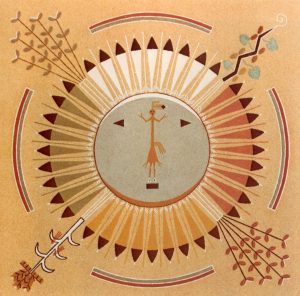
 It’s time to invoke a great whirling surge of Nilch’i Diyin (Holy Wind) into the story, and thereby help it rise back to the surface


 We are in a time when many millions – actually billions – of people can and are by circumstances called to give the archetype expression in their lives. Thus the challenge is laid down before us all: live up to the promise.


 What a marvel that I exist and think these thoughts! What a marvel that anything exists, that there is a universe of billions of galaxies with billions of stars and billions of planets in each, and no doubt billions of life forms all struggling to survive and become more conscious. It is very mysterious.
 But then I look at the human beings, beings capable of love, of beauty and joy. I see humans wrapped in fear, mistrust, and hopelessness. They are angry and frustrated, pursuing self-destruction and destroying the earth along with them.
 me now. Take the magic feather, and we will rise together and soar above the forests here of pine and oak. There below us are the lands of the Pokonoket Wampanoag, the woods, the beaches, the bays, the rivers and lakes where once were the villages of the Acushnet, the Sakonnet, the Pocassett, the Mattapoisett, the Assawompset, the Nemasket, and the Assonet.

 Weetucks was visited one night by two spirit guides from the place of the departed ones, who came to take his mother back on the Star Path to the Land of Souls. At that time they spoke to him of the things that would happen to the land and her people in times that would come.
 It’s a curious fact that the Hopi people of the southwest also have an ancient carving of prophecy on a rock and its message is much the same. That is what the carvings on Dighton Rock are really about, unknown to all the scholars and archaeologists.

 ourselves. There is also no doubt in my mind that anyone can still find the Sacred Path of the Creator, and that each of us who does has the power to create with others a society of harmony and joy, wiser and stronger for the lessons of this age of terror and confusion.


 He placed this forthcoming network, and the importance of seed saving, in the context of three pending corporate mergers: Bayer-Monsanto, Dupont-Dow, and ChemChina-Syngenta. These mergers, likely to get green-lighted by the Trump-Republican Administration, will place over 60% of the world’s remaining seeds in the corporate control of just three companies. They dominate.
 “We are the future. Sometimes we look at these dominant forces, and wonder how can we possibly overcome? But the zombie system is already dead.”
 Our community circle existed in time for just 91 minutes during Tierra Viva (Farming the Living Earth), the hemisphere-wide conference that was summoned into being by the
  practical and spiritual benefits arise for participants in CSA farming. CSA puts shareholders in greater tune with nature. This instinctual impulse to connect with the earth that sustains us is inherent in healthy people; consequently farming and gardening are healing and stabilizing for human beings, and of critical importance as we continue to face extreme and intensifying conditions in our digital era. Biodynamic principles and practices support and enhance all of this.
 “core groups” to create a strong and reliable network of farm support, similar to the way volunteer Boards of Directors serve food coops. While the CSA core group concept hasn’t been popular in CSAs in recent years, it does “take a village” to make a CSA work at the highest possible level. Considering the radically changing circumstances in climate, politics and economics, the core group model – drawing on collective intelligence and resources – is well worth re-considering.
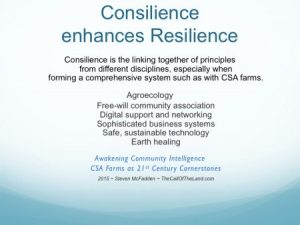 community awareness of environmental issues. CSAs connect people to the earth viscerally. Through that connection people become more firmly rooted in the places where they live and in the natural world, which supports life. Food is a binding impulse that can transcend political orientation. Food is an effective way to invite people into a real community conversation, and to combine their skills and resources to become more effectively and skillfully resilient in the face of the great challenges.
 mmunities often awaken late because of direct crisis, but they can also awaken from intelligent pursuit of models and opportunities. Dialogue can be a big factor in this; thus, it’s important to continue to articulate not just the economic and health dimensions of CSA farms, but also the social and ecological benefits.


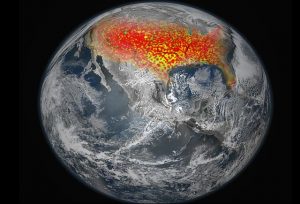 Our era is sharply marked by the mounting, menacing clouds of climate chaos, paralleled by dramatic and urgent shifts in global politics, economics, and social relations. Much more than a market strategy is required. I remain steadfast in my conviction that CSA can play a key role in addressing these issues. It’s time to expand exponentially the CSA vision and reality to hundreds of thousands of community farms around the world, and time also to evolve consciously the community and the associative economic dimensions of CSA.
 A rootstock is part of a plant, often an underground part, from which new above-ground growth can be produced. Grafting refers to the process by which a plant, sometimes just a stump with an established root system, serves as the base onto which cuttings (scions) from another plant are joined.
 Is there, or could there be, a biodynamic preparation that aids, nurtures and supports the grafting of the world’s wide array of cultural and agricultural traditions to the native rootstock and wisdom ways so inseparably a part of North America?